
Parametric Surface and Geometric Construction
Loading the math board and drawing, please wait…
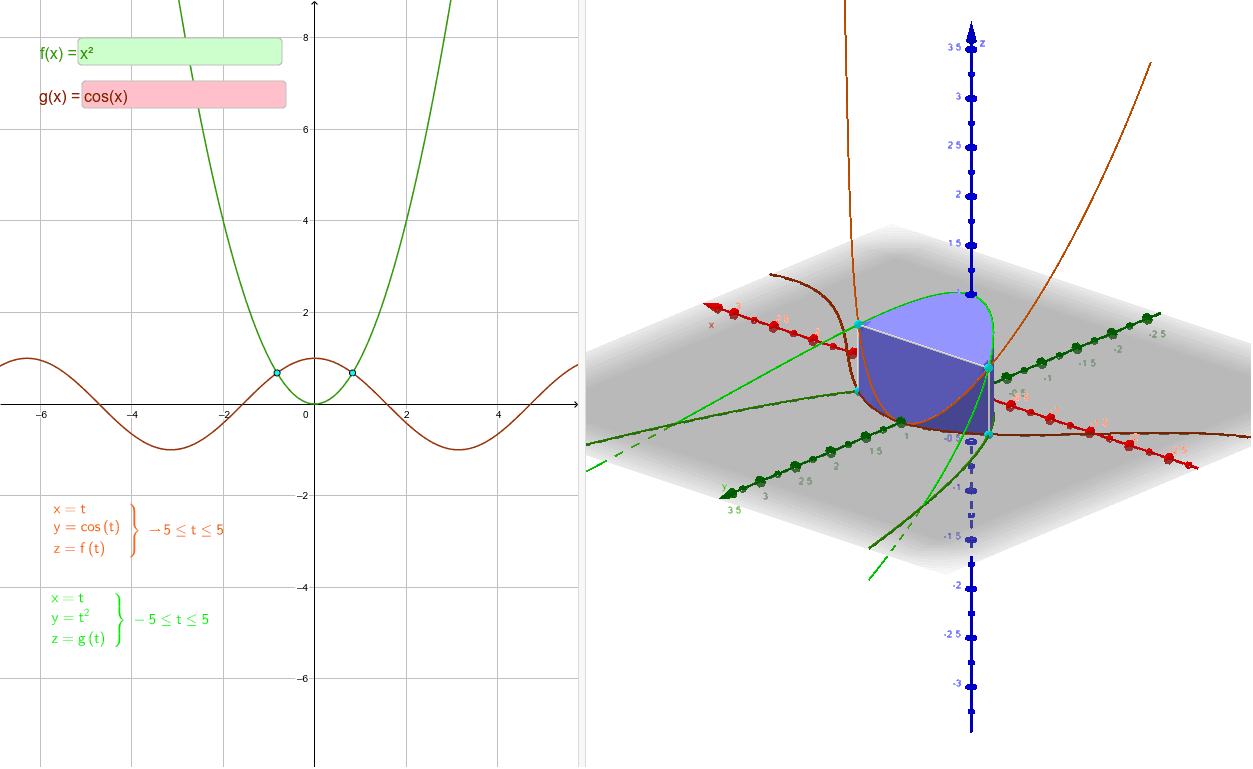
This example demonstrates how to construct a parametric surface using two functions. One function serves as the base, while the other as the height. Through the construction of curves and surfaces, it provides a clear understanding of parametric equations and solid geometry. Commands used include CurveCartesian, Intersect, Surface, Segment, and Vector. Suitable for high school mathematics education and learning.
GeoGebra Commands & Parameters
CurveCartesian(t, f(t), g(t), t, -5, 5) → aCurveCartesian(t, g(t), f(t), t, -5, 5) → bIntersect(f, g, (-0.8241323136805904, 0.679194070452523)) → AIntersect(g, f, (0.8241323126131453, 0.679194067953118)) → BSurface(t, (u * g(t)) + ((1 - u) * f(t)), f(t), t, x(A), x(B), u, 0, 1) → cSurface(t, (u * g(t)) + ((1 - u) * f(t)), 0, t, x(A), x(B), u, 0, 1) → dSurface(t, (u * g(t)) + ((1 - u) * f(t)), g(t), t, x(A), x(B), u, 0, 1) → eSurface(t, g(t), (u * f(t)), t, x(A), x(B), u, 0, 1) → iSurface(t, f(t), (u * g(t)), t, x(A), x(B), u, 0, 1) → hSurface(t, f(t), (u * f(t)), t, x(A), x(B), u, 0, 1) → jSurface(t, g(t), (u * g(t)), t, x(A), x(B), u, 0, 1) → kSegment(A', B') → lVector(A', B') → uCurveCartesian(x(A) + (t * x(u)), y(A), f(x(A)), t, -5, 5) → mTextfield(f) → CampEntradaSortida1Textfield(g) → CampEntradaSortida2Surface(t, (u * y(A)) + ((1 - u) * g(t)), (u * f(x(A))) + ((1 - u) * f(t)), t, x(A), x(B), u, 0, 1) → nSurface(t, (u * y(A)) + ((1 - u) * f(t)), (u * f(x(A))) + ((1 - u) * g(t)), t, x(A), x(B), u, 0, 1) → oSegment(A', A) → pSegment(B', B) → q