
Intersection of Tetrahedra
Loading the math board and drawing, please wait…
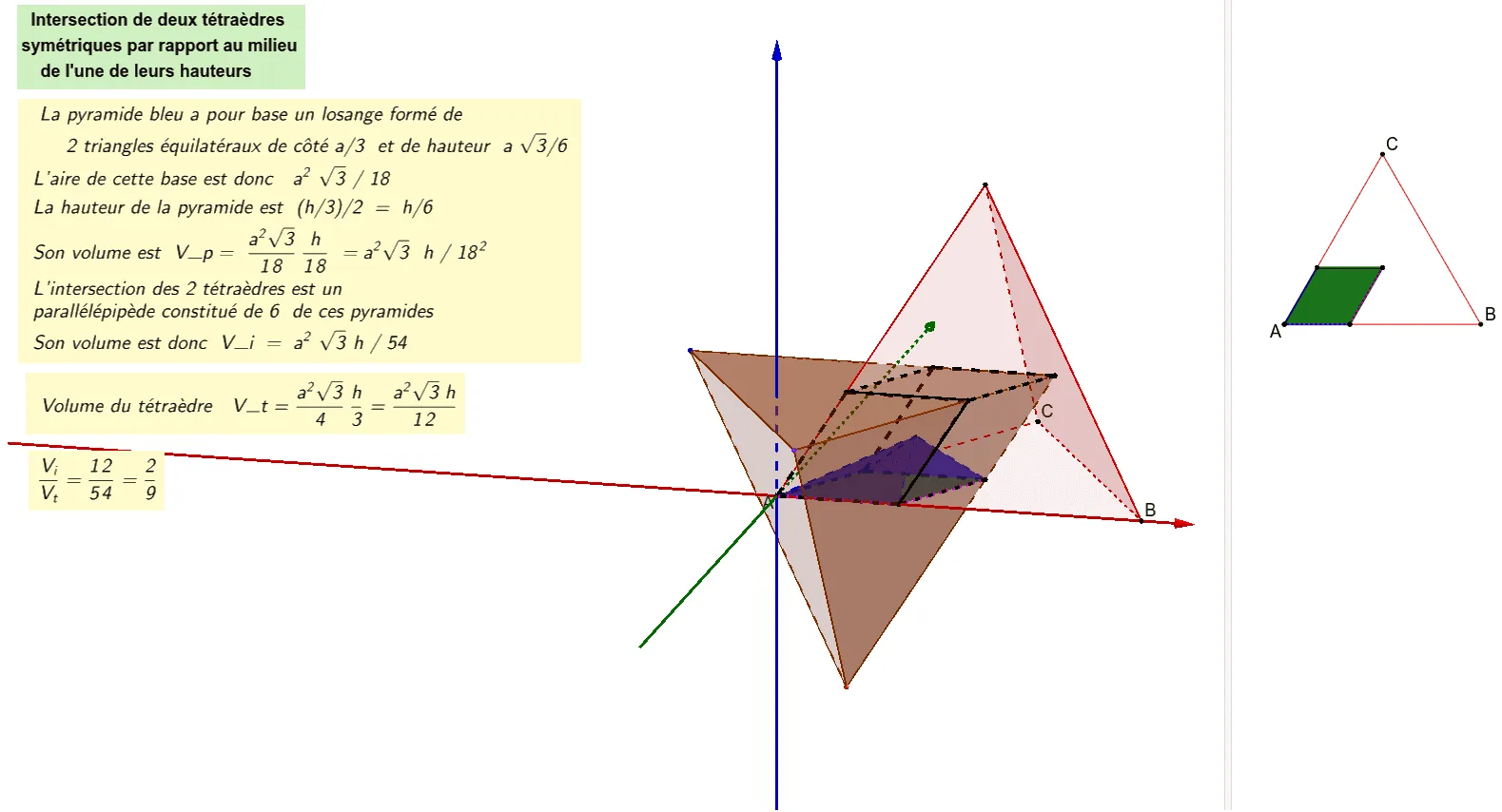
This example demonstrates the intersection of two tetrahedra in 3D space, showing the common volume and cross-section shapes formed when one tetrahedron is mirrored or transformed relative to another. Core mathematical concepts include solid geometry, tetrahedra, plane-polyhedron intersections, similar triangles, and volume computation. Construction highlights: using GeoGebra commands such as Point, Tetrahedron, TriangleCenter, Midpoint, Mirror, Intersect, Polygon, Segment, Line, and OrthogonalLine to build the tetrahedra, compute intersection points, and generate the resulting polygonal faces. Suitable for high school or early college students studying solid geometry, spatial reasoning, and geometric construction, as well as for exploring volume relationships in intersecting polyhedra.
GeoGebra Commands & Parameters
Point(Circle[Midpoint[A, B], (Distance[A, B] * sqrt(3) / 2), Segment[A, B]]) → CTetrahedron(A, B, C) → V_t, C_2, arêteCD, arêteBD, faceABC, faceACD, faceABD, faceBCD, arêteAC, arêteAB, arêteBC, arêteADTriangleCenter(B, C, C_2, 2) → EMidpoint(A, E) → FMirror(faceBCD, F) → faceBCD'Intersect(zAxis, yAxis) → QIntersect(zAxis, yAxis) → RIntersect(zAxis, yAxis) → SMirror(C_2, F) → D'Mirror(B, F) → B'Mirror(C, F) → C'Polygon(B', E, C') → poly1, c', b', ePolygon(D', C', E) → poly2, e_1, d', c'_1Intersect(d', faceABD) → GIntersect(xAxis, poly2) → HSegment(G, H) → fIntersect(arêteAD, poly1) → JSegment(J, G) → h_1Intersect(c', faceACD) → KSegment(J, K) → iSegment(K, E) → jSegment(G, E) → gSegment(J, S) → kSegment(S, H) → lLine(K, f) → mIntersect(m, arêteAC) → ISegment(K, I) → nIntersect(xAxis, yAxis) → LSegment(I, L) → pLine(I, l) → qLine(H, arêteAC) → rIntersect(q, r) → MIntersect(r, q) → NSegment(I, N) → sIntersect(r, xAxis) → OSegment(O, N) → tPolygon(B', D', E) → poly3, e_2, b'_1, d'_1Polygon(O, F, N) → poly5, n_1, o_1, f_2Intersect(q, r) → TPolygon(F, I, T) → poly6, t_1, f_3, i_1OrthogonalLine(F, poly2) → bIntersect(b, poly2) → USegment(F, U) → h_2OrthogonalLine(B, faceACD) → aIntersect(i, n) → VSegment(C_2, T) → hPolygon(A, I, T, O) → poly4, a_1, i_2, t_2, oSegment(A, H) → cSegment(H, M) → dPolygon(A, I, F) → poly7, f_1, a_2, i_3Intersect(yAxis, zAxis) → PIntersect(yAxis, xAxis) → WPolygon(P, F, O) → poly8, o_2, p_1, f_4