
Interactive Exploration of Vertical Angles with an Unknown
Loading the math board and drawing, please wait…
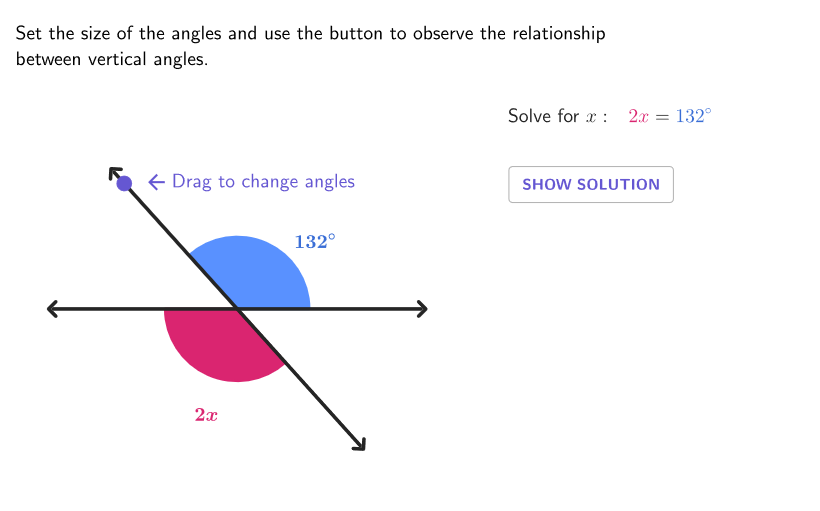
This interactive GeoGebra lesson demonstrates how to determine the measure of an unknown vertical angle formed by two intersecting lines, using the key property that vertical angles are congruent. It centers on vertical angle identification, angle measurement, setting up an unknown value, and validating the relationship through geometric construction. Construction highlights include creating the intersection point with Intersect and generating geometric elements via Point and Segment, using Mirror and Angle to establish the correct corresponding angles, and employing UnitVector and a circle (circlePixels) for directional representation and visual support. The activity also features interactive UI elements for showing solutions and posing questions (e.g., showSolution, btnSol, textSolution, btnNew, btnReset), while angle variables (α, β, γ, versAng1, versAng2) record and compare the computed measures. Best suited for Grades 6–8 to practice angle and line theorems and reason about angle pairs.
GeoGebra Commands & Parameters
Intersect(xAxis, yAxis) → APoint(pGrid) → PSegment(A, P) → sidePMirror(G, A) → P'Angle((-B), A, P') → αUnitVector(AngularBisector[B, A, P]) → versAng1Angle(B, A, P) → βAngle(P, A, (-B)) → γSegment(P, G) → tipPcirclePixels(P, 7 + (7 * pulsing), Corner[1], Corner[3], Corner[5]) → pulsingObjectUnitVector(AngularBisector[(-B), A, P']) → versAng2Segment(A, P') → leg2Segment(A, B') → rightSSegment(A, (-B')) → leftSIndexOf(P, pGrid) → inofP
AI Drawing Prompt Reference
Draw two intersecting lines creating four angles. Mark the intersection point and draw a line segment from it. Mirror this segment across the intersection to create a symmetrical angle on the other side. Measure the original angles and their vertical angles to show they are equal. Represent the angle bisectors with vectors and add a pulsing circle for visual emphasis. Label key points and segments, and display angle variables.
The prompt above was compiled from the original drawing commands and is for reference only.