
Integer Multiplication Game
Loading the math board and drawing, please wait…
In collections
Introduction to Integers and Integer Arithmetics
Introduction to Integers and Integer Arithmetics
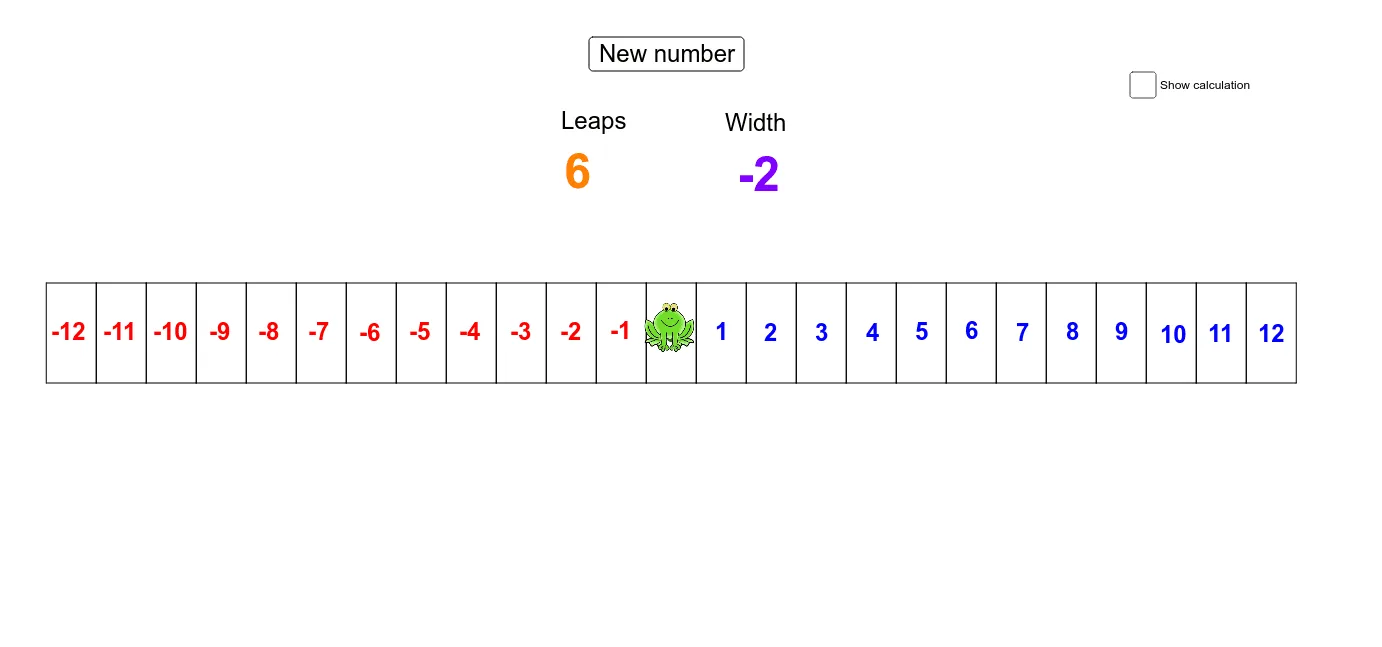
This example is an interactive applet demonstrating integer multiplication for students. It involves core math concepts like integer operations, geometric transformations, and random number generation. The construction uses commands such as RandomElement, Polygon, Point, Rotate, Midpoint, and Segment. Suitable for elementary or middle school students for practice and gamified learning.
GeoGebra Commands & Parameters
RandomElement({-3, -2, -1, 1, 2, 3}) → r1Polygon(A, B, C, D) → poly1, a, b, c, dPoint(Circle[E, a]) → FRotate(F + (b, 0), Angle[C - B] + Angle[F - E] - Angle[B - A], F) → GRotate(G + (c, 0), Angle[D - C] + Angle[G - F] - Angle[C - B], G) → HPolygon(E, F, G, H) → poly2, e, f, g, hPoint(Circle[I, e]) → JRotate(J + (f, 0), Angle[G - F] + Angle[J - I] - Angle[F - E], J) → KRotate(K + (g, 0), Angle[H - G] + Angle[K - J] - Angle[G - F], K) → LPolygon(I, J, K, L) → poly3, i, j, k, lPoint(Circle[M, i]) → NRotate(N + (j, 0), Angle[K - J] + Angle[N - M] - Angle[J - I], N) → ORotate(O + (k, 0), Angle[L - K] + Angle[O - N] - Angle[K - J], O) → PPolygon(M, N, O, P) → poly4, m, n, o, pPoint(Circle[Q, a]) → RRotate(R + (b, 0), Angle[C - B] + Angle[R - Q] - Angle[B - A], R) → SRotate(S + (c, 0), Angle[D - C] + Angle[S - R] - Angle[C - B], S) → TPolygon(Q, R, S, T) → poly5, q, r, s, tPoint(Circle[U, e]) → VRotate(V + (f, 0), Angle[G - F] + Angle[V - U] - Angle[F - E], V) → WRotate(W + (g, 0), Angle[H - G] + Angle[W - V] - Angle[G - F], W) → ZPolygon(U, V, W, Z) → poly6, u, v, w, z_1Point(Circle[A_1, i]) → B_1Rotate(B_1 + (j, 0), Angle[K - J] + Angle[B_1 - A_1] - Angle[J - I], B_1) → C_1Rotate(C_1 + (k, 0), Angle[L - K] + Angle[C_1 - B_1] - Angle[K - J], C_1) → D_1Polygon(A_1, B_1, C_1, D_1) → poly7, a_1, b_1, c_1, d_1Point(Circle[E_1, m]) → F_1Rotate(F_1 + (n, 0), Angle[O - N] + Angle[F_1 - E_1] - Angle[N - M], F_1) → G_1Rotate(G_1 + (o, 0), Angle[P - O] + Angle[G_1 - F_1] - Angle[O - N], G_1) → H_1Polygon(E_1, F_1, G_1, H_1) → poly8, e_1, f_1, g_1, h_1Point(Circle[I_1, q]) → J_1Rotate(J_1 + (r, 0), Angle[S - R] + Angle[J_1 - I_1] - Angle[R - Q], J_1) → K_1Rotate(K_1 + (s, 0), Angle[T - S] + Angle[K_1 - J_1] - Angle[S - R], K_1) → L_1Polygon(I_1, J_1, K_1, L_1) → poly9, i_1, j_1, k_1, l_1Point(Circle[N_1, a]) → O_1Rotate(O_1 + (b, 0), Angle[C - B] + Angle[O_1 - N_1] - Angle[B - A], O_1) → P_1Rotate(P_1 + (c, 0), Angle[D - C] + Angle[P_1 - O_1] - Angle[C - B], P_1) → Q_1Polygon(N_1, O_1, P_1, Q_1) → poly10, n_1, o_1, p_1, q_1Point(Circle[R_1, e]) → S_1Rotate(S_1 + (f, 0), Angle[G - F] + Angle[S_1 - R_1] - Angle[F - E], S_1) → T_1Rotate(T_1 + (g, 0), Angle[H - G] + Angle[T_1 - S_1] - Angle[G - F], T_1) → U_1Polygon(R_1, S_1, T_1, U_1) → poly11, r_1, s_1, t_1, u_1Point(Circle[V_1, i]) → W_1Rotate(W_1 + (j, 0), Angle[K - J] + Angle[W_1 - V_1] - Angle[J - I], W_1) → Z_1Rotate(Z_1 + (k, 0), Angle[L - K] + Angle[Z_1 - W_1] - Angle[K - J], Z_1) → A_2Polygon(V_1, W_1, Z_1, A_2) → poly12, v_1, w_1, z_2, a_2Point(Circle[B_2, m]) → C_2Rotate(C_2 + (n, 0), Angle[O - N] + Angle[C_2 - B_2] - Angle[N - M], C_2) → D_2Rotate(D_2 + (o, 0), Angle[P - O] + Angle[D_2 - C_2] - Angle[O - N], D_2) → E_2Polygon(B_2, C_2, D_2, E_2) → poly13, b_2, c_2, d_2, e_2Point(Circle[F_2, q]) → G_2Rotate(G_2 + (r, 0), Angle[S - R] + Angle[G_2 - F_2] - Angle[R - Q], G_2) → H_2Rotate(H_2 + (s, 0), Angle[T - S] + Angle[H_2 - G_2] - Angle[S - R], H_2) → I_2Polygon(F_2, G_2, H_2, I_2) → poly14, f_2, g_2, h_2, i_2Point(Circle[J_2, u]) → K_2Rotate(K_2 + (v, 0), Angle[W - V] + Angle[K_2 - J_2] - Angle[V - U], K_2) → L_2Rotate(L_2 + (w, 0), Angle[Z - W] + Angle[L_2 - K_2] - Angle[W - V], L_2) → M_2Polygon(J_2, K_2, L_2, M_2) → poly15, j_2, k_2, l_2, m_2Point(Circle[N_2, a_1]) → O_2Rotate(O_2 + (b_1, 0), Angle[C_1 - B_1] + Angle[O_2 - N_2] - Angle[B_1 - A_1], O_2) → P_2Rotate(P_2 + (c_1, 0), Angle[D_1 - C_1] + Angle[P_2 - O_2] - Angle[C_1 - B_1], P_2) → Q_2Polygon(N_2, O_2, P_2, Q_2) → poly16, n_2, o_2, p_2, q_2Point(Circle[R_2, e_1]) → S_2Rotate(S_2 + (f_1, 0), Angle[G_1 - F_1] + Angle[S_2 - R_2] - Angle[F_1 - E_1], S_2) → T_2Rotate(T_2 + (g_1, 0), Angle[H_1 - G_1] + Angle[T_2 - S_2] - Angle[G_1 - F_1], T_2) → U_2Polygon(R_2, S_2, T_2, U_2) → poly17, r_2, s_2, t_2, u_2Point(Circle[V_2, i_1]) → W_2Rotate(W_2 + (j_1, 0), Angle[K_1 - J_1] + Angle[W_2 - V_2] - Angle[J_1 - I_1], W_2) → Z_2Rotate(Z_2 + (k_1, 0), Angle[L_1 - K_1] + Angle[Z_2 - W_2] - Angle[K_1 - J_1], Z_2) → A_3Polygon(V_2, W_2, Z_2, A_3) → poly18, v_2, w_2, z_3, a_3Point(Circle[M_1, b_2]) → B_3Rotate(B_3 + (c_2, 0), Angle[D_2 - C_2] + Angle[B_3 - M_1] - Angle[C_2 - B_2], B_3) → C_3Rotate(C_3 + (d_2, 0), Angle[E_2 - D_2] + Angle[C_3 - B_3] - Angle[D_2 - C_2], C_3) → D_3Polygon(M_1, B_3, C_3, D_3) → poly19, m_1, b_3, c_3, d_3Point(Circle[E_3, v_1]) → F_3Rotate(F_3 + (w_1, 0), Angle[Z_1 - W_1] + Angle[F_3 - E_3] - Angle[W_1 - V_1], F_3) → G_3Rotate(G_3 + (z_2, 0), Angle[A_2 - Z_1] + Angle[G_3 - F_3] - Angle[Z_1 - W_1], G_3) → H_3Polygon(E_3, F_3, G_3, H_3) → poly20, e_3, f_3, g_3, h_3Point(Circle[I_3, f_2]) → J_3Rotate(J_3 + (g_2, 0), Angle[H_2 - G_2] + Angle[J_3 - I_3] - Angle[G_2 - F_2], J_3) → K_3Rotate(K_3 + (h_2, 0), Angle[I_2 - H_2] + Angle[K_3 - J_3] - Angle[H_2 - G_2], K_3) → L_3Polygon(I_3, J_3, K_3, L_3) → poly21, i_3, j_3, k_3, l_3Point(Circle[M_3, j_2]) → N_3Rotate(N_3 + (k_2, 0), Angle[L_2 - K_2] + Angle[N_3 - M_3] - Angle[K_2 - J_2], N_3) → O_3Rotate(O_3 + (l_2, 0), Angle[M_2 - L_2] + Angle[O_3 - N_3] - Angle[L_2 - K_2], O_3) → P_3Polygon(M_3, N_3, O_3, P_3) → poly22, m_3, n_3, o_3, p_3Point(Circle[Q_3, n_2]) → R_3Rotate(R_3 + (o_2, 0), Angle[P_2 - O_2] + Angle[R_3 - Q_3] - Angle[O_2 - N_2], R_3) → S_3Rotate(S_3 + (p_2, 0), Angle[Q_2 - P_2] + Angle[S_3 - R_3] - Angle[P_2 - O_2], S_3) → T_3Polygon(Q_3, R_3, S_3, T_3) → poly23, q_3, r_3, s_3, t_3Point(Circle[U_3, r_2]) → V_3Rotate(V_3 + (s_2, 0), Angle[T_2 - S_2] + Angle[V_3 - U_3] - Angle[S_2 - R_2], V_3) → W_3Rotate(W_3 + (t_2, 0), Angle[U_2 - T_2] + Angle[W_3 - V_3] - Angle[T_2 - S_2], W_3) → Z_3Polygon(U_3, V_3, W_3, Z_3) → poly24, u_3, v_3, w_3, z_4Point(Circle[A_4, a]) → B_4Rotate(B_4 + (b, 0), Angle[C - B] + Angle[B_4 - A_4] - Angle[B - A], B_4) → C_4Rotate(C_4 + (c, 0), Angle[D - C] + Angle[C_4 - B_4] - Angle[C - B], C_4) → D_4Polygon(A_4, B_4, C_4, D_4) → poly25, a_4, b_4, c_4, d_4Midpoint(G_4, F_4) → CenterSegment(H_4, I_4) → f_4Segment(J_4, K_4) → g_4
AI Drawing Prompt Reference
Create an interactive geometric game demonstrating integer multiplication. Use randomly generated positive and negative integers as initial values. Construct multiple polygons through geometric transformations, where each polygon rotates around its center by specific angles and translates, forming a series of similar shapes in different positions. Finally, display the combined dynamic effect of multiple polygons for educational purposes.
The prompt above was compiled from the original drawing commands and is for reference only.