
Inscribed Angle Theorem Proof Exercise (Case 1)
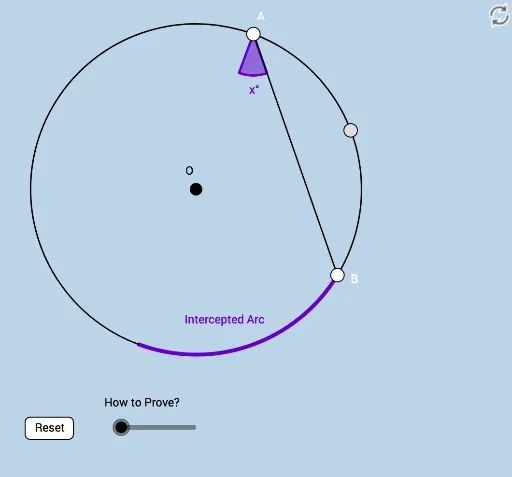
Loading the math board and drawing, please wait…
This example demonstrates the proof of the Inscribed Angle Theorem when the center of the circle lies on the inscribed angle's chord. It involves core mathematical concepts such as circles, inscribed angles, central angles, and geometric proofs. The construction uses GeoGebra commands like Circle, Point, CircleArc, Line, Intersect, Segment, Angle, Rotate, CircleSector, Dilate, Vector, Polygon, and Translate. It is suitable for high school mathematics education, helping students understand and master the proof method of the Inscribed Angle Theorem.
GeoGebra Commands & Parameters
Circle(O, B_1) → cPoint(c) → BPoint(c) → C_1CircleArc(O, B, C_1) → dPoint(d) → ALine(A, O) → f_1Intersect(c, f_1) → Q, CPoint(d) → FSegment(O, C_1) → aSegment(A, B) → gSegment(F, C_1) → hSegment(F, B) → iAngle(C_1, O, B) → αRotate(C_1, α / 2, O) → C'Angle(C_1, O, C') → βSegment(O, C') → jSegment(A, C) → fCircle(A, (0.25 * Distance[O, B_1])) → kIntersect(k, f, 1) → GIntersect(k, g, 1) → HCircle(F, (0.25 * Distance[O, B_1])) → pIntersect(p, h, 1) → JIntersect(p, i, 1) → KCircleSector(A, G, H) → qCircleSector(F, J, K) → rDilate(A, If[0 < l ≤ 1, 1 - l, 0], O) → E'Vector(A, E') → uLine(A, a) → mIntersect(k, m, 2) → LAngle(L, A, G) → γDilate(A, If[2 < l ≤ 3, 3 - l, 0], O) → E'_1Vector(A, E'_1) → vLine(A, j) → nIntersect(k, n, 2) → MAngle(M, A, G) → δCircle(O, (0.25 * Distance[O, B_1])) → tIntersect(t, a, 1) → NIntersect(t, j, 1) → O_1Intersect(t, c, 1) → IIntersect(k, f_1) → S, TCircleArc(O, C, B) → eIntersect(t, f_1) → U, VAngle(G, A, H) → εSegment(O, C) → sSegment(A, O) → g_1Dilate(A, If[-1 < l ≤ 0, (-l), 0], O) → E'_2Segment(A, E'_2) → i_1Dilate(O, If[0 < l ≤ 1, 1 - l, 0], C) → A'Segment(O, A') → j_1Angle(C, O, B) → ηRotate(O, If[1 < l ≤ 2, ((l - 1) * η), η], O) → A'_1Rotate(A', If[1 < l ≤ 2, ((l - 1) * η), η], O) → A''Segment(A'_1, A'') → k_1Rotate(A'_1, If[2 < l ≤ 3, ((l - 2) * (π - η)), π - η], O) → PRotate(A'', If[2 < l ≤ 3, ((l - 2) * (π - η)), π - η], O) → A'''Segment(P, A''') → bPolygon(O, B, A) → poly1, e_1, a_1, d_1Circle(B, Radius[k]) → c_1Intersect(c_1, k_1) → W,Angle(A, B, O) → ζRotate(W, If[3 < l ≤ 4, ((-(l - 3)) * ζ), (-ζ)], B) → W'CircleSector(B, W', W) → h_1CircleArc(O, B, C) → p_1Dilate(A, If[0 < o ≤ 1, 1 - o, 0], O) → E'_3Vector(A, E'_3) → wTranslate(q, w) → q'Line(A, k_1) → l_1Point(l_1) → ZAngle(B, A, Z) → θRotate(q', If[1 < o ≤ 2, ((o - 1) * θ), θ], O) → q''Dilate(A, If[2 < o ≤ 3, 3 - o, 0], O) → E'_4Vector(A, E'_4) → u_1Translate(q, u_1) → q'_1