
Inscribed Angle Theorem Demonstration
Loading the math board and drawing, please wait…
In collections
Circles (Theorems)
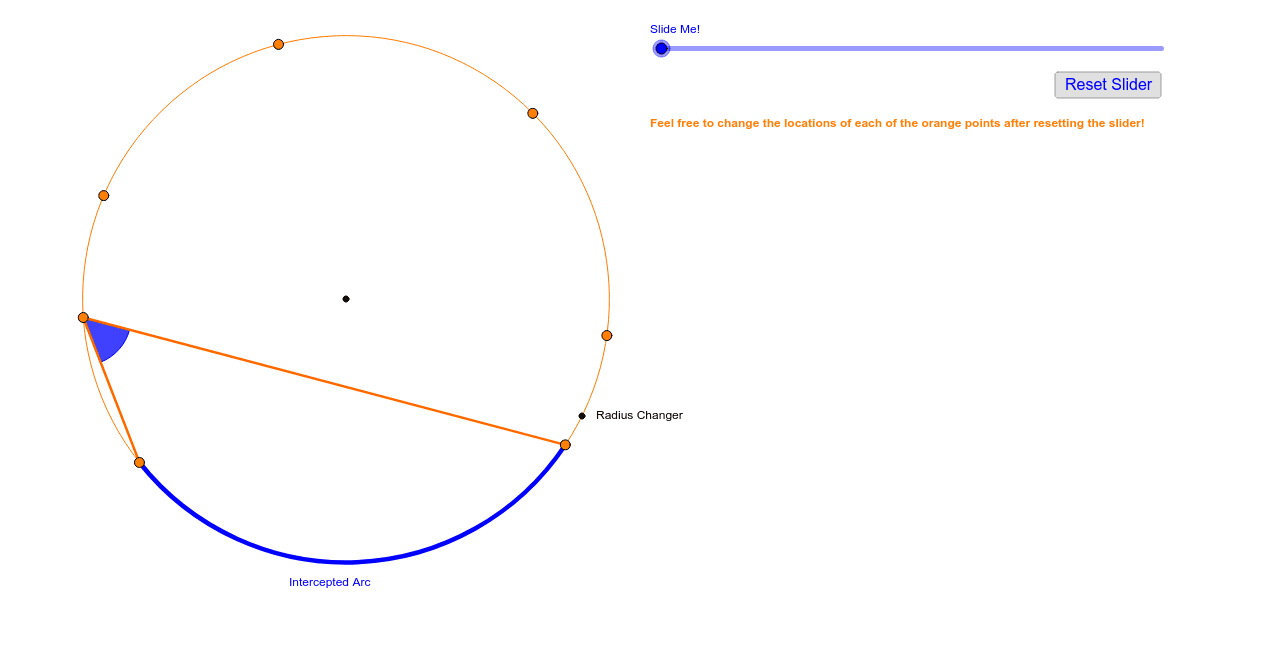
This example demonstrates the Inscribed Angle Theorem: if two inscribed angles intercept the same arc, then they are equal. It involves core concepts like circle, inscribed angle, central angle, and arc. Construction highlights include using GeoGebra commands such as Circle, Point, CircleArc, Segment, Intersect, CircleSector, Dilate, Vector, Translate, Line, Angle, and Rotate, with objects like points A, B, C, D, O, P. Suitable for high school mathematics teaching to visually understand the theorem and its applications.
GeoGebra Commands & Parameters
Circle(A, B) → cPoint(c) → CPoint(c) → DCircleArc(A, C, D) → dCircleArc(A, D, C) → ePoint(e) → EPoint(e) → FPoint(e) → JPoint(e) → KPoint(e) → MSegment(E, C) → aSegment(E, D) → bSegment(F, C) → fSegment(F, D) → gSegment(J, C) → nSegment(J, D) → pSegment(K, C) → qSegment(K, D) → rSegment(M, C) → a_1Segment(M, D) → b_1Circle(E, 1.5) → e_1Circle(F, 1.5) → f_1Circle(J, 1.5) → p_1Circle(K, 1.5) → q_1Circle(M, 1.5) → s_1Intersect(e_1, a, 1) → OIntersect(e_1, b, 1) → PIntersect(f_1, f, 1) → QIntersect(f_1, g, 1) → RIntersect(p_1, n, 1) → A_1Intersect(p_1, p, 1) → B_1Intersect(q_1, q, 1) → C_1Intersect(q_1, r, 1) → D_1Intersect(s_1, a_1, 1) → G_1Intersect(s_1, b_1, 1) → H_1CircleSector(E, O, P) → c_2CircleSector(F, Q, R) → d_2CircleSector(J, A_1, B_1) → h_2CircleSector(K, C_1, D_1) → k_2CircleSector(M, G_1, H_1) → q_2Dilate(E, If[0 < o < 1, 1 - o, 0], F) → E'Vector(E, E') → uTranslate(c_2, u) → s_2Line(E, g) → i_1Line(R, b) → j_1Line(F, j_1) → l_1Intersect(f_1, l_1, 2) → K_1Angle(R, F, K_1) → αVector(F, J) → vDilate(F, If[1.5 < o < 2.5, 2.5 - o, 0], J) → F'Vector(F, F') → wTranslate(d_2, w) → hAngle(O, E, P) → βAngle(Q, F, R) → γLine(J, g) → iIntersect(p_1, i, 2) → GAngle(B_1, J, G) → δAngle(A_1, J, B_1) → εDilate(J, If[3 < o < 4, 4 - o, 0], K) → J'Vector(J, J') → jTranslate(h_2, j) → kLine(K, p) → lIntersect(q_1, l) → H, IAngle(D_1, K, I) → ζAngle(C_1, K, D_1) → ηDilate(K, If[4.5 < o < 5.5, 5.5 - o, 0], M) → K'Vector(K, K') → mTranslate(k_2, m) → sLine(M, r) → tIntersect(s_1, t) → L, NAngle(H_1, M, N) → θAngle(G_1, M, H_1) → ιRotate(s_2, If[0 < o < 1, (o * (-α)), 0], E') → t_2Rotate(h, If[1.5 < o < 2.5, ((o - 1.5) * (-δ)), 0], F') → h'Rotate(k, If[3 < o < 4, ((o - 3) * (-ζ)), 0], J') → k'Rotate(s, If[4.5 < o < 5.5, ((o - 4.5) * (-θ)), 0], K') → s'