
Inscribed Angle Action! (2 Theorems)
Loading the math board and drawing, please wait…
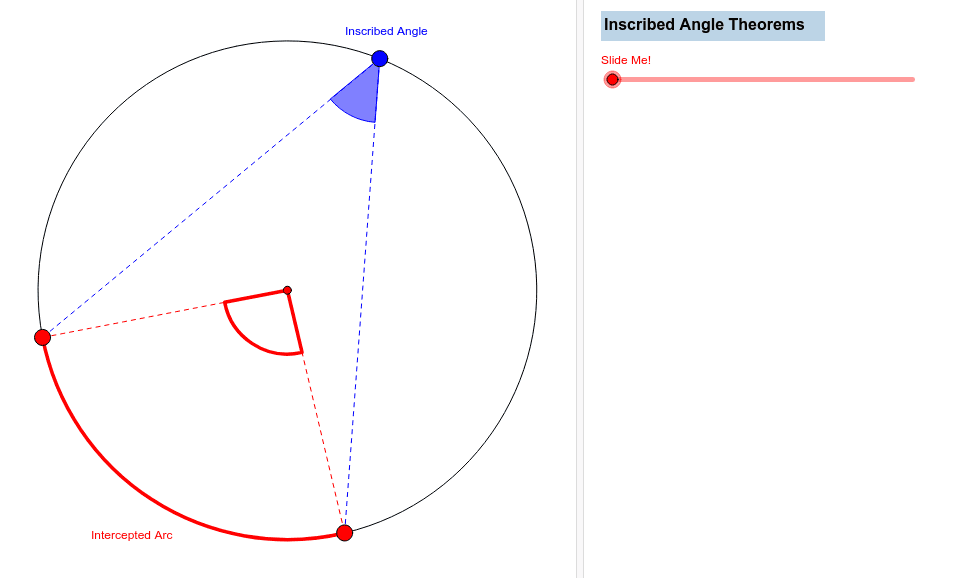
This example demonstrates two theorems related to inscribed angles. Key mathematical concepts include circles, angles, and inscribed angles. Using GeoGebra commands such as Circle, Segment, Point, etc., it dynamically illustrates the properties of inscribed angles. Suitable for middle school and above students to learn geometric construction and circle theorems.
GeoGebra Commands & Parameters
Circle(A, B) → cSegment(B, A) → aPoint(c) → CSegment(A, C) → bPoint(c) → DCircumcircleArc(C, D, B) → dCircleArc(A, B, C) → ePoint(d) → ESegment(C, E) → fSegment(E, B) → gCircle(E, 1.5) → hRay(E, C) → iRay(E, B) → jIntersect(h, j) → F,Intersect(h, i) → G,CircleSector(E, F, G) → kSegment(E, A) → lLine(A, xAxis) → mDilate(E, If[0 ≤ n ≤ 1, 1 - n, 0], A) → E'Vector(E, E') → uTranslate(k, u) → k'Line(E, a) → pLine(E, b) → qIntersect(h, p, 1) → HAngle(H, E, B) → αIntersect(h, q, 2) → IAngle(C, E, I) → βDilate(E, If[1 < n ≤ 2, 2 - n, 0], A) → E'_1Vector(E, E'_1) → vTranslate(k, v) → k'_1Rotate(k'_1, If[1 < n ≤ 2, ((n - 1) * β), β], E'_1) → k''Rotate(k', If[0 < n ≤ 1, ((-n) * α), (-α)], E') → k''_1Circle(A, 1.5) → rIntersect(r, a, 1) → JIntersect(r, b, 1) → KCircleSector(A, J, K) → sPoint(d) → LPoint(d) → MPoint(d) → NPoint(d) → OPoint(d) → PSegment(L, B) → tSegment(L, C) → a_1Segment(M, B) → b_1Segment(M, C) → c_1Segment(N, B) → d_1Segment(N, C) → e_1Segment(O, B) → f_1Segment(O, C) → g_1Segment(P, C) → h_1Segment(P, B) → i_1Vector(E, L) → w_2Vector(E, P) → j_1Circle(L, 1.5) → k_1Circle(M, 1.5) → p_1Circle(N, 1.5) → q_1Circle(O, 1.5) → r_1Circle(P, 1.5) → s_1Intersect(k_1, t, 1) → QIntersect(k_1, a_1, 1) → RIntersect(p_1, b_1, 1) → SIntersect(p_1, c_1, 1) → TIntersect(q_1, d_1) → U,Intersect(q_1, e_1, 1) → VIntersect(r_1, f_1, 1) → WIntersect(r_1, g_1, 1) → ZIntersect(s_1, i_1, 1) → A_1Intersect(s_1, h_1, 1) → B_1CircleSector(M, S, T) → t_1CircleSector(L, Q, R) → c_2CircleSector(N, U, V) → d_2CircleSector(O, W, Z) → e_2CircleSector(P, A_1, B_1) → f_2Dilate(E, If[0 < w < 1, 1 - w, 0], L) → E'_2Vector(E, E'_2) → l_1Translate(k, l_1) → k'_2Line(E, a_1) → m_1Point(m_1) → C_1Angle(C, E, C_1) → γRotate(k'_2, If[0 < w < 1, (w * γ), 0], E'_2) → g_2Dilate(L, If[1 < w < 2, 2 - w, 0], O) → L'Vector(L, L') → u_1Line(L, f_1) → n_1Translate(c_2, u_1) → h_2Intersect(k_1, n_1, 2) → D_1Angle(D_1, L, Q) → δRotate(h_2, If[1 < w < 2, ((-(w - 1)) * δ), 0], L') → k_2Dilate(O, If[2 < w < 3, 3 - w, 0], M) → O'Vector(O, O') → w_1Translate(e_2, w_1) → p_2Line(O, c_1) → a_2Intersect(r_1, a_2, 2) → E_1Angle(Z, O, E_1) → εRotate(p_2, If[2 < w < 3, ((w - 2) * ε), 0], O') → q_2Dilate(M, If[3 < w < 4, 4 - w, 0], P) → M'Vector(M, M') → v_1Translate(t_1, v_1) → r_2Line(M, i_1) → b_2Intersect(p_1, b_2, 2) → F_1Angle(S, M, F_1) → ζRotate(r_2, If[3 < w < 4, ((w - 3) * ζ), 0], M') → s_2Dilate(P, If[4 < w < 5, 5 - w, 0], N) → P'Vector(P, P') → u_2Translate(f_2, u_2) → t_2Line(P, e_1) → i_2Intersect(s_1, i_2, 2) → G_1Angle(B_1, P, G_1) → ηRotate(t_2, If[4 < w < 5, ((w - 4) * η), 0], P') → c_3