
Imaginary Planes: Spatial Geometric Construction and Transformation
Loading the math board and drawing, please wait…
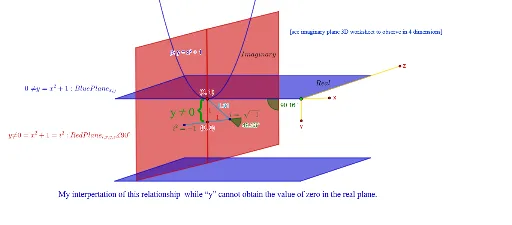
This example demonstrates the construction of multiple interconnected planes in 3D space using points, segments, and polygons, followed by transformations such as mirroring, translation, and rotation to create symmetric solid structures, forming a visual model called 'Imaginary Planes'. The core mathematical concepts involve spatial geometry of planes and prisms, vector transformations, differential equations, and statistical characteristics (geometric mean, mode) represented geometrically, along with symmetry and transformation groups. The construction uses GeoGebra commands including Point, Segment, Polygon, Mirror, Intersect, Vector, Translate, Rotate, Line, and Angle to build the base shapes and apply transformations. This example is suitable for high school to university-level teaching in solid geometry, linear algebra, or mathematical modeling, and can be used to explore intuitive connections between geometric transformations and statistical concepts.
GeoGebra Commands & Parameters
Point(xAxis) → ASegment(A, B) → fPoint(xAxis) → CSegment(C, D) → gSegment(D, B) → hSegment(A, C) → iPoint(i) → EPoint(h) → FSegment(E, F) → jSegment(G, F) → kPoint(yAxis) → HSegment(G, H) → lSegment(H, E) → mPoint(h) → IPolygon(H, E, F, G) → q1, h_1, e, f_1, g_1Polygon(B, D, C, A) → q2, b, d, c, aMirror(F, j) → F'Intersect(p, yAxis, 1) → JVector(K, L) → uTranslate(B, u) → B'Translate(D, u) → D'Translate(C, u) → C'Translate(A, u) → A'Polygon(B', D', C', A') → q2', b', d', c', a'Rotate(B, 90°, E) → B'_1Rotate(D, 90°, E) → D'_1Rotate(C, 90°, E) → C'_1Rotate(A, 90°, E) → A'_1Polygon(B'_1, D'_1, C'_1, A'_1) → q2'_1, b'_1, d'_1, c'_1, a'_1Rotate(B, (-(90°)), E) → B'_2Rotate(D, (-(90°)), E) → D'_2Rotate(C, (-(90°)), E) → C'_2Rotate(A, (-(90°)), E) → A'_2Polygon(B'_2, D'_2, C'_2, A'_2) → q2'_2, b'_2, d'_2, c'_2, a'_2Mirror(B'_2, yAxis) → MMirror(D'_2, yAxis) → NMirror(C'_2, yAxis) → OMirror(A'_2, yAxis) → PPolygon(M, N, O, P) → q3, m_1, n, o, p_1Mirror(B'_1, yAxis) → QMirror(D'_1, yAxis) → RMirror(C'_1, yAxis) → SMirror(A'_1, yAxis) → TPolygon(Q, R, S, T) → q4, q, r, s, tPoint(t) → VLine(V, t) → i_1Point(r) → ZLine(Z, r) → j_1Point(i_1) → UPoint(j_1) → WSegment(U, W) → k_1Polygon(V, U, W, Z) → q5, v, u_1, w, z_1Segment(A_1, B_1) → l_1Segment(B_1, C_1) → n_1Polygon(C_1, A_1, B_1) → t1, b_1, c_1, a_1Point(yAxis) → D_1Polygon(D_1, J, E_1, F_1) → q6, d_1, j_2, e_1, q_1Rotate(D_1, (-(180°)), J) → G_1Rotate(J, (-(180°)), J) → J'Rotate(E_1, (-(180°)), J) → H_1Rotate(F_1, (-(180°)), J) → I_1Polygon(G_1, J', H_1, I_1) → q6', r_1, j', s_1, t_1Vector(J_1, K_1) → v_1Translate(G_1, v_1) → L_1Translate(J', v_1) → J''Translate(H_1, v_1) → M_1Translate(I_1, v_1) → N_1Polygon(L_1, J'', M_1, N_1) → q6'', f_2, j'', g_2, h_2Polygon(O_1, P_1, Q_1, R_1) → q7, o_1, i_2, k_2, l_2Point(Circle[E, 1]) → S_1Segment(E, S_1) → m_2Point(Circle[E, -1]) → T_1Segment(E, T_1) → n_2Rotate(E, 180°, E) → E'Rotate(S_1, 180°, E) → U_1Segment(E', U_1) → p_2Rotate(O_1, 180°, J) → V_1Rotate(P_1, 180°, J) → W_1Rotate(Q_1, 180°, J) → Z_1Rotate(R_1, 180°, J) → A_2Polygon(V_1, W_1, Z_1, A_2) → q7', q_2, w_1, r_2, a_2Vector(B_2, C_2) → u_2Translate(V_1, u_2) → D_2Translate(W_1, u_2) → E_2Translate(Z_1, u_2) → F_2Translate(A_2, u_2) → G_2Polygon(D_2, E_2, F_2, G_2) → q7'', d_2, e_2, s_2, t_2Vector(H_2, I_2) → v_2Translate(B, v_2) → B'_3Translate(D, v_2) → D'_3Translate(C, v_2) → C'_3Translate(A, v_2) → A'_3Polygon(B'_3, D'_3, C'_3, A'_3) → q2'_3, b'_3, d'_3, c'_3, a'_3Intersect(d', c') → J_2Segment(J_2, K_2) → b_2Segment(J_2, L_2) → c_2Segment(J_2, M_2) → f_3Point(p_2) → N_2Point(m_2) → O_2Angle(c', i_2) → αSegment(J, O_2) → g_3Angle(g_3, m_2) → β
AI Drawing Prompt Reference
Construct multiple interconnected planes in 3D space using points and line segments, then apply transformations like mirroring, translation, and rotation to create symmetric solid structures. Begin with a quadrilateral and perform transformations to generate interconnected geometric shapes, demonstrating spatial geometry and symmetry of transformation groups.
The prompt above was compiled from the original drawing commands and is for reference only.