
Imaginary Number Line (i) - Time Space
Loading the math board and drawing, please wait…
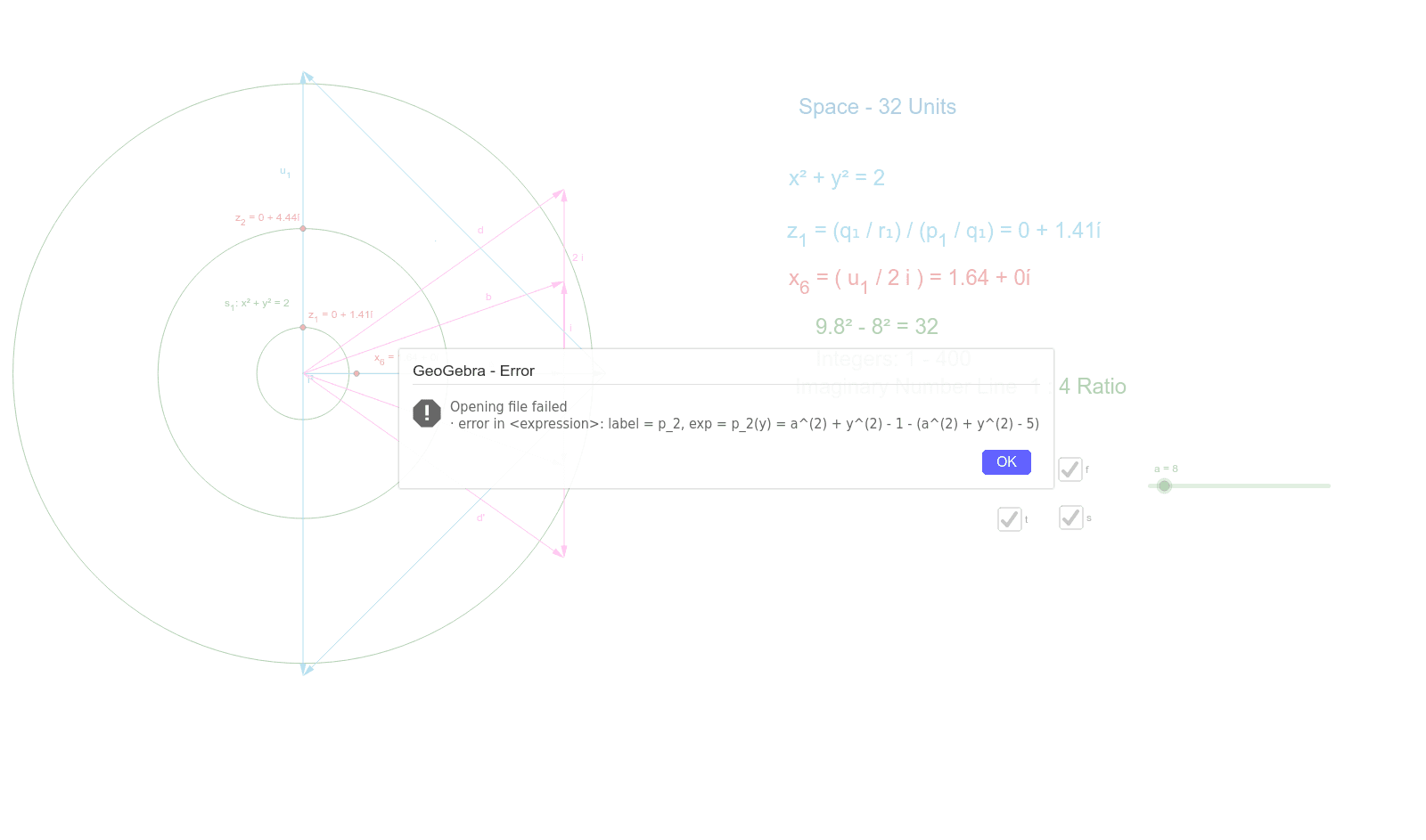
This GeoGebra example presents a dynamic geometric model incorporating an imaginary number line, aiming to visualize the relationship between the imaginary unit i, the real axis, and spatial geometric elements, while attempting to express the abstract concept of 'time-space' graphically. Core mathematical concepts involve the complex plane, imaginary unit, vector operations, rotation transformations, and congruence/similarity in geometric constructions. Key construction steps include using commands such as Vector, Point, Polygon, Rotate, Segment, Angle, Circle, Distance, Line, and Mirror to create multiple points, segments, polygons, circles, and mirrored objects, with sliders or parameters enabling dynamic changes to show connections among the imaginary axis, real axis, angles, and areas. This example is suitable for high school and above students or math enthusiasts to understand the geometric meaning of complex numbers, algebraic expressions of rotations, and to explore interdisciplinary links between mathematics and physical spacetime concepts.
GeoGebra Commands & Parameters
Vector((a, 0)) → uVector((a, 0), (a, b)) → vVector((0, 0), (a, b)) → wVector((0, 0), (a, c)) → dVector((a, 0), (a, c)) → eVector((o, 0)) → sVector((0, o)) → u_1Vector((o, 0), (0, o)) → v_1Point(u_1) → APoint(s) → BPolygon(C, B, A) → poly1, a_2, c_1, b_2Rotate(h_1, -80*°, C) → e_1Point(e_1) → DPoint(e_1) → EPolygon(C, E, D) → poly2, d_2, c_2, e_2Segment(C, D) → g_1Segment(C, E) → i_1Angle(E, C, D) → α_iPoint(d) → FPoint(u) → GCircle(C, F) → p_1Circle(C, A) → q_1Point(u) → HCircle(C, H) → r_1Circle(C, z_1) → s_1Circle(C, z_2) → t_1Circle(C, z_3) → f_2Circle(C, z_4) → g_2Circle(C, z_5) → h_2Distance(C, z_1) → distanceCz1Distance(C, z_2) → distanceCz2Distance(C, z_3) → distanceCz3Distance(C, z_4) → distanceCz4Distance(C, z_5) → distanceCz5Line(I, v_1) → a_3Mirror(C, a_3) → C'Mirror(B, a_3) → B'Mirror(A, a_3) → A'Mirror(C, a_3) → C'_1Mirror(B, a_3) → B'_1Mirror(A, a_3) → A'_1Polygon(C'_1, B'_1, A'_1) → poly1', a'_1, c'_1, b'_1Point(c_1) → JPoint(c'_1) → KPoint(a_2) → LPoint(a'_1) → MVector(K, J) → w_2Vector(M, L) → u_3Mirror(d, a_2) → d'Mirror(w, a_2) → w'Mirror(v, a_2) → v'Mirror(e, a_2) → e'Distance(K, J) → distanceKJDistance(K, M) → distanceKMMirror(v_1, xAxis) → v_3Mirror(u_1, xAxis) → w_3Point(s) → NPoint(u_1) → OCircle(N, O) → d_3Circle(A, x_7) → k_3Circle(A, x_6) → p_3