
Icosahedron Temari Ball Construction
Loading the math board and drawing, please wait…
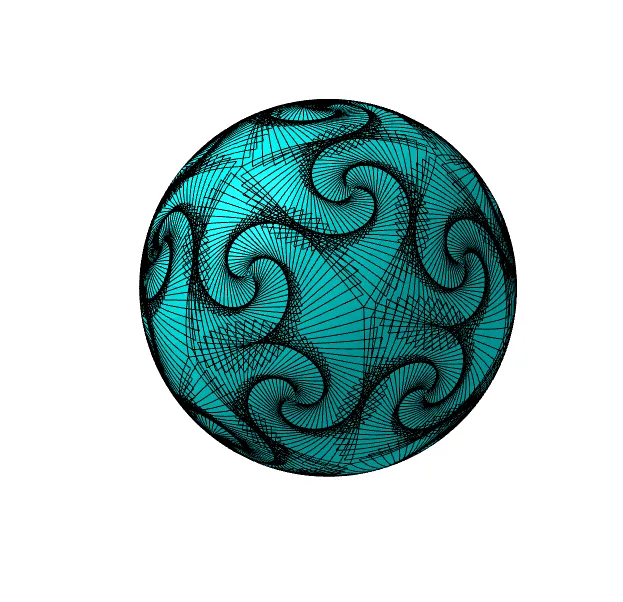
This example demonstrates the construction of an icosahedron-based temari ball using GeoGebra, showcasing geometric elements and relationships. Key math concepts include solid geometry, derivatives, median value, parallelograms, and differential equations. The construction involves commands like Point, Icosahedron, Midpoint, Sphere, OrthogonalLine, Intersect, Angle, Plane, Sequence, Rotate, Mirror, and objects such as A, B, C, a, D, E, F, G, H, I, J, K, L, faceABC, etc. Suitable for high school and advanced learners exploring complex geometric constructions and mathematical applications.
GeoGebra Commands & Parameters
Point(Circle[Midpoint[A, B], (Distance[A, B] * sqrt(3) / 2), Segment[A, B]]) → CIcosahedron(A, B, C) → a, D, faceABC, faceACF, faceAFG, faceADG, faceABD, faceBDH, faceBEH, faceBCE, faceCEI, faceCFI, E, faceEHK, faceEIK, faceIKL, faceFIL, faceHJK, faceJKL, faceGJL, faceFGL, faceDHJ, faceDGJ, F, edgeAC, edgeAB, edgeBC, edgeAF, edgeCF, edgeAG, edgeFG, edgeAD, edgeDG, edgeBD, G, edgeBH, edgeDH, edgeBE, edgeEH, edgeCE, edgeCI, edgeEI, edgeFI, edgeEK, edgeHK, H, edgeIK, edgeIL, edgeKL, edgeFL, edgeJK, edgeHJ, edgeJL, edgeGL, edgeGJ, edgeDJ, I, J, K, LMidpoint(D, I) → MSphere(M, A) → bOrthogonalLine(M, xOyPlane) → fIntersect(f, b) → N, OAngle(J, M, O) → αPlane(J, f) → cOrthogonalLine(M, c) → gSequence(Rotate[Rotate[J, (-a), g], (6 * a), f], a, 0, α, α / 36) → L_1Rotate(L_1, (2 * π / 3), f) → L_2Sequence(CircleArc[M, Element[L_1, i], Element[L_2, i]], i, 1, Length[L_1]) → L_3Rotate(L_3, (2 * π / 3), f) → L_4Rotate(L_3, (-2 * π / 3), f) → L_5Sequence(Rotate[{L_3, L_4, L_5}, ((a * 2) * π / 5), Line[M, J]], a, 1, 4) → L_6Sequence(Rotate[{L_3, L_4, L_5}, ((a * 2) * π / 5), Line[M, K]], a, 2, 4) → L_7Mirror(L_6, M) → L_8Sequence(Rotate[{L_3, L_4, L_5}, ((a * 2) * π / 5), Line[M, L]], a, 2, 3) → L_9Mirror(L_9, M) → L_{10}Rotate({L_3, L_4, L_5}, (4 * π / 5), Line[M, J]) → L_{11}Rotate(L_{11}, (4 * π / 5), Line[M, D]) → L_{12}Rotate(L_{11}, (2 * π / 5), Line[M, D]) → L_{13}Rotate(L_{11}, (6 * π / 5), Line[M, G]) → L_{14}Rotate(L_{12}, (-2 * π / 5), Line[M, A]) → L_{15}