
Hyperbola Equation Anatomy: From Geometric Parts to Standard Form
Loading the math board and drawing, please wait…
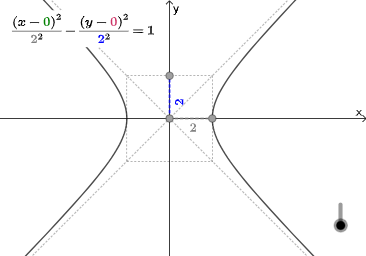
This example uses dynamic geometry to “analyze” the hyperbola equation, showing how its key geometric elements—center, foci, vertices, and orientation—map to the corresponding parameters in the standard hyperbola form. It focuses on core ideas from analytic geometry: the geometric definition of a hyperbola, distance-based relationships, and how computed distances relate to the algebraic equation, along with angle/annotation cues for interpretation. Construction-wise, the GeoGebra commands from the build summary are reflected in the workflow: Point, Line, Vector, and Segment to create and connect the defining elements; Mirror to enforce symmetry; Polygon for auxiliary shapes/visual structure; If to conditionally control visibility or choices; and Distance to compute and use distance measures. Text/rotation and labeling objects (e.g., RotateText variants) help present equation components clearly. Suitable for upper secondary students, contest prep, and early university learners in analytic geometry and geometric construction-based visualization.
GeoGebra Commands & Parameters
Point(Segment[(h, y(C) + 10), (h, y(C) + 1)]) → DLine(A, B) → fVector(A, C) → uPolygon(A, C, B) → t1, b, a_1, cSegment(A, C) → h_{1}Vector((h, 0), A) → wVector((0, 0), (h, 0)) → jPoint(Segment[(x(C) + 1, k), (x(C) + 10, k)]) → EMirror(F, D) → F'Mirror(F, E) → F'_{1}Mirror(F, A) → F'_{2}Segment(F', F) → rSegment(F, F'_{1}) → sSegment(F'_{1}, F'_{2}) → tSegment(F'_{2}, F') → f_1Segment(A, D) → i_1Segment(A, E) → j_1Segment(F'_{2}, F'_{1}) → qIf(n ≟ 0, (x - h)^(2) / j_1^(2) - (y - k)^(2) / i_1^(2) = 1, (y - k)^(2) / i_1^(2) - (x - h)^(2) / j_1^(2) = 1) → eq2Line(F'_{2}, F) → pLine(F', F'_{1}) → g_1Distance(A, D) → c_1RotateText(text1, pi / 2) → text2
AI Drawing Prompt Reference
Draw a hyperbola with point A as the center, points F and F' as the foci, and point C as the vertex. Start by drawing segment AC, then use mirroring to get F' and F'1, and connect these points to form the standard equation of the hyperbola. Finally, draw auxiliary segments and label key distances to ensure the geometric definition and algebraic equation of the hyperbola are correctly reflected.
The prompt above was compiled from the original drawing commands and is for reference only.