
How Many Radians?
Loading the math board and drawing, please wait…
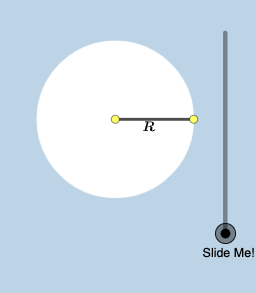
This example demonstrates the concept of radians and their relationship with angles. Key mathematical concepts include radians, angles, pi, and geometric construction. Construction involves GeoGebra commands such as Segment, Rotate, CircleArc, Angle, etc. Suitable for middle or high school mathematics to understand the application of radians in geometry and geometric construction techniques.
GeoGebra Commands & Parameters
Segment((0, 0), (r, 0)) → fRotate((r, 0), 1, (0, 0)) → ARotate((r, 0), 2, (0, 0)) → BRotate((r, 0), 3, (0, 0)) → CRotate((r, 0), 4, (0, 0)) → DRotate((r, 0), 5, (0, 0)) → ERotate((r, 0), -1, (0, 0)) → FRotate(f, If[0 < a ≤ 1, ((-a) * pi / 2), ((-pi)) / 2], (r, 0)) → f'Rotate(G, If[1.5 < a ≤ 2.5, a - 1.5, 1], (0, 0)) → G'CircleArc((0, 0), G, G') → cCircle(G', r - c) → dLine((0, 0), G') → gOrthogonalLine(G', g) → hIntersect(d, h, 2) → HSegment(G', H) → iDilate(G, If[3 < a ≤ 4, 4 - a, 0], A) → G'_{1}Vector(G, G'_{1}) → uTranslate(f, u) → f'_{1}Line((0, 0), A) → jOrthogonalLine(A, j) → kPoint(p) → IPoint(k) → JAngle(J, A, I) → αRotate(f'_{1}, If[3 < a ≤ 4, ((-(a - 3)) * α), (-α)], G'_{1}) → lRotate(A, If[4 < a ≤ 5, a - 4, 1], (0, 0)) → A'CircleArc((0, 0), A, A') → eCircle(A', r - e) → qLine((0, 0), A') → mOrthogonalLine(A', m) → nIntersect(q, n, 2) → KSegment(A', K) → sDilate((0, 0), If[5.5 < a ≤ 6.5, 6.5 - a, 0], B) → LVector(M, L) → vTranslate(f, v) → f'_{2}Line(M, B) → bOrthogonalLine(B, b) → f_1Point(t) → NPoint(f_1) → OAngle(O, B, N) → βRotate(f'_{2}, If[5.5 < a ≤ 6.5, ((-(a - 5.5)) * β), (-β)], L) → g_1Rotate(B, If[6.5 < a ≤ 7.5, a - 6.5, 1], (0, 0)) → B'CircleArc(M, B, B') → c_1Line(M, B') → h_1OrthogonalLine(B', h_1) → i_1Circle(B', r - c_1) → d_1Intersect(d_1, i_1, 2) → PDilate(M, If[8 < a ≤ 9, 9 - a, 0], C) → M'Vector(M, M') → wTranslate(f, w) → f'_{3}Line(M, C) → k_1OrthogonalLine(C, k_1) → l_1Point(p_1) → QPoint(l_1) → RAngle(R, C, Q) → γRotate(f'_{3}, If[8 < a ≤ 9, ((-(a - 8)) * γ), (-γ)], M') → m_1Rotate(C, If[9 < a ≤ 10, a - 9, 1], M) → C'CircleArc(M, C, C') → e_1Line(M, C') → n_1OrthogonalLine(C', n_1) → q_1Circle(C', r - e_1) → r_1Intersect(r_1, q_1) → S, B_1Intersect(d_1, i_1, 1) → TDilate(M, If[10.5 < a ≤ 11.5, 11.5 - a, 0], D) → M'_{1}Vector(M, M'_{1}) → u_1Translate(f, u_1) → f'_{4}Line(M, D) → a_1OrthogonalLine(D, a_1) → b_1Point(b_1) → UPoint(t_1) → VAngle(U, D, V) → δRotate(f'_{4}, If[10.5 < a ≤ 11.5, ((-(a - 10.5)) * δ), (-δ)], M'_{1}) → f_2Rotate(D, If[11.5 < a ≤ 12.5, a - 11.5, 1], M) → D'CircleArc(M, D, D') → c_2Line(M, D') → g_2OrthogonalLine(D', g_2) → h_2Circle(D', r - c_2) → d_2Intersect(d_2, h_2, 2) → WIntersect(d_2, h_2, 2) → ZRotate(M, If[13 < a ≤ 14, ((a - 13) * pi / 2), pi / 2], G) → M'_{2}Segment(G, M'_{2}) → j_2If(x(P) ≤ x(T), P, T) → A_1Segment(B', A_1) → j_1If(y(B_1) < y(S), B_1, S) → C_1Segment(C', C_1) → s_1Rotate(G, If[14 < a ≤ 15, (-(a - 14)), -1], M) → G'_{2}CircleArc(M, G'_{2}, G) → e_2Line(M, G'_{2}) → k_2Circle(G'_{2}, r - e_2) → p_2OrthogonalLine(G'_{2}, k_2) → l_2Intersect(p_2, l_2) → D_1, E_1If(y(D_1) ≤ y(E_1), D_1, E_1) → F_1Segment(G'_{2}, F_1) → m_2Rotate(D, 1, M) → D'_{1}Rotate(G, 0.5) → G'_{3}Rotate(G, 1.5) → G'_{4}Rotate(G, 2.5) → G'_{5}Rotate(G, 3.5) → G'_{6}Rotate(G, 4.5) → G'_{7}Rotate(G, -0.5) → G'_{8}If(0 < a < 15, G, F) → H_1If(0 < a < 5, A, D'_{1}, 5 ≤ a < 7.5, B, 7.5 ≤ a < 10, C, 10 ≤ a < 12.5, D, 12.5 ≤ a < 15, D'_{1}) → I_1Segment(G_1, I_1) → n_2Angle(H_1, G_1, I_1) → θSegment(G_1, H_1) → q_2If(a < 5, "ian", "ians") → text8Segment(D', Z) → i_2
AI Drawing Prompt Reference
Draw a circle centered at the origin with radius r. Start with a horizontal line segment from the origin and rotate it around the origin to form multiple angle segments. Then draw a circular arc connecting the endpoints of these segments. Use rotation and translation commands to construct multiple angle segments and arcs, ultimately forming a complex geometric figure that demonstrates the relationship between angles and radians.
The prompt above was compiled from the original drawing commands and is for reference only.