
Histogram Analysis Problems
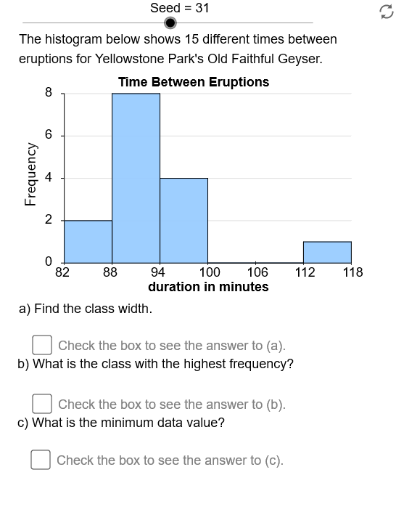
Loading the math board and drawing, please wait…
This GeoGebra applet presents various questions about a few histograms. Checking the check boxes reveals the answers. The example involves histogram construction and analysis, using commands such as Sequence, Element, Max, Min, If, KeepIf, Sort, CountIf, Segment, Append, TableText, VerticalText, and Text. Suitable for high school mathematics, particularly in statistics and probability.
GeoGebra Commands & Parameters
Sequence(Mod[11 + (k * 29), 59] + 1, k, 0, 59) → OpSq1Element(OpSq1, Seed) → OpNm1Element(AcSq, Op0) → AccElement(RtSq, Mod[Seed, 8] + 1) → RateSequence(Mod[(Rate * k) + Strt, 23] + 1, k, 0, 22, 1) → OpSq2Element(DSSq, Op0) → DS0Sequence(Element[DS0, Element[OpSq2, k]], k, 1, Size) → SampleMax(Sample) → SmpMx1Min(Sample) → SmpMn1If(C0 ≤ UB, 0, If[C1 ≤ UB, 0, If[C2 ≤ UB, 1, If[C3 ≤ UB, 2, 3]]]) → CWAccMax(Acc, CWAcc) → QFTAccIf(C0 ≤ UB, C0, If[C1 ≤ UB, C1, If[C2 ≤ UB, C2, If[C3 ≤ UB, C3, C4]]]) → ClWdSequence(SmpMn1 + (k * ClWd), k, 0, NmCls - 1) → LCLSq1Element(LCLSq1, 2) → LCL2Sequence(UCL1 + (ClWd * k), k, 0, NmCls - 1) → UCLSq1Sequence(CountIf[Element[LCLSq1, k] ≤ x ≤ Element[UCLSq1, k], Sample], k, 1, NmCls) → FrqSqMax(FrqSq) → FrqMx1If(FrqMx1 > 12, 3, If[FrqMx1 > 6, 2, 1]) → VASclSequence(7.95 - (k * 0.75), k, 0, 3) → LHSqElement(LHSq, 4) → LH3If(Mod[Size, 3] ≟ 2, ceil(Size / 3), floor(Size / 3)) → RL2Element(LHSq, 2) → LH1Element(LCLSq1, 1) → SmpMn0Element(Places, Op0) → DPSequence(k, k, 1, 19) → StrSqKeepIf(floor(20 / x) ≠ 20 / x, StrSq) → RlPrSqElement(GrphTtSq, Op0) → TypeLabelElement(DDSq, Op0) → GD0Sort(Sample) → SrtSqCountIf(x > 0, RtSq) → RateNoElement(SclSq, Op0) → ScaleSegment(RE, LE) → HAxElement(TSSq, Op0) → TSElement(AxTtlSq, Op0) → HALbSequence(SmpMn1 + (k * ClWd), k, 0, NmCls - 2) → LCLSq2Append(SmpMn1, LCLSq2) → LCLSq0Sequence(UCL1 + (ClWd * k), k, 0, NmCls - 2) → UCLSq2Append(UCL1, UCLSq2) → UCLSq0Sequence(Segment[(HAMn + ((HAScl * ClWd) * k), VAMn - 0.1), (HAMn + ((HAScl * ClWd) * k), VAMn + 0.1)], k, 0, NmCls, 1) → HTcSegment(LE, VAE) → VAxIf(VAScl ≟ 3, (ceil(FrqMx1 / 3) * 3), If[VAScl ≟ 2, (ceil(FrqMx1 / 2) * 2), FrqMx1]) → FrqMx2Element(LCLSq1, 1) → LCL1Element(LHSq, 3) → LH2Element(LHSq, 1) → LH0Element(PrtBSq, Mod[OpNm1, 4] + 1) → PrtBMin(FrqSq) → FrqMnSequence(Text["[" + (Element[LCLSq1, k]) + "," + (Element[UCLSq1, k]) + "]"], k, 1, NmCls) → ClsSqSequence(If[Element[FrqSq, k] ≟ FrqMx1, k, 0], k, 1, NmCls) → MxClsLcKeepIf(x > 0, MxClsLc) → MxPsCountIf(x > 0, MxPs) → FrqCntMxSequence(Element[ClsSq, Element[MxPs, k]], k, 1, FrqCntMx) → MxClsSequence(If[Element[FrqSq, k] ≟ FrqMn, k, 0], k, 1, NmCls) → MnClsKeepIf(x > 0, MnCls) → MnPsCountIf(x > 0, MnPs) → FrqCntMnSequence(Element[ClsSq, Element[MnPs, k]], k, 1, FrqCntMn) → MnClsLcTableText({MxCls}, "hl") → AnsB1TableText({MnClsLc}, "hl") → AnsB2Element(AnBSq, Mod[OpNm1, 4] + 1) → AnsBVerticalText("Frequency", (0.2, -2)) → VAxLbSequence(Text[k, (HAMn - 1.1, adp2(k)) - 0.2], k, 0, FrqMx2, VAScl) → VLbsSequence(Text[LCL1 + (k * ClWd), (adp1(LCL1 + (k * ClWd)) - 0.6, VAMn - 0.9)], k, 0, NmCls) → HALb_2Text("c) What is the maximum data value?") → PrtC2Sequence(Mod[8 + (k * 23), 59] + 1, k, 0, 59) → OpSq3Element(OpSq3, Seed) → OpNm3Text("c) What is the minimum data value?") → PrtC1Element(PrtCSq, ChC) → PrtCText((("The minimum data value is about " * SmpMn0) * ".")) → AnsC1Text((("The maximum data value is about " * SmpMx2) * ".")) → AnsC2If(ChC ≟ 1, AnsC1, AnsC2) → AnsCSequence((adp1(LCL1 + (ClWd * (k - 1))), adp2(Element[FrqSq, k])), k, 1, NmCls) → BrULSqSequence((adp1(LCL1 + (ClWd * k)), adp2(Element[FrqSq, k])), k, 1, NmCls) → BrURSqSequence((adp1(LCL1 + ((k - 1) * ClWd)), VAMn), k, 1, NmCls) → BrLLSqSequence((adp1(LCL1 + (k * ClWd)), VAMn), k, 1, NmCls) → BrLRSqSequence(Polygon[Element[BrLLSq, k], Element[BrULSq, k], Element[BrURSq, k], Element[BrLRSq, k]], k, 1, NmCls) → BrSqSequence(Segment[Element[BrULSq, k], Element[BrURSq, k]], k, 1, NmCls) → BrTpSqSequence(Segment[Element[BrULSq, k], Element[BrLLSq, k]], k, 1, NmCls) → BrLSSqSequence(Segment[Element[BrURSq, k], Element[BrLRSq, k]], k, 1, NmCls) → BrRSSqSequence(Segment[Element[BrLLSq, k], Element[BrLRSq, k]], k, 1, NmCls) → BrBtSqSequence(Segment[(HAMn - 0.2, adp2(k)), (HAMn, adp2(k))], k, 0, FrqMx2, VAScl) → VtcsSequence(Segment[(HAMn, adp2(k)), (HAMx, adp2(k))], k, 0, FrqMx2, VAScl) → HGrd