
Hexagonal Pyramid Design
Loading the math board and drawing, please wait…
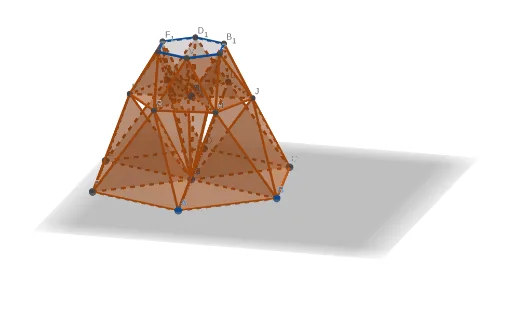
This example demonstrates how to construct a hexagonal pyramid using GeoGebra, involving core mathematical concepts like polygon construction, solid geometry, functions, and transformations. Key GeoGebra commands and objects used include Polygon, Point, Tetrahedron, and Pyramid, making it suitable for high school students and educators for practicing solid geometry and geometric constructions.
GeoGebra Commands & Parameters
Polygon(A, B, 6, xOyPlane) → poly1, f, F, g, h, i, j, k, C, D, EPoint(Circle[Midpoint[A, B], (Distance[A, B] * sqrt(3) / 2), Segment[A, B]]) → GTetrahedron(A, B, G) → a, H, edgeGH, edgeBH, faceABG, faceAGH, faceABH, faceBGH, edgeAG, edgeAB, edgeBG, edgeAHPoint(Circle[Midpoint[B, C], (Distance[B, C] * sqrt(3) / 2), Segment[B, C]]) → ITetrahedron(B, C, I) → b, J, edgeIJ, edgeCJ, faceBCI, faceBIJ, faceBCJ, faceCIJ, edgeBI, edgeBC, edgeCI, edgeBJPoint(Circle[Midpoint[C, D], (Distance[C, D] * sqrt(3) / 2), Segment[C, D]]) → KTetrahedron(C, D, K) → c, L, edgeKL, edgeDL, faceCDK, faceCKL, faceCDL, faceDKL, edgeCK, edgeCD, edgeDK, edgeCLPoint(Circle[Midpoint[D, E], (Distance[D, E] * sqrt(3) / 2), Segment[D, E]]) → MTetrahedron(D, E, M) → d, N, edgeMN, edgeEN, faceDEM, faceDMN, faceDEN, faceEMN, edgeDM, edgeDE, edgeEM, edgeDNPoint(Circle[Midpoint[E, F], (Distance[E, F] * sqrt(3) / 2), Segment[E, F]]) → OTetrahedron(E, F, O) → e, P, edgeOP, edgeFP, faceEFO, faceEOP, faceEFP, faceFOP, edgeEO, edgeEF, edgeFO, edgeEPPoint(Circle[Midpoint[F, A], (Distance[F, A] * sqrt(3) / 2), Segment[F, A]]) → QTetrahedron(F, A, Q) → l, R, edgeQR, edgeAR, faceAFQ, faceFQR, faceAFR, faceAQR, edgeFQ, edgeAF, edgeAQ, edgeFRPoint(Circle[Midpoint[P, R], (Distance[P, R] * sqrt(3) / 2), Segment[P, R]]) → STetrahedron(P, R, S) → m, T, edgeST, edgeRT, facePRS, facePST, facePRT, faceRST, edgePS, edgePR, edgeRS, edgePTPoint(Circle[Midpoint[R, H], (Distance[R, H] * sqrt(3) / 2), Segment[R, H]]) → UTetrahedron(R, H, U) → n, V, edgeUV, edgeHV, faceHRU, faceRUV, faceHRV, faceHUV, edgeRU, edgeHR, edgeHU, edgeRVPoint(Circle[Midpoint[H, J], (Distance[H, J] * sqrt(3) / 2), Segment[H, J]]) → WTetrahedron(H, J, W) → o, Z, edgeWZ, edgeJZ, faceHJW, faceHWZ, faceHJZ, faceJWZ, edgeHW, edgeHJ, edgeJW, edgeHZPoint(Circle[Midpoint[J, L], (Distance[J, L] * sqrt(3) / 2), Segment[J, L]]) → A_1Tetrahedron(J, L, A_1) → p, B_1, edge5, edge4, face1, face3, face2, face4, edge1, edgeJL, edge3, edge2Point(Circle[Midpoint[L, N], (Distance[L, N] * sqrt(3) / 2), Segment[L, N]]) → C_1Tetrahedron(L, N, C_1) → q, D_1, edge10, edge9, face5, face7, face6, face8, edge6, edgeLN, edge8, edge7Point(Circle[Midpoint[N, P], (Distance[N, P] * sqrt(3) / 2), Segment[N, P]]) → E_1Tetrahedron(N, P, E_1) → r, F_1, edge15, edge14, face9, face11, face10, face12, edge11, edgeNP, edge13, edge12Polygon(B_1, D_1, F_1, T, V, Z) → poly2, b_1, d_1, f_1, t, v, z_1Pyramid(poly2, Q) → s, face15, edgeQT, edgeQV, edgeQZ, face16, face13, faceQTV, faceQVZ, face14, edge16, edge17, edge18