
Hexagon Dimensions
Loading the math board and drawing, please wait…
In collections
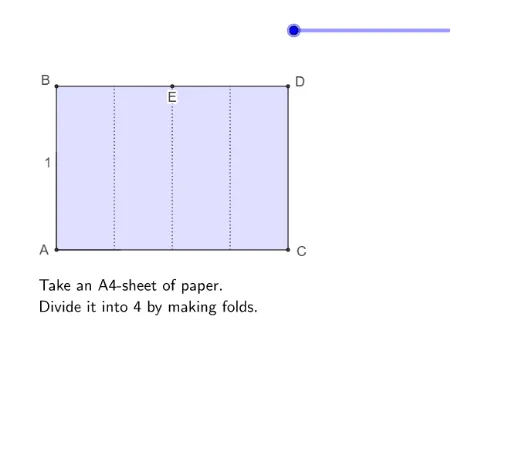
Folding paper, doing geometry figures
This example demonstrates the geometric construction and dimension calculation of a hexagon. It involves core mathematical concepts such as polygon construction, midpoint, rotation, arc intersection, angle bisector, perpendicular line, and mirror. GeoGebra commands used include Polygon, Segment, Midpoint, Rotate, CircleArc, Intersect, AngularBisector, OrthogonalLine, Mirror, Circle, and Line. It is suitable for high school geometry construction teaching and learning, helping to understand polygon properties and construction methods.
GeoGebra Commands & Parameters
Polygon(A, C, D, B) → vierhoek1, a, c, d, bSegment((sqrt(2) / 4, 0), (sqrt(2) / 4, 1)) → fSegment((sqrt(2) / 2, 0), (sqrt(2) / 2, 1)) → gSegment(((3 * sqrt(2) / 4), 0), ((3 * sqrt(2) / 4), 1)) → hMidpoint(B, D) → ERotate(D, -90°, E) → DDCircleArc(E, DD, D) → eIntersect(e, h, 1) → FCircleArc(E, F, D) → kAngularBisector(F, E, D) → iIntersect(i, c) → GSegment(E, G) → jPolygon(A, C, G, E, B) → veelhoek1, a_1, c_1, g_1, e_1, b_1Polygon(E, D, G) → driehoek1, g_2, e_2, d_1Rotate(E, (((-(s - 1)) * 180))°, g_1) → E'Rotate(D, (((-(s - 1)) * 180))°, g_1) → D'Rotate(G, (((-(s - 1)) * 180))°, g_1) → G'Polygon(E', D', G') → driehoek1', g', e', d'Polygon(E, F, G) → driehoek2, g_3, e_3, f_1Segment(E, D) → lSegment(D, G) → mOrthogonalLine(F, a_1) → nIntersect(j, d') → IIIntersect(n, j) → RIntersect(n, a_1) → SSegment(R, S) → pSegment(F, S) → qMirror(F, g) → HMirror(G, g) → ISegment(I, E) → rCircleArc(E, B, H) → tPolygon(I, E, B) → driehoek3, b_2, i_1, e_4Rotate(I, (((s - 3) * 180))°, r) → I'Rotate(E, (((s - 3) * 180))°, r) → E'_1Rotate(B, (((s - 3) * 180))°, r) → B'Polygon(I', E'_1, B') → driehoek3', b', i', e'_1Polygon(E, I, A, C, G) → veelhoek2, e_5, i_2, a_2, c_2, g_4Segment(B, E) → h_1Segment(B, I) → j_1Mirror(R, g) → TTMirror(S, g) → SSSegment(SS, TT) → k_1Segment(SS, H) → l_1Polygon(I, H, E) → driehoek4, e_6, i_3, h_2Circle(G, C) → p_1Intersect(d', f_1) → JIntersect(d', f_1) → KIntersect(d', f_1) → LIntersect(d', f_1) → MIntersect(p_1, f_1) → N,CircleArc(G, N, C) → q_1Line(G, F) → m_1Intersect(m_1, a_2) → OSegment(O, F) → n_1Polygon(O, C, G) → driehoek5, g_5, o, c_3Rotate(O, (((s - 5) * 180))°, c_3) → O'Rotate(C, (((s - 5) * 180))°, c_3) → C'Rotate(G, (((s - 5) * 180))°, c_3) → G'_1Polygon(O', C', G'_1) → driehoek5', g'_1, o', c'Polygon(I, A, O, G, E) → veelhoek3, i_4, a_3, o_1, g_6, e_7Mirror(O, n_1) → O'_1Mirror(C, n_1) → C'_1Mirror(G, n_1) → G'_2Polygon(O'_1, C'_1, G'_2) → driehoek5'_1, g'_2, o'_1, c'_1Mirror(O, g) → O'_2Mirror(C, g) → C'_2Mirror(G, g) → G'_3Polygon(O'_2, C'_2, G'_3) → driehoek5'_2, g'_3, o'_2, c'_2Rotate(O, (((s - 5) * 180))°, c_3) → O'_3Rotate(G, (((s - 5) * 180))°, c_3) → G'_4Rotate(O'_2, (((-(s - 6)) * 180))°, c'_2) → QRotate(G'_3, (((-(s - 6)) * 180))°, c'_2) → UIntersect(c', o_1) → VIntersect(c', o_1) → WIntersect(c', o_1) → ZLine(I, H) → r_1Intersect(o_1, r_1) → TSegment(O, C) → s_1Segment(C, G) → t_1Polygon(I, A, O, T) → vierhoek2, i_5, a_4, o_2, t_2Rotate(I, (((-(s - 7)) * 180))°, t_2) → I'_1Rotate(A, (((-(s - 7)) * 180))°, t_2) → A'Rotate(O, (((-(s - 7)) * 180))°, t_2) → O'_4Rotate(T, (((-(s - 7)) * 180))°, t_2) → T'Polygon(I, T, G, E) → vierhoek3, i_6, t_3, g_7, e_8Segment(E, T) → f_2Segment(T, E) → j_2Intersect(Segment[O, N], j_2) → A_1Segment(A_1, E) → k_2Rotate(I, (((-(s - 7)) * 180))°, i_6) → I'_2Rotate(A, (((-(s - 7)) * 180))°, i_6) → A'_1Rotate(O, (((-(s - 7)) * 180))°, i_6) → O'_5Rotate(T, (((-(s - 7)) * 180))°, i_6) → T'_1Polygon(I'_2, A'_1, O'_5, T'_1) → vierhoek2', i'_2, a'_1, o'_5, t'_1Mirror(N, g) → NNCircleArc(I, A, NN) → d_2Segment(I, T) → l_2Intersect(g'_2, l_2) → B_1Polygon(N, B_1, T, G) → vierhoek4, n_2, b_3, t_4, g_8Segment(I, A) → m_2Segment(A, O) → p_2Mirror(H, Segment[I, G]) → HHMirror(HH, g) → GGIntersect(n_2, g) → C_1Polygon(I, T, C_1, NN) → vierhoek5, i_7, t_5, c_4, nnSegment(HH, H) → q_2Segment(GG, F) → r_2Polygon(GG, F, G) → driehoek6, g_9, gg, f_3Polygon(I, H, HH) → driehoek7, hh, i_8, h_3Rotate(GG, (((s - 9) * 180))°, q) → GG'Rotate(F, (((s - 9) * 180))°, q) → F'Rotate(G, (((s - 9) * 180))°, q) → G'_5Polygon(GG', F', G'_5) → driehoek6', g'_5, gg', f'Rotate(I, (((s - 9) * 180))°, f) → I'_3Rotate(H, (((s - 9) * 180))°, f) → H'Rotate(HH, (((s - 9) * 180))°, f) → HH'Polygon(I'_3, H', HH') → driehoek7', hh', i'_3, h'Segment(HH, E) → s_2Segment(H, B_1) → j_3Segment(E, GG) → k_3Segment(T, F) → l_3Polygon(E, HH, H, T, F, GG) → veelhoek4, e_9, hh_1, h_4, t_6, f_4, gg_1Segment(C_1, T) → m_3Segment(E, G) → n_3Segment(T, G) → p_3Segment(T, I) → q_3Segment(E, I) → r_3Midpoint(E, T) → MMMidpoint(E, G) → HHHMidpoint(E, MM) → EMPolygon(E, MM, HHH) → driehoek8, hhh, e_{10}, mmSegment(EM, HHH) → s_3
AI Drawing Prompt Reference
Draw a regular hexagon and demonstrate its geometric construction. Start by creating base segments and points, then use rotations, midpoints, and arc intersections to form part of the hexagon. Complete the hexagon by applying angle bisectors, perpendicular lines, and reflections. Finally, add some helper lines and triangles to illustrate the symmetry and related geometric properties of the hexagon.
The prompt above was compiled from the original drawing commands and is for reference only.