
Hexagon Angle Theorems Exploration
Loading the math board and drawing, please wait…
In collections
Interior and Exterior Angles of Polygons
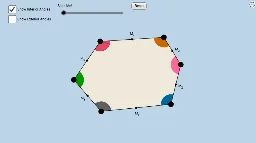
This example demonstrates how students can explore the sum of interior and exterior angles of a hexagon using interactive tools. Key math concepts include polygon angle sum theorem, exterior angle theorem, and angle measurement. Construction involves commands like Circle, Ray, Intersect, Segment, Polygon from GeoGebra, suitable for middle school and above for geometry learning and concept understanding.
GeoGebra Commands & Parameters
Circle(C, 1.5) → hRay(C, D) → cIntersect(h, c, 1) → PRay(A, B) → aRay(B, C) → bRay(E, A) → eCircle(A, 1.5) → fCircle(B, 1.5) → gCircle(D, 1.5) → kCircle(E, 1.5) → pSegment(C, A) → iSegment(C, E) → jIntersect(f, a, 1) → FIntersect(f, i, 1) → GIntersect(f, e, 1) → HIntersect(f, e, 2) → IIntersect(p, e) → J,Intersect(p, j) → K,Intersect(k, c, 2) → OIntersect(h, j, 1) → QIntersect(h, i, 1) → RIntersect(h, b, 1) → SIntersect(g, a, 2) → TIntersect(g, b, 1) → UIntersect(g, a, 1) → VCircleSector(A, F, G) → qCircleSector(A, G, H) → rCircleSector(B, U, V) → sCircleSector(C, Q, R) → c_1CircleSector(C, R, S) → d_1Intersect(k, c, 1) → WCircleSector(E, J, K) → h_1CircleSector(A, I, F) → p_1CircleSector(B, T, U) → q_1Intersect(h, b, 2) → ZCircleSector(C, Z, P) → r_1Vector(A, B) → uVector(C, B) → vVector(E, D) → wVector(C, D) → u_1Vector(C, E) → v_1Vector(A, E) → w_1Translate(d_1, v) → s_1Dilate(C, If[1 < l ≤ 2, 2 - l, 0], E) → C'_1Dilate(C, If[2 < l ≤ 3, 3 - l, 0], D) → C'_2Dilate(E, If[2 < l ≤ 3, 3 - l, 0], D) → E'Vector(A, B) → a_1Vector(E, E') → j_1Vector(C, C'_2) → l_1Vector(C, C'_1) → m_1Translate(r, w_1) → r'_2Translate(c_1, v_1) → f_2Translate(c_1, m_1) → g_2Translate(q, a_1) → r'Vector(D, C) → u_2Vector(E, C) → v_2Vector(A, C) → w_2Vector(B, C) → l_2Dilate(B, If[0 < o < 1, 1 - o, 0], C) → B'Dilate(A, If[1 < o < 2, 2 - o, 0], C) → A'_2Dilate(E, If[2 < o < 3, 3 - o, 0], C) → E'_1Dilate(D, If[3 < o < 4, 4 - o, 0], C) → D'Vector(B, B') → m_2Vector(A, A'_2) → n_2Vector(E, E'_1) → s_2Vector(D, D') → t_2Translate(q_1, m_2) → c_3Translate(q_1, l_2) → d_3Translate(p_1, w_2) → e_3If(1 < o < 2, Translate[p_1, n_2]) → h_3Ray(D, A_1) → a_3Ray(A_1, E) → b_3Circle(A_1, 1.5) → q_3Intersect(q_3, b_3, 1) → NIntersect(q_3, a_3, 2) → B_1Intersect(k, c, 2) → C_1Intersect(k, a_3, 1) → D_1Intersect(k, c, 1) → E_1Intersect(p, b_3, 1) → F_1Dilate(C, If[2 < l < 3, 3 - l, 0], A_1) → C'_3Vector(E, A_1) → f_1Vector(C, A_1) → g_1Vector(C, C'_3) → b_2Intersect(q_3, a_3, 1) → I_1CircleSector(D, D_1, E_1) → k_3Vector(C, D) → j_2Vector(A_1, D) → u_3Intersect(p, b_3, 2) → J_1Polygon(A, B, C) → poly1, c_4, a_4, b_4Polygon(A, C, E) → poly2, e_4, a_5, c_5Polygon(E, C, A_1) → poly3, a_6, e_5, c_6Polygon(A_1, C, D) → poly4, d_4, a_7, c_7Polygon(A, B, C, D, A_1, E) → poly5, a_8, b_5, c_8, d_5, a_9, e_6Intersect(e, e_6) → K_1Intersect(p, e, 1) → L_1CircleSector(E, J_1, L_1) → f_4CircleSector(A_1, B_1, N) → g_4CircleSector(D, C_1, D_1) → h_4Vector(E, C) → j_3Vector(A_1, C) → l_3Vector(D, C) → m_3Translate(f_4, j_3) → k_4Translate(g_4, l_3) → p_4Translate(h_4, m_3) → q_4Dilate(E, If[2 < o < 3, 3 - o, 0], C) → E'_3Dilate(A_1, If[3 < o < 4, 4 - o, 0], C) → M_7Dilate(D, If[4 < o < 5, 5 - o, 0], C) → D'_1Vector(E, E'_3) → n_3Vector(A_1, M_7) → u_4Vector(D, D'_1) → v_4If(2 < o < 3, Translate[f_4, n_3]) → r_4If(3 < o < 4, Translate[g_4, u_4]) → s_4If(4 < o < 5, Translate[h_4, v_4]) → t_4Ray(C, A_1) → l_4Ray(C, E) → m_4Point(l_4) → N_1Point(m_4) → O_1Segment(D, C) → n_4Segment(C, B) → f_5Segment(B, A) → g_5Segment(A, E) → h_5Segment(E, A_1) → i_5Segment(A_1, D) → j_5Midpoint(f_5) → M_2Midpoint(g_5) → M_1Rotate(d_1, If[0 < l ≤ 1, (((-l) * 180))°, -180°], M_2) → dRotate(C, If[0 < l ≤ 1, (((-l) * 180))°, -180°], M_2) → C'Segment(M_2, C') → tRotate(q, If[0 < l ≤ 1, ((l * 180))°, 180°], M_1) → q'Rotate(A, If[0 < l ≤ 1, ((l * 180))°, 180°], M_1) → A'Segment(M_1, A') → e_1Rotate(R, 180°, M_2) → R'Line(B, R') → k_1Ray(E, O_1) → i_1Midpoint(h_5) → M_6Rotate(r, If[1 < l ≤ 2, (((-(l - 1)) * 180))°, -180°], M_6) → r'_1Rotate(A, If[1 < l ≤ 2, (((-(l - 1)) * 180))°, -180°], M_6) → A'_1Segment(M_6, A'_1) → n_1CircleSector(E, K, F_1) → c_2Midpoint(i_5) → M_5Rotate(E, If[2 < l ≤ 3, (((-(l - 2)) * 180))°, -180°], M_5) → E'_2Segment(M_5, E'_2) → a_2Rotate(c_2, If[2 < l ≤ 3, (((-(l - 2)) * 180))°, -180°], M_5) → d_2Segment(A_1, C) → e_2Intersect(h, e_2, 1) → U_1CircleSector(C, U_1, Q) → h_2CircleSector(C, P, U_1) → k_2Vector(C, C'_3) → t_1Translate(h_2, t_1) → p_2Intersect(q_3, e_2, 1) → R_1CircleSector(A_1, N, R_1) → q_2CircleSector(A_1, R_1, I_1) → r_2Vector(C, A_1) → i_2Translate(U_1, i_2) → S_1Ray(A_1, S_1) → f_3Midpoint(j_5) → M_4Midpoint(n_4) → M_3Rotate(k_2, If[3 < l ≤ 4, (((l - 3) * 180))°, 180°], M_3) → g_3Rotate(C, If[3 < l ≤ 4, (((l - 3) * 180))°, 180°], M_3) → C'_4Rotate(U_1, 180°, M_3) → W_1Segment(M_3, C'_4) → i_3Rotate(r_2, If[3 < l ≤ 4, (((-(l - 3)) * 180))°, -180°], M_4) → p_3Rotate(A_1, If[3 < l ≤ 4, (((-(l - 3)) * 180))°, -180°], M_4) → Z_1Segment(M_4, Z_1) → r_3Line(D, W_1) → s_3CircleArc(C, R, S) → t_3CircleArc(A, F, G) → k_5CircleArc(C, Q, R) → p_5CircleArc(A, G, H) → q_5CircleArc(C, U_1, Q) → r_5CircleArc(E, K, F_1) → s_5CircleArc(C, P, U_1) → t_5CircleArc(A_1, R_1, I_1) → d_6
AI Drawing Prompt Reference
Draw a hexagon and explore its interior and exterior angles. Start by drawing a circle and then draw rays from the center to intersect the circle, forming the vertices of the hexagon. Next, draw the sides of the hexagon using intersection points and circles. Finally, use rotation and dilation operations to demonstrate the relationships between the interior and exterior angles.
The prompt above was compiled from the original drawing commands and is for reference only.