
Meanings of the 3 Trigonometric Ratios in a Right Triangle
Loading the math board and drawing, please wait…
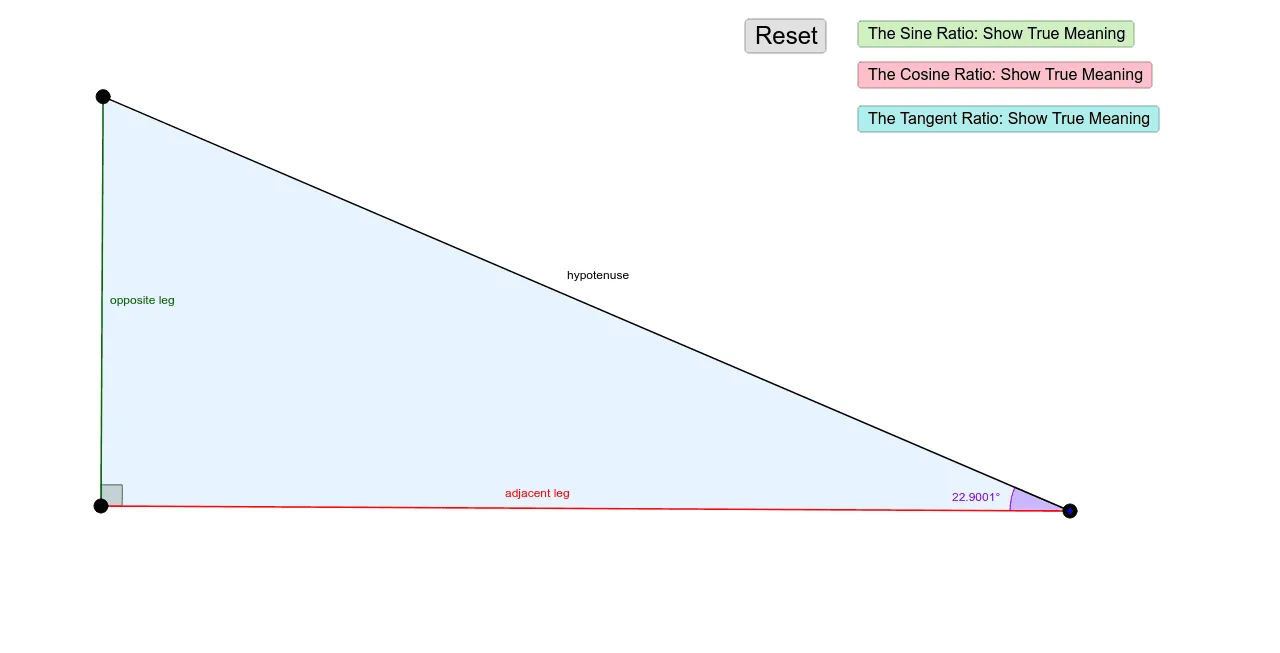
This example demonstrates the definitions and calculations of sine, cosine, and tangent in a right triangle. Through dynamic constructions, it shows the proportional relationships between angles and side lengths. The core mathematical concepts involved include the definition of trigonometric functions, side length relationships in right triangles, and angle measurement. Key GeoGebra commands and objects used in the construction include Segment, OrthogonalLine, Point, Ray, Angle, Rotate, Polygon, Midpoint, and Vector, visually presenting the geometric meaning of trigonometric functions. Suitable for high school mathematics teaching, helping students understand and remember the definitions and applications of trigonometric functions.
GeoGebra Commands & Parameters
Segment(A, B) → aOrthogonalLine(B, a) → bPoint(b) → ERay(B, E) → cAngle(A, B, E) → αPoint(c) → CSegment(C, A) → dAngle(B, C, A) → βSegment(B, C) → eRotate(B, If[0 < f ≤ 1, (f * β), 0], C) → B'Rotate(C, If[0 < f ≤ 1, (f * β), 0], C) → C'Segment(B', C') → e'Angle(C, A, B) → γRotate(A, If[0 < g ≤ 1, ((-g) * γ), 0], A) → A'Rotate(B, If[0 < g ≤ 1, ((-g) * γ), 0], A) → B'_1Segment(A', B'_1) → a'Rotate(B, If[0 < h ≤ 1, ((-h) * α), 0], B) → B'_2Rotate(C, If[0 < h ≤ 1, ((-h) * α), 0], B) → C'_1Segment(B'_2, C'_1) → e'_1Polygon(B, A, C) → poly1, c_1, b_1, a_1Midpoint(e') → DVector(F, D) → uMidpoint(a') → GVector(H, G) → vMidpoint(e'_1) → IVector(J, I) → w