
Hex Prism
Loading the math board and drawing, please wait…
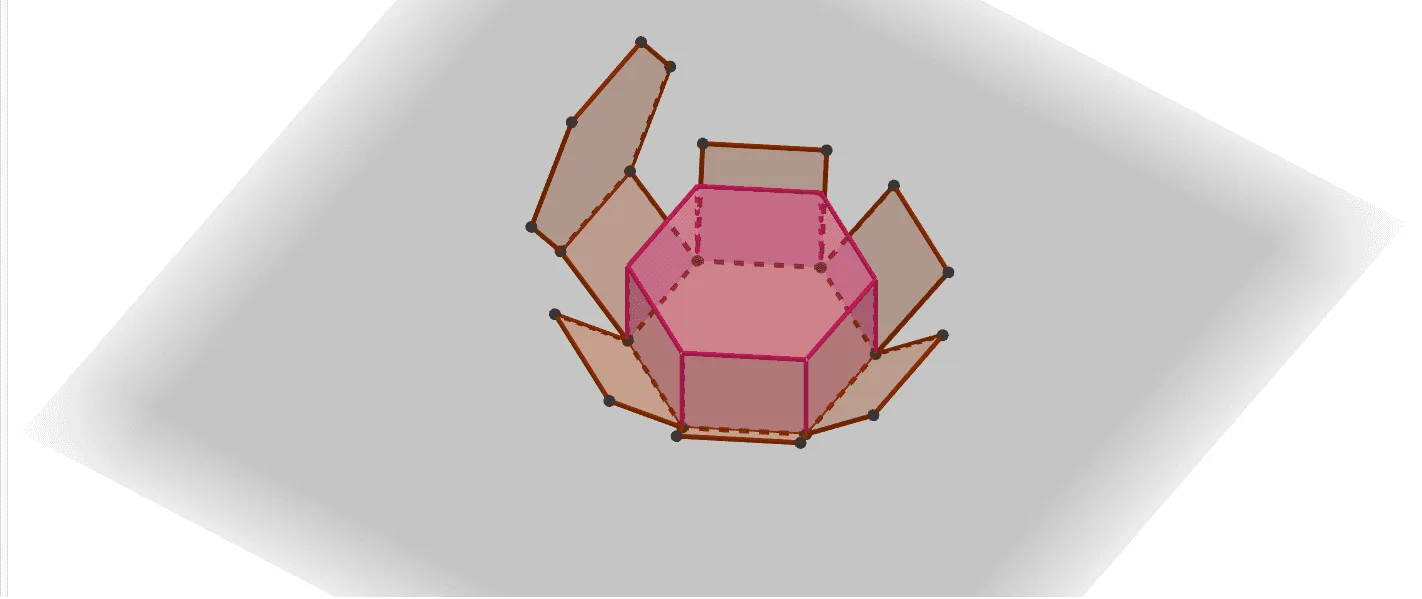
This example demonstrates the geometric construction and properties of a hexagonal prism. Key math concepts include polygons, solid geometry, surface area calculation, equilateral triangles, and coordinate systems. The construction uses GeoGebra commands like Polygon, Prism, and Net, focusing on creating faces, edges, and the overall prism structure. Suitable for high school mathematics education or for those interested in learning about 3D shapes and their properties.
GeoGebra Commands & Parameters
Polygon(A, B, 6, xOyPlane) → poly1, f, F, g, h, i, j, k, C, D, EPrism(Polygon[A, B, C, D, E, F], 3.81524791385932) → a, G, faceDEKJ, faceEFLK, faceAFLG, faceGHIJKL, edgeAG, edgeBH, edgeCI, edgeDJ, edgeEK, edgeFL, H, edgeGH, edgeHI, edgeIJ, edgeJK, edgeKL, edgeGL, I, J, K, L, faceABHG, faceBCIH, faceCDJINet(a, b) → c, M, V, W, Z, A_1, B_1, C_1, D_1, E_1, F_1, G_1, N, H_1, I_1, J_1, faceMNOPQR, faceMNTS, faceNOVU, faceOPZW, face2, face3, face1, O, face4, edgeMN, edgeNO, edgeOP, edgePQ, edgeQR, edgeMR, edgeMS, edgeST, edgeNT, P, edgeNU, edgeUV, edgeOV, edgeOW, edgeWZ, edgePZ, edge2, edge9, edge3, edge4, Q, edge10, edge5, edge6, edge11, edge1, edge8, edge12, edge13, edge14, edge7, R, S, T, U
AI Drawing Prompt Reference
In 3D space, first draw a regular hexagon on the horizontal plane as the base, then extrude it vertically upward to a height of about 3.8 to form a hexagonal prism. The prism has six rectangular lateral faces and two congruent hexagonal bases. Then unfold one lateral face to generate a net of the prism, consisting of six rectangular side faces and two hexagonal bases connected by edges, forming a foldable flat pattern. The overall figure shows both the solid prism and its unfolded surface layout.
The prompt above was compiled from the original drawing commands and is for reference only.