
Heptagon Angle Sum Theorems
Loading the math board and drawing, please wait…
In collections
Interior and Exterior Angles of Polygons
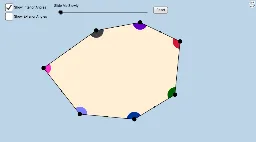
This GeoGebra applet helps students discover the sum of the interior and exterior angles of a heptagon through dynamic demonstration. Key mathematical concepts include the sum of interior and exterior angles of a polygon. Using commands like Ray, Circle, Intersect, Segment, CircleSector, Vector, Translate, Dilate, If, Polygon, Point, Midpoint, Rotate, Line, students can visually understand these theorems. Suitable for middle school and above students learning polygon geometry.
GeoGebra Commands & Parameters
Ray(N_1, D) → l_4Circle(D, 3) → kIntersect(k, l_4) → W_1, Z_1Ray(D, A_1) → a_3Intersect(k, a_3, 1) → D_1Segment(C, A_1) → i_3Circle(C, 3) → hIntersect(h, i_3) → L,Ray(C, D) → cIntersect(h, c, 1) → PRay(A, B) → aRay(B, C) → bRay(E, A) → eCircle(A, 3) → fCircle(B, 3) → gCircle(E, 3) → pSegment(C, A) → iSegment(C, E) → jIntersect(f, a, 1) → FIntersect(f, i, 1) → GIntersect(f, e, 1) → HIntersect(f, e, 2) → IIntersect(p, e) → J,Intersect(p, j) → K,Intersect(k, c, 2) → OIntersect(h, j, 1) → QIntersect(h, i, 1) → RIntersect(h, b, 1) → SIntersect(g, a, 2) → TIntersect(g, b, 1) → UIntersect(g, a, 1) → VCircleSector(A, F, G) → qCircleSector(A, G, H) → rCircleSector(B, U, V) → sCircleSector(C, Q, R) → c_1CircleSector(C, R, S) → d_1Intersect(k, c, 1) → WCircleSector(E, J, K) → h_1CircleSector(A, I, F) → p_1CircleSector(B, T, U) → q_1Intersect(h, b, 2) → ZVector(A, B) → uVector(C, B) → vVector(E, D) → wVector(C, D) → u_1Vector(C, E) → v_1Vector(A, E) → w_1Translate(d_1, v) → s_1Dilate(A, If[0 < l ≤ 1, 1 - l, 0], B) → A'Dilate(C, If[0 < l ≤ 1, 1 - l, 0], B) → C'Dilate(A, If[1 < l ≤ 2, 2 - l, 0], E) → A'_1Dilate(C, If[1 < l ≤ 2, 2 - l, 0], E) → C'_1Dilate(C, If[2 < l ≤ 3, 3 - l, 0], D) → C'_2Dilate(E, If[2 < l ≤ 3, 3 - l, 0], D) → E'Vector(A, B) → a_1Vector(C, C') → b_1Vector(A, A'_1) → i_1Vector(E, E') → j_1Vector(C, C'_2) → l_1Vector(C, C'_1) → m_1Translate(d_1, b_1) → c_2Translate(r, i_1) → r'_1Translate(r, w_1) → r'_2Translate(c_1, v_1) → f_2Translate(c_1, m_1) → g_2CircleSector(C, P, L) → tTranslate(t, u_1) → t'Translate(t, l_1) → t'_1Translate(q, a_1) → r'Translate(d_1, b_1) → h_2Vector(A, A') → n_1Ray(C, E) → i_2Vector(D, C) → u_2Vector(E, C) → v_2Vector(A, C) → w_2Vector(B, C) → l_2Dilate(B, If[0 < o < 1, 1 - o, 0], C) → B'Dilate(A, If[1 < o < 2, 2 - o, 0], C) → A'_2Dilate(E, If[2 < o < 3, 3 - o, 0], C) → E'_1Dilate(D, If[3 < o < 4, 4 - o, 0], C) → D'Vector(B, B') → m_2Vector(A, A'_2) → n_2Vector(E, E'_1) → s_2Vector(D, D') → t_2Translate(q_1, m_2) → c_3Translate(q_1, l_2) → d_3Translate(p_1, w_2) → e_3If(1 < o < 2, Translate[p_1, n_2]) → h_3Ray(A_1, E) → b_3Circle(A_1, 3) → q_3Intersect(q_3, i_3) → M,Intersect(q_3, b_3, 1) → NIntersect(q_3, a_3, 2) → B_1Intersect(k, c, 2) → C_1Intersect(k, c, 1) → E_1CircleSector(C, L, Q) → dIntersect(p, b_3, 1) → F_1Intersect(p, i_2) → G_1, H_2CircleSector(E, G_1, N) → e_1Dilate(E, If[2 < l < 3, 3 - l, 0], A_1) → E'_2Dilate(C, If[2 < l < 3, 3 - l, 0], A_1) → C'_3Dilate(C, If[3 < l < 4, 4 - l, 0], D) → C'_4Dilate(A_1, If[3 < l < 4, 4 - l, 0], D) → H_1Vector(E, A_1) → f_1Vector(C, A_1) → g_1Translate(e_1, f_1) → k_1Translate(d, g_1) → d'Vector(E, E'_2) → a_2Vector(C, C'_3) → b_2Translate(e_1, a_2) → d_2Translate(d, b_2) → d'_1CircleSector(A_1, N, M) → f_3Intersect(q_3, a_3, 1) → I_1CircleSector(A_1, M, I_1) → g_3CircleSector(D, D_1, E_1) → k_3Vector(C, D) → j_2Vector(A_1, D) → u_3Translate(g_3, u_3) → p_3Translate(t, j_2) → t'_2Vector(A_1, H_1) → v_3Vector(C, C'_4) → w_3Translate(g_3, v_3) → s_3Translate(t, w_3) → t'_3Intersect(p, b_3, 2) → J_1Polygon(A, B, C) → poly1, c_4, a_4, b_4Polygon(A, C, E) → poly2, e_4, a_5, c_5Polygon(E, C, A_1) → poly3, a_6, e_5, c_6Polygon(A_1, C, D) → poly4, d_4, a_7, c_7Intersect(p, e, 1) → L_1CircleSector(E, J_1, L_1) → f_4CircleSector(A_1, B_1, N) → g_4Vector(E, C) → j_3Vector(A_1, C) → l_3Vector(D, C) → m_3Translate(f_4, j_3) → k_4Translate(g_4, l_3) → p_4CircleSector(D, Z_1, D_1) → h_4Translate(h_4, m_3) → q_4Dilate(E, If[2 < o < 3, 3 - o, 0], C) → E'_3Dilate(A_1, If[3 < o < 4, 4 - o, 0], C) → M_1Dilate(D, If[4 < o < 5, 5 - o, 0], C) → D'_1Vector(E, E'_3) → n_3Vector(A_1, M_1) → u_4Vector(D, D'_1) → v_4If(2 < o < 3, Translate[f_4, n_3]) → r_4If(3 < o < 4, Translate[g_4, u_4]) → s_4If(4 < o < 5, Translate[h_4, v_4]) → t_4Ray(C, N_1) → i_4Circle(N_1, 3) → d_5Intersect(d_5, i_4, 2) → K_1Intersect(d_5, l_4, 1) → O_1Intersect(d_5, i_4, 1) → P_1Intersect(h, i_4, 1) → Q_1CircleSector(C, Q_1, P) → f_5CircleSector(N_1, O_1, P_1) → g_5Intersect(k, l_4, 1) → R_1CircleSector(D, E_1, R_1) → h_5Dilate(D, If[4 < l < 5, 5 - l, 0], N_1) → D'_2Dilate(C, If[4 < l < 5, 5 - l, 0], N_1) → C'_5Vector(C, N_1) → w_4Vector(D, N_1) → j_4Translate(h_5, j_4) → p_5Vector(D, D'_2) → m_4Vector(C, C'_5) → n_4Translate(h_5, m_4) → r_5Polygon(D, C, N_1) → poly5, n_5, d_6, c_8Segment(D, C) → b_5Ray(C, E) → i_5Ray(C, A_1) → j_5Ray(C, D) → l_5Point(j_5) → T_1Point(l_5) → U_1Ray(A_1, T_1) → m_5Ray(D, U_1) → b_6Polygon(A_1, E, A, B, C, N_1, D) → poly6, a_8, e_6, a_9, b_7, c_9, n_6, d_7Intersect(d_5, l_4, 1) → S_1Intersect(d_5, i_4, 2) → V_1CircleSector(N_1, V_1, S_1) → f_6CircleSector(C, Z, Q_1) → r_1Vector(N_1, C) → u_5Translate(f_6, u_5) → g_6Dilate(N_1, If[5 < o < 6, 6 - o, 0], C) → A_2Vector(N_1, A_2) → v_5Translate(f_6, v_5) → h_6Vector(D, C) → w_5Translate(h_4, w_5) → k_6Segment(E, A) → i_6Segment(A, B) → j_6Segment(B, C) → l_6Segment(C, N_1) → m_6Segment(N_1, D) → p_6Segment(D, A_1) → q_6Segment(A_1, E) → r_6Midpoint(i_6) → B_2Midpoint(j_6) → C_2Midpoint(l_6) → D_2Midpoint(m_6) → E_2Midpoint(p_6) → F_2Midpoint(q_6) → G_2Midpoint(r_6) → I_2Rotate(d_1, If[0 < l ≤ 1, (((-l) * 180))°, -180°], D_2) → t_1Rotate(C, If[0 < l ≤ 1, (((-l) * 180))°, -180°], D_2) → C'_6Segment(D_2, C'_6) → k_2Rotate(A, If[0 < l ≤ 1, ((l * 180))°, 180°], C_2) → A'_3Segment(C_2, A'_3) → s_6Rotate(q, If[0 < l ≤ 1, ((l * 180))°, 180°], C_2) → q'Rotate(R, 180°, C_2) → R'Rotate(R, 180°, D_2) → R'_1Line(B, R'_1) → t_6Rotate(A, If[1 < l ≤ 2, (((-(l - 1)) * 180))°, 180°], B_2) → A'_4Rotate(r, If[1 < l ≤ 2, (((-(l - 1)) * 180))°, 180°], B_2) → r'_3Segment(B_2, A'_4) → q_2Ray(E, H_2) → e_7Rotate(e_1, If[2 < l ≤ 3, (((-(l - 2)) * 180))°, 180°], I_2) → e_2Rotate(E, If[2 < l ≤ 3, (((-(l - 2)) * 180))°, 180°], I_2) → E'_4Segment(I_2, E'_4) → f_7Rotate(g_3, If[3 < l ≤ 4, (((-(l - 3)) * 180))°, 180°], G_2) → t_3Rotate(A_1, If[3 < l ≤ 4, (((-(l - 3)) * 180))°, 180°], G_2) → J_2Segment(G_2, J_2) → g_7Rotate(h_5, If[4 < l ≤ 5, (((-(l - 4)) * 180))°, 180°], F_2) → t_5Rotate(D, If[4 < l ≤ 5, (((-(l - 4)) * 180))°, 180°], F_2) → D'_3Segment(F_2, D'_3) → h_7Rotate(f_5, If[4 < l ≤ 5, (((l - 4) * 180))°, 180°], E_2) → s_5Rotate(C, If[4 < l ≤ 5, (((l - 4) * 180))°, 180°], E_2) → C'_7Segment(E_2, C'_7) → i_7Rotate(W, 180°, F_2) → W'Line(N_1, W') → k_5
AI Drawing Prompt Reference
Draw a regular heptagon and demonstrate the sum of its interior and exterior angles. Start by drawing a circle centered at D, then use the intersection of the circle and rays to determine the vertices of the heptagon. Next, draw the sides of the heptagon using the intersection of circles and line segments to locate each vertex. Finally, use rotation and translation to draw the circular sectors representing the interior and exterior angles, to visually show the sum of these angles.
The prompt above was compiled from the original drawing commands and is for reference only.