
HCF & LCM of Two Numbers by Prime Factorization
Loading the math board and drawing, please wait…
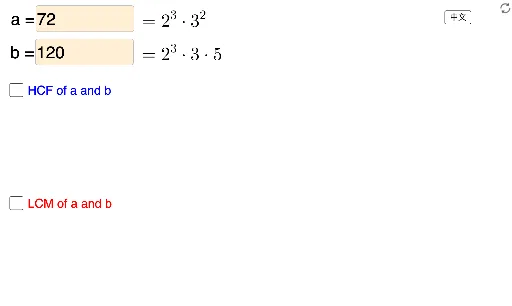
This GeoGebra example demonstrates a dynamic, visual method for calculating the Highest Common Factor (HCF/GCD) and the Least Common Multiple (LCM) of two positive integers using prime factorization. The core mathematical concepts involved are prime factorization, the properties of common factors, and the relationship between HCF and LCM. To construct this interactive tool, several GeoGebra commands and list objects are utilized: `Factors` is used to find the prime factors, while `Unique`, `Sort`, `Zip`, and `KeepIf` are employed to process and align the factor lists. The user interface is built using `Textfield`, `LaTeX`, and input boxes (`inputBox1`, `inputBox2`) to dynamically render the formulas and results in real-time. This applet is highly suitable for secondary school mathematics, introductory number theory courses, and self-study, providing an intuitive way for students to grasp the fundamental principles of divisibility.
GeoGebra Commands & Parameters
Unique(PrimeFactors[b]) → listBFactors(b) → M2Unique(PrimeFactors[a]) → listASort(Union[listA, listB]) → listPrimeZip(If[Defined[IndexOf[k, listB]], Element[M2, IndexOf[k, listB], 2], 0], k, listPrime) → listB2Factors(a) → M1Zip(If[Defined[IndexOf[k, listA]], Element[M1, IndexOf[k, listA], 2], 0], k, listPrime) → listA2Zip({k, Min[m, n]}, k, listPrime, m, listA2, n, listB2) → listHCFKeepIf(Element[k, 2] ≠ 0, k, listHCF) → listHCF'Zip(((Element[p, 1] * If[Element[p, 2] ≠ 1, (("^{" * Element[p, 2]) * "}")]) * If[{p} ≠ Last[M1], UnicodeToLetter[8901], ""]), p, M1) → listTextATextfield(a) → inputBox1LaTeX("=" + (Sum[listTextA])) → textAZip(((Element[p, 1] * If[Element[p, 2] ≠ 1, (("^{" * Element[p, 2]) * "}")]) * If[{p} ≠ Last[M2], UnicodeToLetter[8901], ""]), p, M2) → listTextBLaTeX("=" + (Sum[listTextB])) → textBTextfield(b) → inputBox2Zip(((Element[p, 1] * If[Element[p, 2] ≠ 1, (("^{" * Element[p, 2]) * "}")]) * If[{p} ≠ Last[listHCF'], UnicodeToLetter[8901], ""]), p, listHCF') → listTextHCFZip({k, Max[m, n]}, k, listPrime, m, listA2, n, listB2) → listLCMZip(((Element[p, 1] * If[Element[p, 2] ≠ 1, (("^{" * Element[p, 2]) * "}")]) * If[{p} ≠ Last[listLCM], UnicodeToLetter[8901], ""]), p, listLCM) → listTextLCMLaTeX("\text{HCF= }" + (If[listHCF' ≟ {}, "1", Sum[listTextHCF]])) → textHCFLaTeX("\text{LCM= }" + (Sum[listTextLCM])) → textLCM
AI Drawing Prompt Reference
Create an educational diagram showing the highest common factor (HCF) and least common multiple (LCM) of two positive integers. Include two input boxes for the numbers. Below each, display its prime factorization with exponents, e.g., 2^3×3^2. Then show a list of common prime factors with their minimum exponents for the HCF, and a list of all prime factors with their maximum exponents for the LCM. Finally, display the HCF and LCM as formulas. The layout should be clean and suitable for classroom use.
The prompt above was compiled from the original drawing commands and is for reference only.