
Haga's Theorem Demonstration
Loading the math board and drawing, please wait…
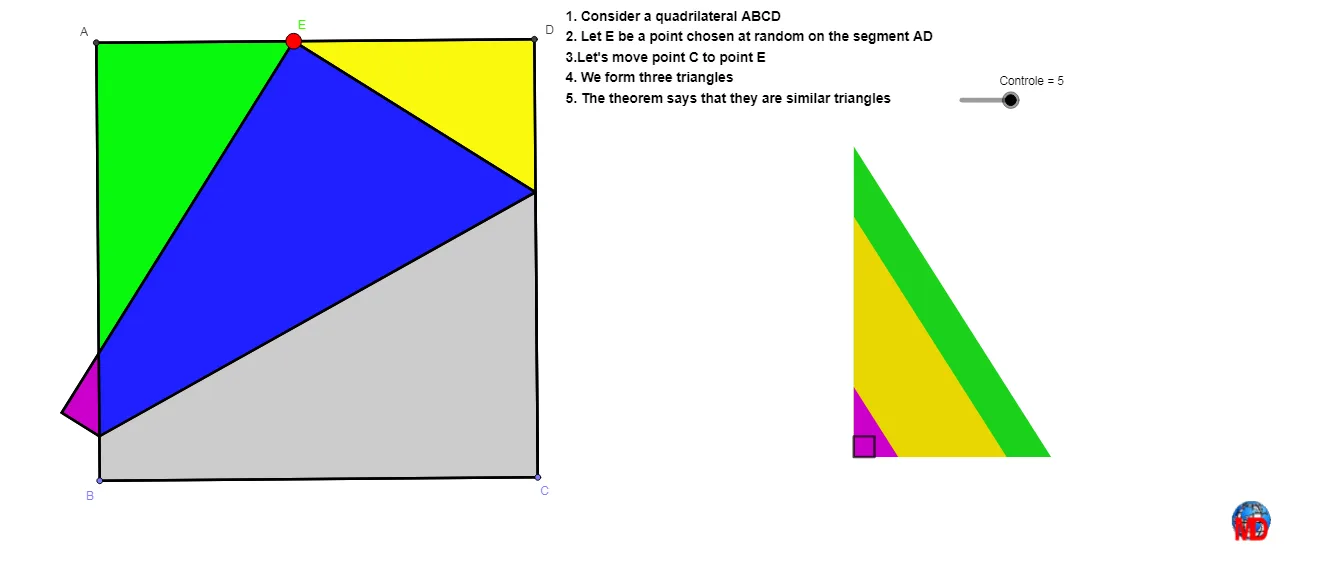
This example demonstrates the geometric figures and properties related to Haga's Theorem. It involves core mathematical concepts such as similar triangles, squares, rotations, vectors, and polynomial functions. The construction uses GeoGebra commands and objects like Point, Polygon, Segment, Vector, Midpoint, OrthogonalLine, Intersect, Mirror, Translate, and Angle. Suitable for high school and above mathematics learners to understand geometric theorem proofs and visualizations.
GeoGebra Commands & Parameters
Point(xAxis) → CPoint(yAxis) → BPolygon(B, C, 4) → poly1, a, b, c, d, D, APoint(c) → ESegment(E, C) → lVector(C, E) → uPoint(l) → CCMidpoint(CC, C) → C1OrthogonalLine(C1, u, xOyPlane) → eIntersect(a, e) → MIntersect(b, e) → FPolygon(M, CC, F) → poly2, i, h, fMirror(M, e) → H'Mirror(CC, e) → F'Mirror(F, e) → I'Polygon(H', F', I') → poly2', i', h', f'Intersect(e, d) → JPolygon(B, J, I', C) → poly3, a_1, j, i'_{1}, b_1Mirror(B, e) → IMirror(J, e) → GMirror(I', e) → I''Mirror(C, e) → B'Polygon(I, G, I'', B') → poly3', a', j', i'', b'Intersect(b', d) → HPolygon(G, I, H) → poly4, f_1, j'_1, a'_1Polygon(H, A, E) → poly5, e_1, f_2, d_1Polygon(E, D, F) → poly6, i_1, e_2, c_1Vector(A, O) → vIntersect(d, b') → QVector(Q, P) → wVector(E, R) → nTranslate(A, Vector[(Controle / 5 * v)]) → A'Translate(E, Vector[(Controle / 5 * n)]) → E'Translate(H, Vector[(Controle / 5 * w)]) → H'_{1}Angle(E', A', H'_{1}, xOyPlane) → κVector(D, O) → qTranslate(D, Vector[(Controle / 5 * q)]) → D'Vector(I'', S) → rVector(E, T) → sTranslate(I'', Vector[(Controle / 5 * r)]) → I'''Translate(E, Vector[(Controle / 5 * s)]) → E'_{1}Polygon(A', E', H'_{1}) → t1, h'_{1}, p, e'Polygon(I''', D', E'_{1}) → t2, e'_{1}, i''', d'Intersect(a', b') → UVector(H, V) → v_1Translate(H, Vector[(Controle / 5 * v_1)]) → H'_{2}Vector(J, W) → w_1Vector(I, O) → u_1Translate(I, Vector[(Controle / 5 * u_1)]) → I'_{1}Translate(J, Vector[(Controle / 5 * w_1)]) → J'Polygon(H'_{2}, I'_{1}, J') → t3, g_1, h'_{2}, i'_{2}Polygon(CC, I'', H') → t4, h_1, j_1, k_1Segment(CC, I') → g
AI Drawing Prompt Reference
Draw a triangle ABC, then take a point E on BC and connect CE to form vector u. Construct a perpendicular line to u at C intersecting AB at M and AC at F, forming quadrilateral MCFE. Mirror M, C, and F to get M', C', and F', then mirror quadrilateral MCFE to get M'CF'E'. Continue by mirroring B, J, I', and C to get I, G, I'', and B', forming quadrilateral I'GIB'. Finally, adjust points A, E, and H to form new triangle A'E'H', and mirror to get the final shape.
The prompt above was compiled from the original drawing commands and is for reference only.