
Guess the Centroid! – Interactive Estimation of Triangle's Center of Mass
Loading the math board and drawing, please wait…
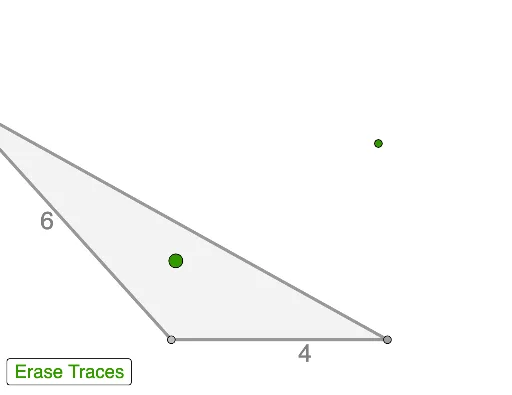
① This example presents a random triangle with its centroid hidden, inviting users to click where they estimate the centroid lies, then reveals the actual centroid for immediate comparison—a quick formative assessment tool. ② Core mathematical concepts include the centroid (barycenter) of a triangle, defined as the intersection of its three medians, which divides the triangle into six equal-area smaller triangles; related ideas include equilateral triangles, circumcircles, conic sections, and definite integrals. ③ Construction details: using GeoGebra commands Random, Midpoint, Rotate, Ray, Circle, Intersect, Segment, Polygon, PointIn, Line, Distance, and If; objects include points A, B, C, E, F, G, H, I, J, K and various lines, circles, and segments (a, b, c, d, e, f, g, k, l, m, n, p, q, r, s, t1–t9). ④ This is ideal for middle or high school geometry classes, quick classroom polls, or individual exploration to strengthen spatial intuition and understanding of centroid properties.
GeoGebra Commands & Parameters
Random(2, 6) → bMidpoint(A, B) → ERandom(30, 150) → aRotate(B, (a * π / 180), A) → B'Ray(A, B') → gRandom(2, 6) → cCircle(A, c) → dIntersect(d, g, 1) → CSegment(E, C) → sMidpoint(B, C) → ISegment(A, I) → qIntersect(s, q) → KPolygon(A, B, C) → t1_1, c_1, a_1, b_1PointIn(t1_1) → t2Line(C, B) → nLine(A, C) → mDistance(K, t2) → eSegment((0, 0), (b, 0)) → fMidpoint(b_1) → FMidpoint(a_1) → GMidpoint(f) → HLine(A, B) → lIf(e ≤ 0.1, "Nice job!", 0.1 < e ≤ 0.4, "Pretty good!", "Not quite.") → t8Midpoint(A, C) → JSegment(J, B) → r