
Gradients & Directional Derivatives
Loading the math board and drawing, please wait…
In collections
MATH1052-edX
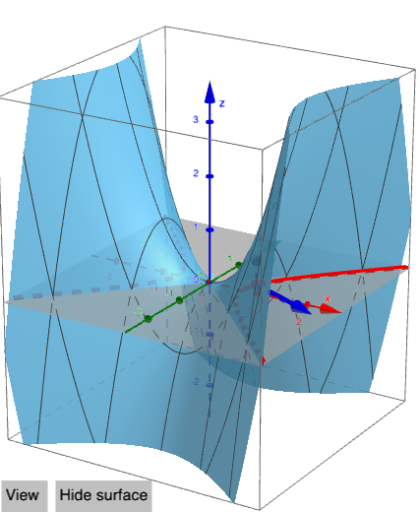
This example demonstrates the geometric and calculus concepts of gradients and directional derivatives using GeoGebra. Key mathematical concepts include derivatives, directional derivatives, and vector analysis. Construction involves using commands like Circle, Point, Derivative to create function graphs and compute gradient vectors. Suitable for high school students or college freshmen to understand basic calculus concepts.
GeoGebra Commands & Parameters
Circle(P, 1) → tPoint(t) → BDerivative(f(x, y), x) → fxDerivative(f(x, y), y) → fyVector(P, P + (fx(x(P), y(P)), fy(x(P), y(P)))) → gradImplicitCurve(f(x, y) - f(x(P), y(P))) → cImplicitCurve(f(x, y)) → dImplicitCurve(f(x, y) - 1) → gImplicitCurve(f(x, y) - 2) → hImplicitCurve(f(x, y) - 3) → iImplicitCurve(f(x, y) - 4) → jImplicitCurve(f(x, y) - 5) → kImplicitCurve(f(x, y) + 1) → lImplicitCurve(f(x, y) + 2) → mImplicitCurve(f(x, y) + 3) → nImplicitCurve(f(x, y) + 4) → oImplicitCurve(f(x, y) + 5) → pPlane(P, P', P + (fx(x(P), y(P)), fy(x(P), y(P)))) → rCurveCartesian(x(P) + (fx(x(P), y(P)) * w), y(P) + (fy(x(P), y(P)) * w), w, -100, 100) → qCurveCartesian(x(P') + (fx(x(P), y(P')) * Q), y(P') + (fy(x(P), y(P)) * Q), z(P') + (((fx(x(P), y(P)))^(2) + (fy(x(P), y(P)))^(2)) * Q), Q, -100, 100) → eTextfield(f) → InputBox1Textfield(Px) → InputBox2Textfield(Py) → InputBox3Length(grad) → normgradSegment(P'', P') → sFunction(f(x(P'), y(P')) + (fx(x(P'), y(P')) * (x - x(P'))) + (fy(x(P'), y(P')) * (y - y(P'))), x(P) - 1, x(P) + 1, y(P) - 1, y(P) + 1) → bRotate(B, θ, P) → AVector(P, A) → uOrthogonalLine(P, u, xOyPlane) → f_1OrthogonalPlane(P'', f_1) → vIntersectPath(v, f) → wIntersectPath(v, b) → a_1Angle(B, P, A) → βTextfield(θ) → InputBox4Point(zAxis) → CIntersect(zAxis, xAxis) → DVector(C, D) → u_1Point(yAxis) → EVector(E, D) → v_1Point(xAxis) → FVector(F, D) → w_1Element(list1, faces) → Selectedvector
AI Drawing Prompt Reference
Draw a 3D coordinate system with a surface representing a binary function and its contour lines (equally spaced from function value minus 5 to plus 5). Pick a point on the surface, show its gradient vector (pointing in the steepest ascent direction), and construct a plane through that point containing the gradient vector. Intersect this plane with the surface to get a curve, and also draw the tangent plane at that point. Take another point on the surface, connect the two points with a segment, and show a direction vector at the second point representing a directional derivative. Add input boxes to modify the function, point coordinates, and rotation angle, and display the length of the gradient vector.
The prompt above was compiled from the original drawing commands and is for reference only.