
GoGeometry Action 5!
Loading the math board and drawing, please wait…
In collections
Circles (Theorems)
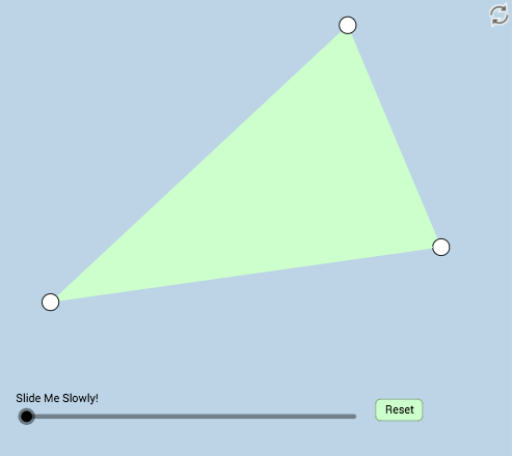
This dynamic and modifiable geometry problem illustration was posted by Antonino Gutierrez on Twitter. It demonstrates how to construct geometric figures using GeoGebra, involving concepts such as line segments, angles, circles, and polygons. Using commands like Line, Slope, PointIn, Angle, and Segment, users can intuitively understand geometric transformations and construction techniques. Suitable for middle school and above students and teachers.
GeoGebra Commands & Parameters
Line(A, B) → dSlope(d) → aPointIn(c) → CLine(A, C) → eLine(B, C) → fAngle(B, A, C) → αAngle(A, C, B) → βAngle(C, B, A) → γSegment(A, C) → gSegment(C, B) → hSegment(B, A) → iMin(list1) → jCircle(C, (0.2 * j)) → qCircle(A, (0.2 * j)) → pCircle(B, (0.2 * j)) → kIntersect(q, f, 2) → DIntersect(q, e, 1) → EIntersect(q, e, 2) → FIntersect(p, e, 2) → GIntersect(p, d, 1) → HIntersect(k, f, 2) → I_2Intersect(k, d, 2) → JIntersect(d, i) → KIntersect(d, i) → LIntersect(k, f, 1) → NIntersect(p, e, 1) → OIntersect(p, d, 2) → PAngle(D, C, E) → δAngle(O, A, P) → εAngle(J, B, I_2) → ηAngle(G, A, H) → θIncircle(A, B, C) → rCenter(r) → ILine(C, I) → lLine(A, I) → nLine(B, I) → sIntersect(e, s) → RIntersect(d, l) → SIntersect(f, n) → TPolygon(A, B, C) → poly1, c_1, a_1, b_1Rotate(D, δ / 2, C) → D'Angle(D, C, D') → κRotate(J, η / 2, B) → J'Angle(J, B, J') → λRay(C, D') → tRay(B, J') → e_1Rotate(O, ε / 2, A) → O'Angle(O, A, O') → ιRay(A, O') → d_1Segment(C, S) → f_1Segment(A, T) → g_1Segment(B, R) → h_1Intersect(q, f_1, 1) → UIntersect(q, f, 1) → VIntersect(p, g_1, 1) → WIntersect(k, h_1, 1) → ZCircleSector(C, E, U) → k_1CircleSector(A, P, W) → q_1CircleSector(B, I_2, Z) → p_1Dilate(C, If[0 < m ≤ 1, 1 - m, 0], S) → C'Segment(C, C') → i_1Rotate(k_1, If[1 < m ≤ 2, ((m - 1) * β / 2), β / 2], C) → r_1Dilate(B, If[2 < m ≤ 3, 3 - m, 0], R) → B'Segment(B, B') → j_1Rotate(p_1, If[3 < m ≤ 4, ((m - 3) * γ / 2), γ / 2], B) → s_1Dilate(A, If[4 < m ≤ 5, 5 - m, 0], T) → A'Segment(A, A') → l_1Rotate(q_1, If[5 < m ≤ 6, ((m - 5) * α / 2), α / 2], A) → t_1OrthogonalLine(I, f) → m_1OrthogonalLine(I, d) → n_1OrthogonalLine(I, e) → a_2Intersect(f, m_1) → MIntersect(d, n_1) → A_1Intersect(e, a_2) → B_1Segment(I, M) → b_2Circle(M, (0.2 * b_2)) → c_2Intersect(c_2, f, 1) → C_1Intersect(c_2, b_2, 1) → D_1Intersect(c_2, f, 2) → E_1CircleSector(M, E_1, D_1) → d_2Dilate(I, If[6 < m ≤ 7, 7 - m, 0], M) → Q'Segment(I, Q') → e_2Rotate(d_2, If[7.5 < m ≤ 8.5, ((m - 7.5) * π / 2), 1.5707963267948966], M) → f_2Segment(I, B_1) → g_2Segment(I, A_1) → h_2Circle(B_1, (0.2 * g_2)) → k_2Circle(A_1, (0.2 * h_2)) → p_2Intersect(k_2, e, 2) → F_1Intersect(k_2, g_2, 1) → G_1Intersect(k_2, e, 1) → H_1Intersect(p_2, d, 2) → I_1Intersect(p_2, h_2, 1) → J_1Intersect(p_2, d, 1) → K_1Dilate(I, If[8.5 < m ≤ 9.5, 9.5 - m, 0], B_1) → Q'_1Segment(I, Q'_1) → i_2CircleSector(B_1, H_1, G_1) → q_2CircleSector(A_1, I_1, J_1) → r_2Rotate(q_2, If[10 < m ≤ 11, ((m - 10) * π / 2), 1.5707963267948966], B_1) → s_2Dilate(I, If[11 < m ≤ 12, 12 - m, 0], A_1) → Q'_2Segment(I, Q'_2) → j_2Rotate(r_2, If[12.5 < m ≤ 13.5, ((m - 12.5) * π / 2), 1.5708], A_1) → t_2Angle(M, I, B_1) → ζAngle(B_1, I, A_1) → μAngle(A_1, I, M) → νRotate(I, If[14 < m ≤ 15, ((m - 14) * ζ), ζ], I) → Q'_3Rotate(Q', If[14 < m ≤ 15, ((m - 14) * ζ), ζ], I) → Q''Segment(Q'_3, Q'') → l_2Rotate(Q'_3, If[15 < m ≤ 16, ((m - 15) * μ), μ], I) → L_1Rotate(Q'', If[15 < m ≤ 16, ((m - 15) * μ), μ], I) → Q'''Segment(L_1, Q''') → m_2Rotate(A_1, If[16 < m ≤ 18, ((m - 16) * π), 6.28319], I) → M'Intersect(m_1, f) → QCircle(I, Q) → d_3Line(A, B) → n_2CircleArc(I, A_1, M') → c_3Segment(I, C) → f_3Intersect(d_3, f_3) → M_1,Segment(A, M_1) → g_3Segment(B, M_1) → h_3Segment(B_1, M) → i_3Intersect(h_3, i_3) → O_1Intersect(f_3, i_3) → P_1Dilate(I, If[20.5 < m ≤ 21.5, 21.5 - m, 0], M_1) → I'Segment(I, I') → j_3Dilate(M_1, If[21.5 < m ≤ 22.5, 22.5 - m, 0], C) → Q_1Segment(M_1, Q_1) → k_3Dilate(B, If[22 < m ≤ 23, 23 - m, 0], O_1) → B'_1Dilate(O_1, If[23 < m ≤ 24, 24 - m, 0], M_1) → S_1Dilate(P_1, If[26 < m ≤ 27, 27 - m, 0], O_1) → V_1Dilate(O_1, If[27 < m ≤ 28, 28 - m, 0], M) → W_1Midpoint(B_1, O_1) → Z_1Rotate(B_1, If[28 < m ≤ 29, ((m - 28) * π), π], Z_1) → A_2Line(C, I) → e_3OrthogonalLine(A, e_3) → f_4Intersect(e_3, f_4) → F_2Segment(B_1, M) → q_3Line(M_1, q_3) → r_3Segment(C, A) → s_3Segment(C, B) → t_3Intersect(r_3, s_3) → G_2Intersect(r_3, t_3) → H_2Dilate(B_1, If[19.5 < m ≤ 20.5, 20.5 - m, 0], M) → N_1Segment(B_1, N_1) → l_3Angle(I, F_2, A) → ξDilate(I, If[23 < m ≤ 24, 24 - m, 0], F_2) → I'_1Dilate(A, If[23 < m ≤ 24, 24 - m, 0], F_2) → A'_1Segment(I, I'_1) → m_3Segment(A, A'_1) → n_3Intersect(j_3, l_3) → R_1Segment(R_1, M_1) → p_3Circle(R_1, (0.5 * p_3)) → c_4Intersect(c_4, l_3, 2) → T_1Intersect(c_4, j_3, 2) → U_1CircleSector(R_1, T_1, U_1) → d_4Dilate(M_1, If[24 < m ≤ 25, 25 - m, 0], H_2) → B_2Dilate(M_1, If[24 < m ≤ 25, 25 - m, 0], G_2) → C_2Segment(M_1, B_2) → a_3Segment(M_1, C_2) → b_3Dilate(R_1, If[25 < m ≤ 26, 26 - m, 0], M_1) → D_2Vector(R_1, D_2) → uTranslate(d_4, u) → e_4Dilate(B, If[26 < m ≤ 27, 27 - m, 0], O_1) → B'_2Segment(B, B'_2) → g_4Dilate(O_1, If[27 < m ≤ 28, 28 - m, 0], M_1) → E_2Segment(O_1, E_2) → h_4Dilate(F_2, If[29 < m ≤ 30, 30 - m, 0], O_1) → J_2Segment(F_2, J_2) → i_4Dilate(O_1, If[30 < m ≤ 31, 31 - m, 0], H_2) → K_2Segment(O_1, K_2) → j_4