
GoGeometry Action 128! Dynamic and Modifiable Geometry-Calculus Illustration
Loading the math board and drawing, please wait…
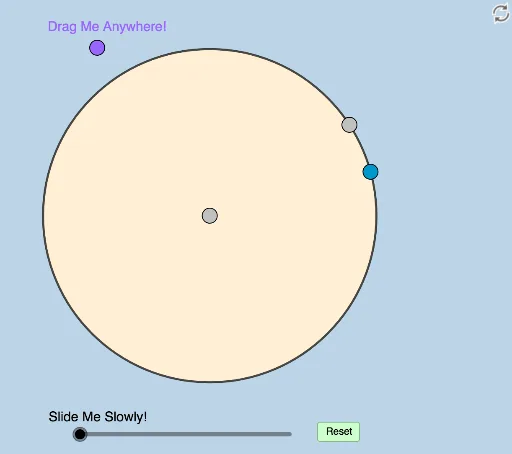
① This example is a dynamic and modifiable illustration of Problem 128 from GoGeometry, demonstrating a geometric configuration intertwined with calculus concepts, where dragging key points updates the figure in real time. ② Core mathematical concepts include upper and lower Riemann sums, derivatives, cosine functions, dilation (homothety), and fundamental geometric constructions such as midpoints, perpendicular lines, and angles. ③ Construction highlights: using GeoGebra commands like Point, Circle, Line, Intersect, Segment, Midpoint, OrthogonalLine, Angle, Dilate, Ray, Rotate, and CircleSector, the construction involves multiple points (A, B, C, D, E, F, G, H, I), circle c, segments, angles α, β, γ, δ, ε, and dilated images (A', E'), with Min and other functions controlling dynamic behavior. ④ Suitable for high school to early college students, this serves as an interactive tool for exploring the connection between geometry and calculus, ideal for classroom demonstrations or self-study to understand Riemann sum approximations, derivative interpretations, and effects of geometric transformations.
GeoGebra Commands & Parameters
Point(yAxis) → ACircle(A, B) → cPoint(c) → CLine(C, A) → fIntersect(c, f, 2) → DSegment(A, B) → gPointIn(a) → EMidpoint(E, A) → FCircle(F, E) → dIntersect(c, d, 1) → GIntersect(c, d, 2) → HLine(E, G) → hLine(E, H) → iSegment(A, G) → jSegment(A, H) → kOrthogonalLine(E, f) → lIntersect(f, l) → ISegment(I, G) → mSegment(I, H) → nAngle(C, I, H) → αAngle(G, I, D) → βDilate(C, If[0 < b ≤ 1, 1 - b, 0], D) → C'Segment(C, C') → pDilate(E, If[1 < b ≤ 2, 2 - b, 0], G) → E'Dilate(E, If[1 < b ≤ 2, 2 - b, 0], H) → E'_1Segment(E, E') → qSegment(E, E'_1) → rDilate(A, If[2 < b ≤ 3, 3 - b, 0], H) → A'Dilate(A, If[2 < b ≤ 3, 3 - b, 0], G) → A'_1Segment(A, A') → sSegment(A, A'_1) → tAngle(A, G, E) → γAngle(E, H, A) → δDilate(E, If[3 < b ≤ 4, 4 - b, 0], I) → E'_2Segment(E, E'_2) → eAngle(E, I, D) → εDilate(I, If[5 < b ≤ 6, 6 - b, 0], H) → I'Dilate(I, If[5 < b ≤ 6, 6 - b, 0], G) → I'_1Segment(I, I') → f_1Segment(I, I'_1) → g_1Ray(I, G) → h_1Ray(I, H) → i_1Segment(I, C) → j_1Segment(I, D) → k_1Min(j_1, k_1) → oCircle(I, (0.4 * o)) → c_1Intersect(c_1, f) → J, KRotate(K, If[7 < b ≤ 8, ((-(b - 7)) * β), (-β)], I) → K'CircleSector(I, K', K) → d_1Rotate(d_1, If[9 < b ≤ 10, ((-(b - 9)) * (π - β)), (-(π - β))], I) → e_1Line(I, H) → l_1Line(I, G) → m_1