
Geometric verification of the Pythagorean theorem with a right triangle
Loading the math board and drawing, please wait…
In collections
Open Middle: Pythagorean Theorem (1)
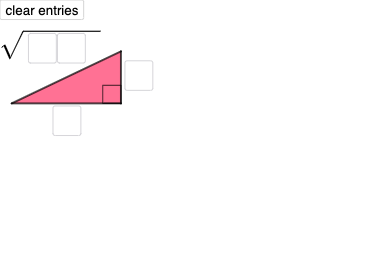
① This GeoGebra example (Open Middle) demonstrates how the Pythagorean Theorem emerges from an interactive geometric construction using a right triangle and its associated figures. ② Key concepts include right triangles, angle measurement/constraints (e.g., angles α, β, γ), circle-based constructions, and visually verifying the square-length relationship tied to the theorem. ③ Construction highlights: Textfield and multiple InputBox controls (InputBox1–InputBox6) to parameterize lengths/angles; Point, Circle, and Intersect to place circle(s) and compute their intersection points; Polygon and Segment to form the main triangle and auxiliary regions/edges; Angle and InteriorAngles to display and track interior angles; Max and If to evaluate quantities and apply conditional logic for which configuration is emphasized or how parameters are chosen. ④ Suitable for middle and high school students and for classroom exploration, inquiry-based learning, and demonstration of geometric reasoning.
GeoGebra Commands & Parameters
Textfield(a) → InputBox1Textfield(b) → InputBox2Textfield(c) → InputBox3Textfield(d) → InputBox4Textfield(f) → InputBox5Textfield(g) → InputBox6Polygon(A, B, C) → t1, c_1, a_1, b_1Segment(C, B) → hSegment(B, A) → iSegment(A, C) → jAngle(C, B, A) → αCircle(D, a) → ePoint(e) → ECircle(E, b) → kCircle(D, sqrt((10 * c) + d)) → pIntersect(k, p, 2) → FPolygon(D, E, F) → t2, f_1, d_1, e_1Segment(D, E) → lSegment(E, F) → mSegment(D, F) → nInteriorAngles(t2) → β, γ, δMax({β, γ, δ}) → oIf(Length[Mode[l1]] ≟ 0, "No digits repeat!", "Repeated digits exist.") → text4
AI Drawing Prompt Reference
Draw a right triangle with three vertices and display its three interior angles. Outside the triangle, construct a circle with a radius equal to one segment length, place a point on this circle, then draw a second circle centered at that point with a radius equal to another segment length. Also draw a larger circle with a third radius, intersecting the second circle at a point. Connect this intersection point with the first circle's center and the point on the circle to form a second triangle. Show all interior angles of this second triangle and identify the largest angle. Finally, include a text note that checks whether a given number combination has repeated digits.
The prompt above was compiled from the original drawing commands and is for reference only.