
Geometric Transformations Animation: Composite Rotations, Translations, and Dila
Loading the math board and drawing, please wait…
In collections
Congruence (CO) Cluster
Congruence (Vol 1)
Congruence (Vol 1) Over 80 Resources
Geometry (Congruence) Volume 1
CCSS High School: Geometry (Congruence) Volume 1 S N ATTAR
CCSS High School: Geometry (Congruence) Volume 1
CCSS High School: Geometry (Congruence) Volume 1
CCSS High School: Geometry (Congruence) Volume 1
CCSS High School: Geometry (Congruence) Volume 1
CCSS High School: Geometry (Congruence) Volume 1
CCSS High School: Geometry (Congruence) Volume 1
CCSS High School: Geometry (Congruence) Volume 1
CCSS High School: Geometry (Congruence) Volume 1
CCSS High School: Geometry (Congruence) Volume 1
CCSS High School: Geometry (Congruence) Volume 1
CCSS High School: Geometry (Congruence) Volume 1
CCSS High School: Geometry (Congruence) Volume 1
Congruence: Volume 1 - Chapter 1
Congruence V1C1 Check
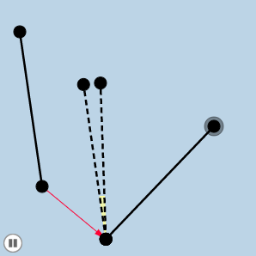
This GeoGebra example presents an animated geometric construction that demonstrates the combined effects of rotations, translations, and dilations on circles, segments, and polygons. The core mathematical concepts include congruence transformations (rotation, translation) and similarity transformations (dilation), as well as composition of transformations. The construction uses GeoGebra commands such as Segment, Point, Dilate, Vector, Line, Translate, Angle, Rotate, Circle, Intersect, and CircleSector to create multiple interrelated objects (A, B, C, D, E, F, G, H, I, etc.), with sliders or animation controls driving continuous changes. This is suitable for middle and high school geometry classes to visualize transformation properties, motion of figures, and dynamic geometric exploration.
GeoGebra Commands & Parameters
Segment(A, B) → aPoint(Circle[C, a]) → DSegment(C, D) → bDilate(A, If[0 < c ≤ 1, 1 - c, 0], D) → A'Vector(A, A') → uLine(A, D) → dVector(A, D) → vTranslate(A, v) → A'_2Translate(B, v) → B'_1Segment(A'_2, B'_1) → a'_1Angle(C, D, B'_1) → αTranslate(A, u) → A'_1Translate(B, u) → B'Segment(A'_1, B') → a'Rotate(A'_1, If[1 < c ≤ 2, ((-(c - 1)) * α), (-α)], A'_1) → ERotate(B', If[1 < c ≤ 2, ((-(c - 1)) * α), (-α)], A'_1) → B''Segment(E, B'') → a''Circle(D, 1) → eIntersect(e, a'_1, 1) → FIntersect(e, b, 1) → GIntersect(e, a'_1, 1) → HIntersect(e, a'', 1) → ICircleSector(D, I, H) → f