
Geometric Transformations and Polygon Construction Animation
Loading the math board and drawing, please wait…
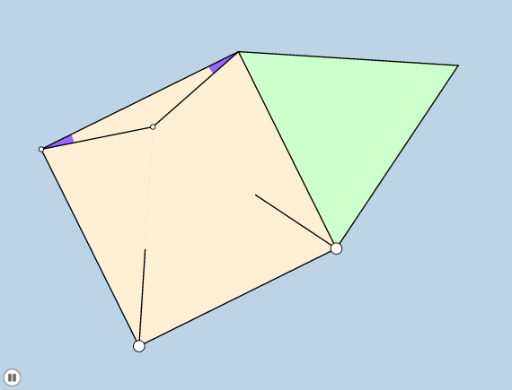
This example demonstrates geometric transformations and constructions involving equilateral triangles, squares, random experiments, and scalene triangles through animations. Key math concepts include angles, similar triangles, integral calculus, exponentials, vectors, and geometric transformations. It utilizes commands like Rotate, Dilate, Polygon, Midpoint, CircleArc, Point, Segment, Intersect, Circle, CircleSector, Vector, Translate, Line, Angle, Mirror, and Ray in GeoGebra for construction. Suitable for high school and above, focusing on geometric transformations, polygon construction, and probability & statistics applications.
GeoGebra Commands & Parameters
Rotate(A, If[1 < e ≤ 2, ((-(e - 1)) * π / 2), -1.5707963267948966], B_2) → A'_1Dilate(A, If[0 < e ≤ 1, 1 - e, 0], B_2) → A'Rotate(A', If[1 < e ≤ 2, ((-(e - 1)) * π / 2), -1.5707963267948966], B_2) → A''Polygon(A, B_2, 4) → poly1, a, b, c, d, C, DMidpoint(A, C) → VCircleArc(V, C, D) → g_2Point(g_2) → BSegment(C, B) → j_1Segment(A, B) → nRotate(A'', If[2 < e ≤ 3, ((-(e - 2)) * π / 2), -1.5707963267948966], C) → A'''Rotate(A'_1, If[2 < e ≤ 3, ((-(e - 2)) * π / 2), -1.5707963267948966], C) → RSegment(R, A''') → f''Intersect(n, f'') → ZSegment(B, Z) → l_1Segment(A, A') → fSegment(A'_1, A'') → f'Segment(A, B_2) → gSegment(B_2, C) → hSegment(C, D) → iSegment(D, A) → jCircle(B_2, (0.15 * f)) → pCircle(C, Radius[p]) → kCircle(A, (0.1 * j)) → qCircle(D, (0.1 * j)) → rSegment(A, C) → lSegment(D, B_2) → mIntersect(r, j, 1) → FIntersect(r, m, 1) → GIntersect(r, i, 1) → HIntersect(k, i, 1) → IIntersect(k, l, 1) → JIntersect(k, h, 1) → KIntersect(p, h, 1) → LIntersect(p, m, 1) → MIntersect(p, g, 1) → NIntersect(q, g, 1) → OIntersect(q, l, 1) → PIntersect(q, j, 1) → QCircleSector(B_2, L, N) → sRotate(R, If[3 < e ≤ 4, ((-(e - 3)) * π / 2), -1.5707963267948966], D) → R'Rotate(A''', If[3 < e ≤ 4, ((-(e - 3)) * π / 2), -1.5707963267948966], D) → SSegment(R', S) → f'''Dilate(B_2, If[4 < e ≤ 5, 5 - e, 0], C) → B'Vector(B_2, B') → uTranslate(s, u) → s'Rotate(s', If[5 < e ≤ 6, ((e - 5) * π / 2), 1.5707963267948966], C) → s''Dilate(C, If[6 < e ≤ 7, 7 - e, 0], D) → C'Vector(C, C') → vTranslate(s'', v) → s'''Rotate(s''', If[7 < e ≤ 8, ((e - 7) * π / 2), 1.5707963267948966], D) → tDilate(D, If[8 < e ≤ 9, 9 - e, 0], A) → D'Vector(D, D') → wTranslate(t, w) → t'Rotate(t', If[9 < e ≤ 10, ((e - 9) * π / 2), 1.5707963267948966], A) → t''Dilate(B_2, If[18 < e ≤ 19, 19 - e, 0], C) → B'_1Dilate(B_2, If[18 < e ≤ 19, 19 - e, 0], A) → B'_2Dilate(B_2, If[18 < e ≤ 19, 19 - e, 0], D) → B'_3Vector(B_2, B'_1) → v_1Vector(B_2, B'_3) → w_1Vector(B_2, B'_2) → i_1Circle(A, n - j_1) → h_2Dilate(B, If[10 < e ≤ 11, 11 - e, 0], C) → W'Dilate(B_2, If[13 < e ≤ 14, 14 - e, 0], B) → B'_4Vector(B_2, B'_4) → u_1Translate(s, u_1) → s'_1Line(B, f') → a_1Point(a_1) → UAngle(U, B, C) → αRotate(B, If[14 < e ≤ 15, ((-(e - 14)) * π / 2), ((-π)) / 2], B) → W'_2Rotate(W', If[14 < e ≤ 15, ((-(e - 14)) * π / 2), ((-π)) / 2], B) → W''Line(A, B_2) → h_1Angle(B, A, D) → βDilate(D, If[19 < e ≤ 20, 20 - e, 0], B) → D'_1Mirror(C, D) → C'_1Rotate(C, ((-π)) / 3, B_2) → C'_2Segment(B_2, C'_2) → f_1Segment(C, C'_2) → g_1Intersect(k, g_1, 1) → EIntersect(k, h) → T,CircleSector(C, T, E) → d_1Rotate(D, 15°, C) → D'_2Angle(D, C, D'_2) → γRay(C, D'_2) → k_1Rotate(C, (-(15°)), D) → C'_3Angle(C'_3, D, C) → δRay(D, C'_3) → m_1Intersect(k_1, m_1) → WRotate(B_2, If[10 < e ≤ 11, (((-π)) / 3 * (e - 10)), ((-π)) / 3], B_2) → A_1Rotate(C, If[10 < e ≤ 11, (((-π)) / 3 * (e - 10)), ((-π)) / 3], B_2) → C'_4Segment(A_1, C'_4) → h'Rotate(B_2, If[11 < e ≤ 12, (π / 3 * (e - 11)), π / 3], C) → B_1Rotate(C, If[11 < e ≤ 12, (π / 3 * (e - 11)), π / 3], C) → C'_5Segment(B_1, C'_5) → h'_1Rotate(E, If[12 < e ≤ 13, (((-π)) / 6 * (e - 12)), ((-π)) / 6], C) → E'CircleSector(C, E', E) → c_1Polygon(C, W, D) → poly2, d_2, c_2, w_2Polygon(A, W, D) → poly3, d_3, a_2, w_3Polygon(B_2, W, C) → poly4, c_3, b_2, w_4Polygon(A, B_2, W) → poly5, w_5, a_3, b_1Polygon(B_2, C'_2, C) → poly6, c_4, b_3, c'_2Midpoint(h') → C_1Segment(C, C_1) → n_1Intersect(k, n_1) → D_1,Dilate(C, If[12 < e ≤ 13, 13 - e, 0], C_1) → C'_6Segment(C, C'_6) → p_1Rotate(T, 15°, C) → T'Angle(T, C, T') → εRay(C, T') → q_1Intersect(h', q_1) → E_1Rotate(c_1, If[13.5 < e ≤ 14.5, (((-π)) / 6 * (e - 13.5)), ((-π)) / 6], C) → e_1Dilate(C, If[16 < e ≤ 17, 17 - e, 0], E_1) → C'_7Segment(C, C'_7) → r_1Rotate(D_1, If[16 < e ≤ 17, (((-π)) / 12 * (e - 16)), ((-π)) / 12], C) → F_1CircleSector(C, F_1, D_1) → s_1Rotate(s_1, If[17.5 < e ≤ 18.5, (((-π)) / 12 * (e - 17.5)), ((-π)) / 12], C) → t_1Rotate(t_1, If[19.5 < e ≤ 20.5, (((-π)) / 2 * (e - 19.5)), ((-π)) / 2], C) → e_2Dilate(C, If[21 < e ≤ 22, 22 - e, 0], D) → C'_8Vector(C, C'_8) → u_2Translate(e_2, u_2) → k_2Rotate(k_2, If[22 < e ≤ 23, ((π - π / 12) * (e - 22)), π - π / 12], D) → p_2Dilate(D, If[23 < e ≤ 24, 24 - e, 0], W) → D'_3Dilate(C, If[23 < e ≤ 24, 24 - e, 0], W) → C'_9Segment(C, C'_9) → f_2Segment(D, D'_3) → i_2Dilate(B_2, If[25 < e ≤ 26, 26 - e, 0], W) → G_1Dilate(A, If[25 < e ≤ 26, 26 - e, 0], W) → A'_2Segment(A, A'_2) → j_2Segment(B_2, G_1) → l_2Rotate(B_2, If[26.75 < e ≤ 27.75, (π / 2 * (e - 26.75)), π / 2], B_2) → H_1Rotate(C'_2, If[26.75 < e ≤ 27.75, (π / 2 * (e - 26.75)), π / 2], B_2) → I_1Rotate(C, If[26.75 < e ≤ 27.75, (π / 2 * (e - 26.75)), π / 2], B_2) → C'_{10}Polygon(H_1, I_1, C'_{10}) → poly6', c'_{10}, h_3, i_3
AI Drawing Prompt Reference
Create an animation demonstrating geometric transformations and constructions involving equilateral triangles, squares, random experiments, and scalene triangles. Show rotations, dilations, and polygon constructions to illustrate concepts like angles, similar triangles, and vectors. Animate a point rotating and scaling around a center, forming dynamic geometric patterns. Include multiple circles, arcs, and line segments connecting points, resulting in a complex geometric structure.
The prompt above was compiled from the original drawing commands and is for reference only.