
Geometric Proof of the Pythagorean Theorem via Area and Vector Construction
Loading the math board and drawing, please wait…
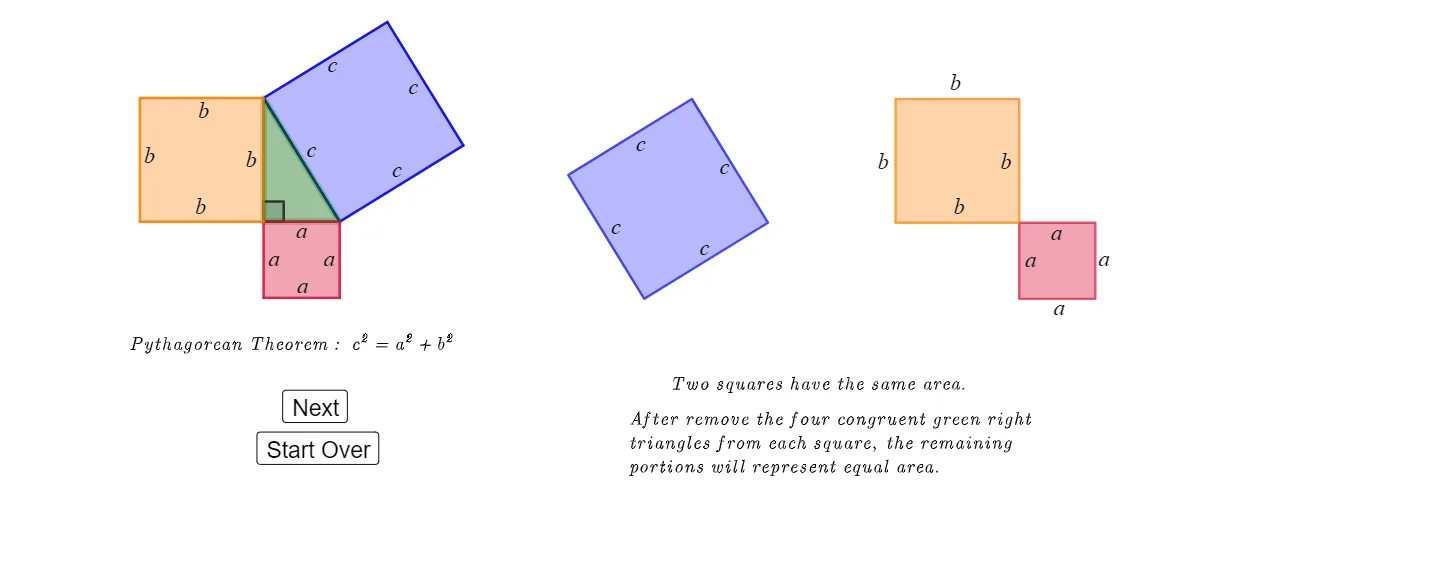
This example demonstrates the Pythagorean Theorem by constructing a coordinated set of polygons and vector-based placements around a right triangle, making the relationship between the squares on the legs and the square on the hypotenuse visually comparable. It centers on core ideas such as right triangles, area equivalence (through polygon construction and interior-angle structure), and the use of vectors and translations to align congruent parts of the figure. Construction highlights include using Point, Intersect, LineBisector, and Segment to locate key points and intersections; using Polygon to create the required regions and InteriorAngles to enforce the geometric angle relationships; employing Vector together with Translate to move and match parts consistently; and using Midpoint and Sequence for symmetric or systematic auxiliary point construction. The GeoGebra workflow references objects like poly1, poly2, poly3 for the main polygon regions, along with vector objects (e.g., f/g/h/i) and the supporting point framework (A, B, C, D, E, F, G, H, I, J, K, etc.). Suitable for middle and high school geometry lessons, visual proof activities, and student-driven exploration.
GeoGebra Commands & Parameters
Point(xAxis) → CIntersect(xAxis, yAxis) → BPoint(yAxis) → APolygon(A, C, 4) → poly1, f, g, h, i, D, EPolygon(A, B, C) → t1, c, a, bInteriorAngles(t1) → α, β, γPolygon(C, B, 4) → poly2, j, k, l, m, F, GPolygon(B, A, 4) → poly3, n, p, q, r, H, IVector(E, ((1 - g3) * E) + (g3 * J)) → uTranslate(poly1, u) → poly1'Translate(A, u) → A'Translate(B, u) → B'Translate(C, u) → C'Polygon(A', B', C') → t1', c', a', b'Midpoint(J, C') → KVector(C, ((1 - g1) * C) + (g1 * L)) → vTranslate(poly2, v) → poly2'Translate(poly3, v) → poly3'Translate(A, v) → A'_1Translate(B, v) → B'_1Translate(C, v) → C'_1Polygon(A'_1, B'_1, C'_1) → t1'_1, c'_1, a'_1, b'_1Midpoint(A'_1, L) → MSequence(Polygon[Rotate[A', (k * θ), K], Rotate[B', (k * θ), K], Rotate[C', (k * θ), K]], k, 1, 3) → l1Point(v) → NLineBisector(B'_1, A'_1) → sLineBisector(N, B'_1) → tIntersect(t, s) → PSequence(Polygon[Rotate[A'_1, (k * φ), Element[l2, k]], Rotate[B'_1, (k * φ), Element[l2, k]], Rotate[C'_1, (k * φ), Element[l2, k]]], k, 1, 3) → l3Point(l3) → UPoint(Circle[Z, a + c]) → A_1Segment(Z, A_1) → f_1Polygon(Z, A_1, 4) → poly4, g_1, h_1, i_1, j_1, B_1, C_1Sequence(((1 - g5) * Element[l5, k]) + (g5 * Element[l6, k]), k, 1, 4) → l8Polygon(l8) → q2Sequence(((1 - g5) * Element[l4, k]) + (g5 * Element[l6, k]), k, 1, 4) → l7Polygon(l7) → q1
AI Drawing Prompt Reference
Create a geometric proof diagram for the Pythagorean theorem. Start by drawing the three vertices of a right triangle. Construct three polygon regions associated with the triangle’s sides and use interior-angle structure to emphasize the triangle’s angle relationships. Then define vector-based translations to move one set of congruent polygon/triangle parts so they align consistently with another set, producing translated copies of the same shape. Use a midpoint as a rotation center and rotate the translated triangle and its polygon regions by evenly spaced angles to form a symmetric arrangement. Include an auxiliary point derived from a circle construction (using a specified center and radius) to create an additional polygon region. The final figure should visually compare the area blocks tied to the two legs with the area block associated to the hypotenuse.
The prompt above was compiled from the original drawing commands and is for reference only.