
Geometric Subtraction of Mixed Numbers
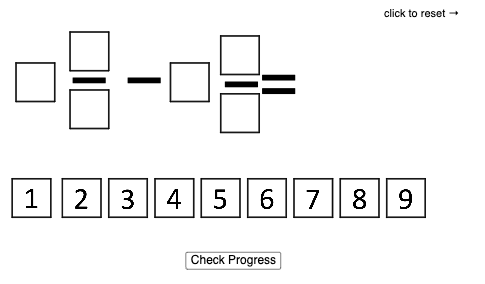
Loading the math board and drawing, please wait…
This example demonstrates how to subtract mixed numbers using a geometric interpretation based on partitioning and recombining regions (or corresponding lengths). It highlights the key ideas of decomposing a mixed number into its integer and fractional parts, using a borrow-like step to make subtraction consistent, and applying fraction equivalence to obtain the correct result. Construction-wise, the provided GeoGebra construction summary emphasizes Polygon-based geometry: multiple polygon objects (e.g., K_1, A2, A0, pic1, A1…A9, B, poly0, poly3, poly7, plus several supporting objects like f, g, h, i, j, k, l, m, E, G, n) are arranged so that the spatial relationship between the minuend and subtrahend visually encodes the arithmetic difference. The setup is suitable for middle-school students learning fraction operations and for classroom use where dynamic geometry helps build intuition for mixed-number subtraction.
GeoGebra Commands & Parameters
Polygon(A0, B, 4) → poly0, f, g, h, i, A, CPolygon(A3, H, 4) → poly3, j, k, l, m, E, GPolygon(A7, P, 4) → poly7, n, p, q, r, I, KPolygon(A1, D, 4) → poly1, s, t, a, b, M, OPolygon(A6, N, 4) → poly6, c, d, e, f_1, Q, SPolygon(A2, K_1, 4) → poly2, k_1, l_1, m_1, n_1, W, ZPolygon(A8, A8 + (2, 0), 4) → poly8, g_1, h_1, i_1, j_1, U, VPolygon(A9, T, 4) → poly9, p_1, q_1, r_1, s_1, A_1, B_1Polygon(A4, J, 4) → poly4, t_1, a_1, b_1, c_1, C_1, D_1Polygon(A5, L, 4) → poly5, d_1, e_1, f_2, g_2, E_1, F_1Polygon(G_1, H_1, 4) → poly10, h_2, i_2, j_2, k_2, I_1, J_1Polygon(G_2, H_2, 4) → poly11, h_3, i_3, j_3, k_3, I_2, J_2Polygon(G_3, H_3, 4) → poly12, h_4, i_4, j_4, k_4, I_3, J_3Polygon(G_4, H_4, 4) → poly13, h_5, i_5, j_5, k_5, I_4, J_4Polygon(G_5, H_5, 4) → poly14, h_6, i_6, j_6, k_6, I_5, J_5Polygon(G_6, H_6, 4) → poly15, h_7, i_7, j_7, k_7, I_6, J_6Polygon(G_7, H_7, 4) → poly16, h_8, i_8, j_8, k_8, I_7, J_7Polygon(G_8, H_8, 4) → poly17, h_9, i_9, j_9, k_9, I_8, J_8Polygon(G_9, H_9, 4) → poly18, h_{10}, i_{10}, j_{10}, k_{10}, I_9, J_9Polygon(G_{10}, H_{10}, 4) → poly19, h_{11}, i_{11}, j_{11}, k_{11}, I_{10}, J_{10}
AI Drawing Prompt Reference
Create a geometric diagram illustrating subtraction of mixed numbers. Arrange multiple rectangular or square regions, each subdivided into smaller unit squares to represent whole and fractional parts. Place the minuend and subtrahend regions side by side or overlapping, showing decomposition, borrowing, and recombination visually. Include several polygon blocks arranged neatly, with distinct shading or colors to differentiate parts, and highlight the resulting difference. Construct by first drawing the overall regions, then partitioning them into grids, and finally emphasizing the difference area.
The prompt above was compiled from the original drawing commands and is for reference only.