
Geometric Sequences Filling a Gap via Construction
Loading the math board and drawing, please wait…
In collections
Grade 12 PreCalculus BC
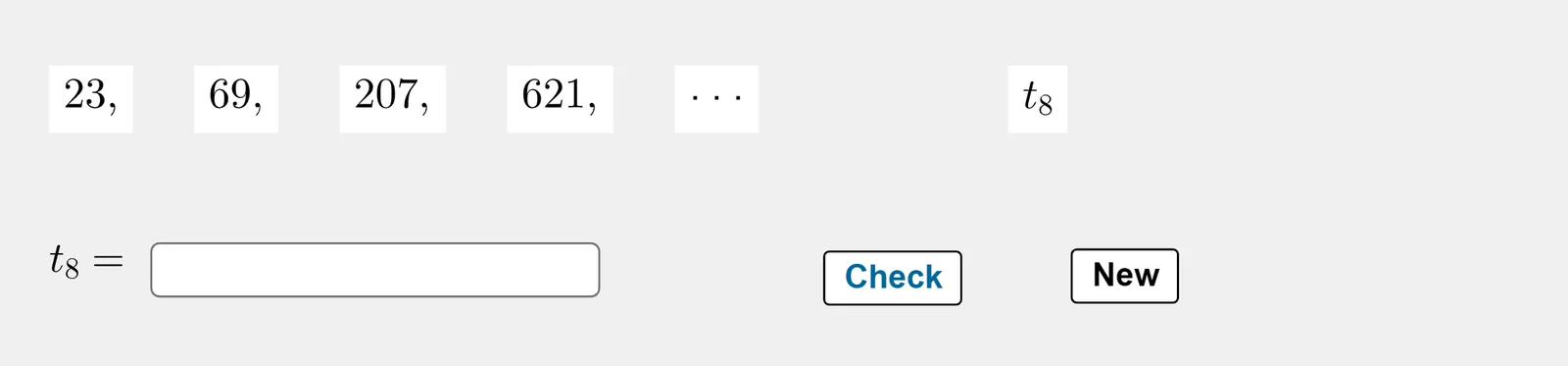
This example visualizes how a geometric sequence (equal-ratio recursion) can be used to “fill a gap” in a geometric figure: successive points and segments are generated so that their lengths follow a common ratio, producing a clear gap-filling pattern. Key math concepts include geometric sequences, first term and common ratio, ratio-based recursion, and the geometric interpretation behind geometric-series-like step scaling. Construction-wise, the GeoGebra setup uses RandomElement and Random for randomized choices, If for conditional logic, Textfield/InputBox1 for interactive parameter entry and on-screen labels, and AreEqual to control branching when conditions match. It creates lists such as rlist, a1list, a2list, a3list and parameter containers like a1, a2, a3, rR, rA, qlist; it also prepares step markers t1–t7 and annotation texts (text1–text8). Point objects P1–P7 are then used to place the geometric elements, while button1/button2 and other controls (e.g., ha, stans, nN, AnsW) manage iteration and the interactive visualization. Suitable for middle/high school learners and early university students for teaching sequence reasoning and geometric construction with ratio-driven patterns.
GeoGebra Commands & Parameters
RandomElement(a1list) → a1RandomElement(a2list) → a2RandomElement(a3list) → a3RandomElement(rlist) → rRIf(rR ≟ -0.2 ∨ rR ≟ 0.2, a3, If[rR ≟ -0.5 ∨ rR ≟ 0.5 ∨ rR ≟ 1.5, a2, a1]) → aARandom(7, 12) → nNTextfield(stans) → InputBox1AreEqual(InputBox1, AnsW) → correct
AI Drawing Prompt Reference
Draw a geometric figure showing a sequence of points and segments that fill a gap progressively, with distances between consecutive points following a geometric progression (constant ratio). Include multiple labeled points, an interactive input box for answer verification, and buttons to control iteration. The construction should visually demonstrate the recursive ratio-based scaling, with random initial terms and ratios generating different sequence patterns.
The prompt above was compiled from the original drawing commands and is for reference only.