
Geometric Puzzle Construction
Loading the math board and drawing, please wait…
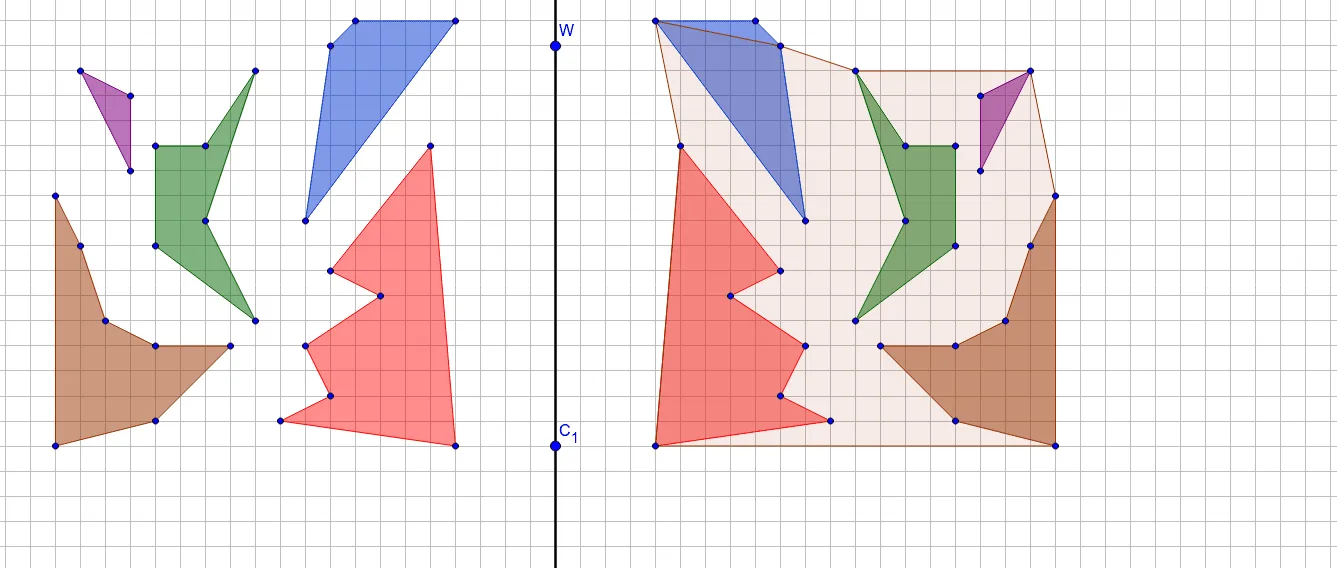
This example demonstrates the geometric construction and exploration of properties involving polygons, centroids, circumcircles, and transformations. Key math concepts include geometric mean, coordinate geometry, and geometric transformations. It is constructed using commands like Polygon, PointIn, Line, Mirror. Suitable for high school students and geometry enthusiasts to deepen their understanding of geometric constructions and transformations.
GeoGebra Commands & Parameters
Polygon(A, B, C, D, E, F, G) → poly1, a, b, c, d, e, f, gPolygon(I, J, K, L, M, N, O) → poly2, ı, j, k, l, m, n, oPolygon(Q, R, S, T, U, V) → poly3, q, r, s, t, u, vPolygon(Z, A_1, B_1) → t1, b_1, z_1, a_1Polygon(D_1, E_1, F_1, G_1) → q1, d_1, e_1, f_1, g_1PointIn(q1) → Pointq1PointIn(t1) → Pointt1PointIn(poly3) → Pointpoly3PointIn(poly2) → Pointpoly2PointIn(poly1) → Pointpoly1Line(W, C_1) → hMirror(A, h) → A'Mirror(B, h) → B'Mirror(C, h) → C'Mirror(D, h) → D'Mirror(E, h) → E'Mirror(F, h) → F'Mirror(G, h) → G'Polygon(A', B', C', D', E', F', G') → poly1', a', b', c', d', e', f', g'Mirror(I, h) → I'Mirror(J, h) → J'Mirror(K, h) → K'Mirror(L, h) → L'Mirror(M, h) → M'Mirror(N, h) → N'Mirror(O, h) → O'Polygon(I', J', K', L', M', N', O') → poly2', ı', j', k', l', m', n', o'Mirror(Q, h) → Q'Mirror(R, h) → R'Mirror(S, h) → S'Mirror(T, h) → T'Mirror(U, h) → U'Mirror(V, h) → V'Polygon(Q', R', S', T', U', V') → poly3', q', r', s', t', u', v'Mirror(Z, h) → Z'Mirror(A_1, h) → H_1Mirror(B_1, h) → I_1Polygon(Z', H_1, I_1) → t1', ı_1, z', h_1Mirror(D_1, h) → J_1Mirror(E_1, h) → K_1Mirror(F_1, h) → L_1Mirror(G_1, h) → M_1Polygon(J_1, K_1, L_1, M_1) → q1', j_1, k_1, l_1, m_1Polygon(K_1, M_1, Q', Z', F', E', M', N') → poly4, i, p, i_1, n_1, p_1, q_1, r_1, s_1
AI Drawing Prompt Reference
Draw a heptagon using seven points, then draw another heptagon using a different set of seven points. Create a line segment and use it as a mirror axis to reflect each vertex of the first heptagon to the opposite side, forming a new heptagon. Repeat this reflection process for the second heptagon, connecting the reflected vertices to create a new heptagon. Finally, connect the reflected vertices of both heptagons to form a complex geometric pattern.
The prompt above was compiled from the original drawing commands and is for reference only.