
Geometric Investigation of Trig Identities via Rotation and Reflection
Loading the math board and drawing, please wait…
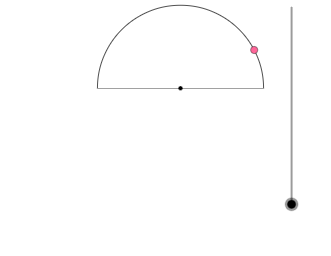
This GeoGebra example demonstrates trigonometric identities through geometric transformations. Core math concepts: definitions and relationships of sine and cosine functions, circle geometry, rotation and reflection symmetry, angle measurement. Construction details: Use Rotate command to generate rotated points (B'); apply Mirror for reflection transformations; draw circles and semicircles using Circle and Semicircle; construct polygons with Polygon to represent trigonometric relationships; measure angles with Angle command; implement vector translation via Vector and Translate; complete intersections and perpendicular lines using OrthogonalLine and Intersect. Suitable for high school trigonometry teaching, ideal for visualizing sinθ = cos(90°-θ) relationship and exploring rotational symmetry in geometry.
GeoGebra Commands & Parameters
Point(Ray[(0, 0), (1, 0)]) → BRotate(B, π / 4, A) → B'Circle(A, B) → cPoint(CircleArc[A, B, B']) → DRotate(D, Angle[B, A, D], A) → D'Segment(A, D') → fOrthogonalLine(D', xAxis) → gIntersect(g, xAxis) → EIntersect(h, yAxis) → FIntersect(g, h) → GMirror(D, yAxis) → D'_{1}OrthogonalLine(D'_{1}, xAxis) → iSegment(A, D'_{1}) → jIntersect(i, xAxis) → HPolygon(A, H, 4) → poly1, k, l, m, n, I, JPolygon(H, D'_{1}, 4) → poly2, p, q, r, s, K, LSemicircle(M, B) → dPolygon(A, E, G, F) → q1, a_1, e, g_1, f_1Line(D'_{1}, K) → tCircle(H, Distance[H, I]) → c_1Intersect(c_1, t, 2) → NDilate(A, If[0 < a ≤ 1, 1 - a, 0], D) → A'Dilate(A, If[0 < a ≤ 1, 1 - a, 0], D') → A'_{1}Segment(A, A'_{1}) → h_1Segment(A, A') → i_1Circle(A, 0.4) → d_1Intersect(d_1, i_1, 1) → OAngle(B, A, D) → αAngle(B, A, O) → βAngle(D, A, D') → γIntersect(d_1, xAxis, 2) → PRotate(P, If[2 < a ≤ 3, ((a - 2) * α), α], A) → P'CircleSector(A, P, P') → e_1Rotate(e_1, If[4 < a ≤ 5, ((a - 4) * α), α], A) → k_1Angle(D'_{1}, A, M) → δRotate(k_1, If[6 < a ≤ 7, ((a - 6) * (π - (2 * α))), π - (2 * α)], A) → p_1Dilate(A, If[7 < a ≤ 8, 8 - a, 0], D'_{1}) → A'_{2}Segment(A, A'_{2}) → j_1Dilate(D'_{1}, If[9 < a ≤ 10, 10 - a, 0], H) → QDilate(D', If[9 < a ≤ 10, 10 - a, 0], E) → D''Segment(D', D'') → l_1Segment(D'_{1}, Q) → m_1Dilate(A, If[9 < a ≤ 10, 10 - a, 0], E) → A'_{3}Dilate(A, If[9 < a ≤ 10, 10 - a, 0], H) → A'_{4}Segment(A, A'_{3}) → n_1Segment(A, A'_{4}) → q_1RotateText(text1, π / 2) → text2Rotate(H, If[13 < a ≤ 14, ((-(a - 13)) * π / 2), ((-π)) / 2], D'_{1}) → H'Segment(D'_{1}, H') → r_1Dilate(D'_{1}, If[14 < a ≤ 15, 15 - a, 0], H) → RVector(D'_{1}, R) → uTranslate(D'_{1}, u) → STranslate(H', u) → H''Segment(S, H'') → s_1Dilate(H, If[15 < a ≤ 16, 16 - a, 0], L) → H'_{1}Vector(H, H'_{1}) → vTranslate(D'_{1}, v) → TTranslate(Q, v) → Q'Segment(T, Q') → t_1Polygon(H, D'_{1}, H', L) → q2, h_2, d'_{1}, h', l_2Rotate(A, If[17 < a ≤ 18, ((-(a - 17)) * π / 2), ((-π)) / 2], H) → A'_{5}Segment(H, A'_{5}) → b_1Dilate(H, If[18 < a ≤ 19, 19 - a, 0], I) → H'_{2}Vector(H, H'_{2}) → wTranslate(A, w) → A'_{6}Translate(A'_{4}, w) → USegment(A'_{6}, U) → f_2Dilate(I, If[19 < a ≤ 20, 20 - a, 0], J) → I'Vector(I, I') → u_1Translate(H, u_1) → H'_{3}Translate(A'_{5}, u_1) → VSegment(H'_{3}, V) → g_2Angle(F, A, D') → εRotate(D', If[20 < a ≤ 21, ((-(a - 20)) * ε), (-ε)], A) → D''_{1}Segment(A, D''_{1}) → i_2Dilate(A, If[21 < a ≤ 22, 22 - a, 0], F) → A'_{7}Vector(A, A'_{7}) → v_1Translate(A, v_1) → A'_{8}Translate(A'_{3}, v_1) → WSegment(A'_{8}, W) → j_2Dilate(F, If[22 < a ≤ 23, 23 - a, 0], G) → F'Vector(F, F') → w_1Translate(A, w_1) → A'_{9}Translate(D''_{1}, w_1) → ZSegment(A'_{9}, Z) → k_2Polygon(A, E, G, F) → q3, a_2, e_2, g_3, f_3Dilate(D'_{1}, If[26 < a ≤ 27, 27 - a, 0], N) → A_1Vector(D'_{1}, A_1) → u_2Translate(H', u_2) → H''_{1}Polygon(H, A_1, H''_{1}, L) → q4, h_3, m_2, h''_{1}, l_3Line(H''_{1}, L) → n_2OrthogonalLine(H, n_2) → p_2Intersect(n_2, p_2) → B_1Dilate(L, If[28 < a ≤ 29, 29 - a, 0], B_1) → L'Vector(L, L') → v_2Translate(H''_{1}, v_2) → C_1Polygon(N, C_1, L', H) → q5, n_3, q_2, l', h_4Dilate(H, If[30 < a ≤ 31, 31 - a, 0], A) → H'_{4}Vector(H, H'_{4}) → w_2Angle(B_1, H, I) → ζTranslate(N, w_2) → N'Translate(C_1, w_2) → D_1Translate(L', w_2) → L''Translate(H, w_2) → H'_{5}Polygon(N', D_1, L'', H'_{5}) → q5', n', r_2, l'', h'_{5}Rotate(N', If[30 < a ≤ 31, ((a - 30) * ζ), ζ], H'_{5}) → N''Rotate(D_1, If[30 < a ≤ 31, ((a - 30) * ζ), ζ], H'_{5}) → E_1Rotate(L'', If[30 < a ≤ 31, ((a - 30) * ζ), ζ], H'_{5}) → L'''Rotate(H'_{5}, If[30 < a ≤ 31, ((a - 30) * ζ), ζ], H'_{5}) → F_1Polygon(N'', E_1, L''', F_1) → q5'', n'', s_2, l''', t_2Line(A, E) → b_2Circle(A, Distance[I, J]) → c_2Line(D', E) → d_2Intersect(c_2, d_2) → I_1, J_1Dilate(E, If[32 < a ≤ 33, 33 - a, 0], J_1) → E'Vector(E, E') → u_3Translate(G, u_3) → G'Polygon(A, E', G', F) → q6, a_3, e', g', f_4Line(A, J_1) → i_3OrthogonalLine(G', i_3) → j_3Intersect(i_3, j_3) → G_1Dilate(J_1, If[34 < a ≤ 35, 35 - a, 0], G_1) → H_1Vector(J_1, H_1) → v_3Translate(A, v_3) → A'_{10}Polygon(F, G', H_1, A'_{10}) → q7, f_5, k_3, m_3, a'_{10}Dilate(G_1, If[36 < a ≤ 37, 37 - a, 0], J) → K_1Line(G', f_2) → p_3Point(p_3) → N_1Angle(F, G', N_1) → ηDilate(G', If[36 < a ≤ 37, 37 - a, 0], J) → G''Vector(G', G'') → w_3Translate(F, w_3) → F'_{1}Translate(G', w_3) → G''_{1}Translate(H_1, w_3) → L_1Translate(A'_{10}, w_3) → M_1Polygon(F'_{1}, G''_{1}, L_1, M_1) → q7', f'_{1}, g''_{1}, q_3, r_3Rotate(G''_{1}, If[36 < a ≤ 37, ((a - 36) * η), η], G''_{1}) → P_1Rotate(L_1, If[36 < a ≤ 37, ((a - 36) * η), η], G''_{1}) → Q_1Rotate(M_1, If[36 < a ≤ 37, ((a - 36) * η), η], G''_{1}) → R_1Rotate(F'_{1}, If[36 < a ≤ 37, ((a - 36) * η), η], G''_{1}) → O_1Rotate(G''_{1}, If[36 < a ≤ 37, ((a - 36) * η), η], G''_{1}) → S_1Rotate(L_1, If[36 < a ≤ 37, ((a - 36) * η), η], G''_{1}) → T_1Rotate(M_1, If[36 < a ≤ 37, ((a - 36) * η), η], G''_{1}) → U_1Polygon(O_1, S_1, T_1, U_1) → q7'', o_1, s_3, t_3, b_3Line(D'_{1}, H') → c_3Line(H''_{1}, B_1) → d_3Line(H, d_3) → e_3Line(A, F) → g_4Line(F, G') → i_4Line(J_1, G_1) → j_4Segment(A, B) → k_4Segment(A, M) → l_4
AI Drawing Prompt Reference
Draw a unit circle and a right triangle, demonstrating the relationship between sine and cosine functions through rotation and reflection. Start by drawing point B, then rotate B around point A to get B', draw circle c, take point D on the circle and rotate it to get D', draw line segments f and g, find intersection points E and H, mirror and rotate D' to get D'₁, draw polygons and semicircles, and finally generate new points and line segments through a series of rotations and reflections to show the symmetry and periodicity of trigonometric functions.
The prompt above was compiled from the original drawing commands and is for reference only.