
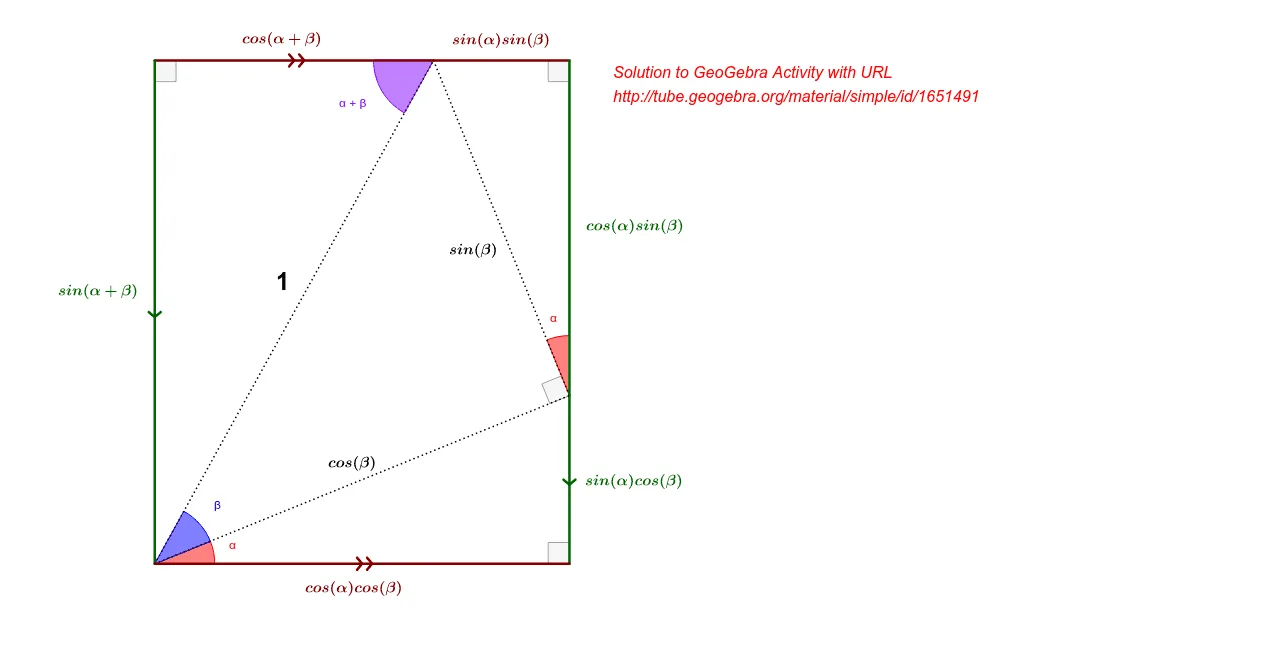
Geometric Discovery of sin(a+b) and cos(a+b) (Solution)
Loading the math board and drawing, please wait…
In collections
Trigonometric Identities
This GeoGebra example demonstrates a geometric discovery and solution for the addition formulas sin(a+b) and cos(a+b). It uses rays, points, angles, orthogonal lines, intersections, rotations, lines, and segments to build auxiliary right triangles and projection relationships, revealing how the sine and cosine of a sum can be expressed through component angles. The construction emphasizes trigonometric identities, angle composition, perpendicular projections, and dynamic geometric reasoning. It is suitable for high school trigonometry lessons, inquiry-based mathematics activities, GeoGebra demonstrations, and visual proofs of addition formulas.
GeoGebra Commands & Parameters
Ray(A, C) → aRay(A, D) → cIntersect(a, b) → EOrthogonalLine(E, a) → dAngle(B, A, E) → αAngle(E, A, D) → βPoint(d) → FAngle(F, E, A) → γRotate(D, α, E) → D'Intersect(d, c) → GLine(G, xAxis) → eIntersect(f, yAxis) → HIntersect(e, f) → IIntersect(b, e) → JSegment(G, E) → gSegment(I, G) → hSegment(G, J) → iSegment(J, E) → jSegment(E, B) → kSegment(I, A) → lSegment(A, E) → mSegment(A, G) → nIntersect(b, c) → MAngle(M, E, G) → δSegment(A, B) → qAngle(I, G, A) → εAngle(A, I, G) → ζAngle(G, J, E) → ηAngle(E, B, A) → θ