
Geometric construction with a circle and chords: building a computation model vi
Loading the math board and drawing, please wait…
In collections
Poorly Drawn Parallelograms 3
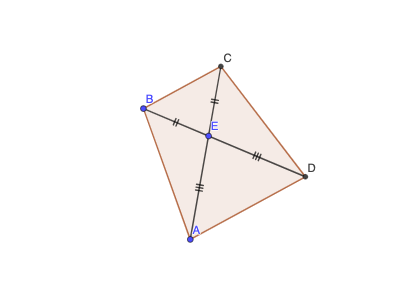
This GeoGebra example demonstrates how to generate essential geometric entities—constructed from a circle, lines, and their intersection points—and then combine them into segments and polygons to support computable quantities (e.g., geometric measures or visual verification of interval-based estimates). The core math ideas include circle-and-chord geometry, point determination through line–circle intersections, segment and polygon construction, and deriving relationships from the constrained configuration. Construction highlights: it uses Circle to create the circle, Line to draw straight lines that interact with the circle or act as boundaries, Intersect to locate key intersection points, Segment to connect important points with line segments, and Polygon to assemble the resulting shape. The construction objects include points such as E, B, C, D, and A, along with geometric elements represented by labels like c, d, f, g and auxiliary points/variables such as a, h, i, j, k that feed the final configuration. Suitable for secondary school through early undergraduate levels, especially for teaching geometric construction and using geometry to support ideas behind interval estimation (e.g., Riemann-sum style visualization).
GeoGebra Commands & Parameters
Circle(E, B) → cCircle(E, A) → dLine(B, E) → fLine(A, E) → gIntersect(c, g, 2) → CIntersect(d, f, 2) → DPolygon(B, C, D, A) → q1, b, c_1, d_1, aSegment(B, E) → hSegment(E, C) → iSegment(E, D) → jSegment(E, A) → k
AI Drawing Prompt Reference
Draw two concentric circles sharing a common center. From the center, draw two radial lines to two outer points on the circles. Mark the intersection of the larger circle with one radial line and the intersection of the smaller circle with the other radial line. Connect the two outer points and these two intersection points to form a quadrilateral. Then draw four segments from the center to each of the two outer points and the two intersection points, creating a clear geometric figure that illustrates circle-chord relationships and polygon construction.
The prompt above was compiled from the original drawing commands and is for reference only.