
Geometric Construction for Multiplying Fractions
Loading the math board and drawing, please wait…
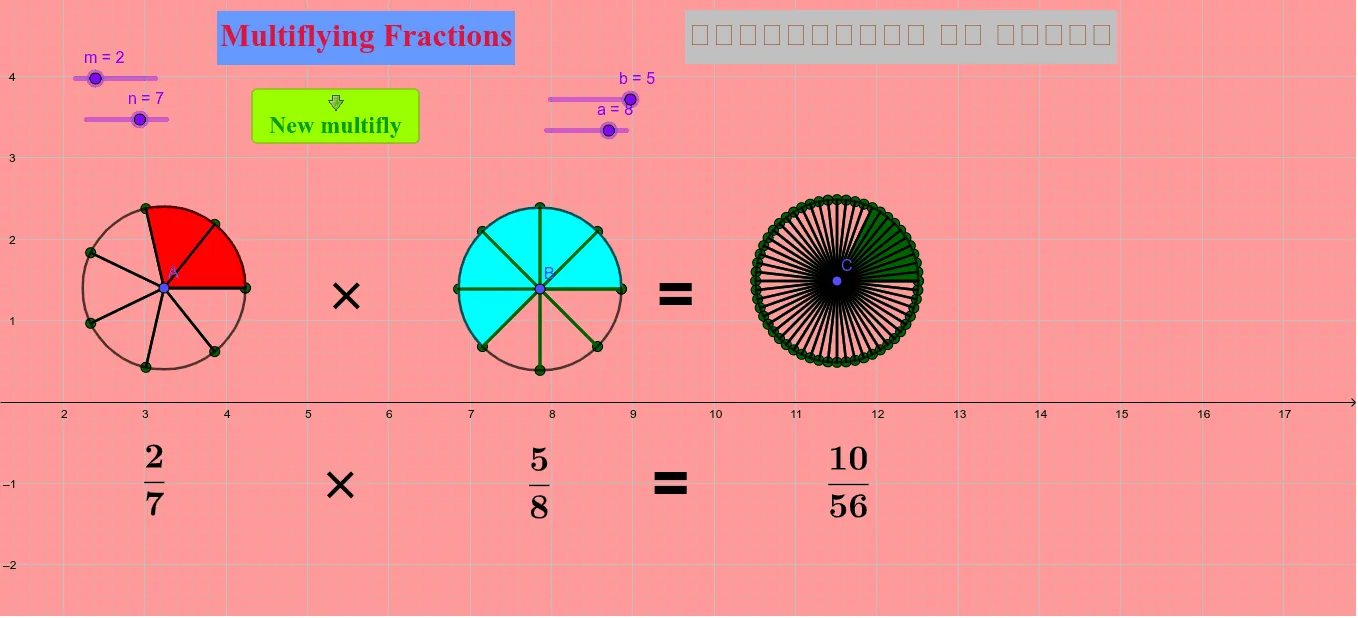
This example demonstrates how to visualize fraction multiplication by translating the algebraic operation into geometric proportion and length relationships. Instead of only computing symbolically, it uses intersections of lines and circle-based constructions to make the product of two fractions correspond to a measurable or constructible segment in the figure. The core math concepts are fraction representation, proportional reasoning, and geometric correspondences (often relying on similarity/linear mapping ideas). In GeoGebra terms, the construction is driven by commands such as Sequence and Circle, generating key points and auxiliary circles, while line objects (e.g., L, L1–L5, L8–L13) connect and locate the relevant points. The figure also includes multiple labeled objects and text annotations (e.g., text1–text7 and other text fields) and an interactive control (button1), helping learners see how the constructed points encode the multiplication result. Suitable for middle and high school teaching, conceptual instruction on fraction arithmetic, and geometry–algebra integration activities.
GeoGebra Commands & Parameters
Sequence(Segment[C, C + ℯ^((((2 * π) * ί) * t))], t, 0, 1, 1 / f) → L11Circle(A, 1) → cSequence(A + ℯ^((2 * (π * (ί * t)))), t, 0, 1, 1 / n) → LSequence(Segment[A, A + ℯ^((((2 * π) * ί) * t))], t, 0, 1, 1 / n) → L1Sequence(CircleSector[A, Element[L, t], Element[L, t + 1]], t, 1, m) → L2Circle(B, 1) → dSequence(B + ℯ^((((2 * π) * ί) * t)), t, 0, 1, 1 / a) → L3Sequence(Segment[B, B + ℯ^((((2 * π) * ί) * t))], t, 0, 1, 1 / a) → L4Sequence(CircleSector[B, Element[L3, t], Element[L3, t + 1]], t, 1, b) → L5Sequence(Segment[B, B + ℯ^((((2 * π) * ί) * t))], t, 0, 1, 1 / a) → L6Sequence(Segment[A, A + ℯ^((((2 * π) * ί) * t))], t, 0, 1, 1 / n) → L7Circle(C, 1) → eSequence(Segment[B, B + ℯ^((((2 * π) * ί) * t))], t, 0, 1, 1 / a) → L8Sequence(Segment[B, B + ℯ^((((2 * π) * ί) * t))], t, 0, 1, 1 / a) → L9Sequence(CircleSector[C, Element[L10, t], Element[L10, t + 1]], t, 1, g) → L12Sequence(Segment[C, C + ℯ^((((2 * π) * ί) * t))], t, 0, 1, 1 / f) → L13
AI Drawing Prompt Reference
Draw three unit circles with distinct centers. Divide each circle into equal arcs using points on the circumference, and connect each center to its division points with radial segments. In the first circle, shade a sector spanning the first few divisions; in the second circle, shade a sector spanning the first few divisions; in the third circle, shade a sector spanning the first few divisions. All division points are evenly spaced on the circles, and sectors are formed by adjacent points and the center. Include text labels and a button for interactive exploration.
The prompt above was compiled from the original drawing commands and is for reference only.