
Geometric Construction and Properties of Ellipse Foci
Loading the math board and drawing, please wait…
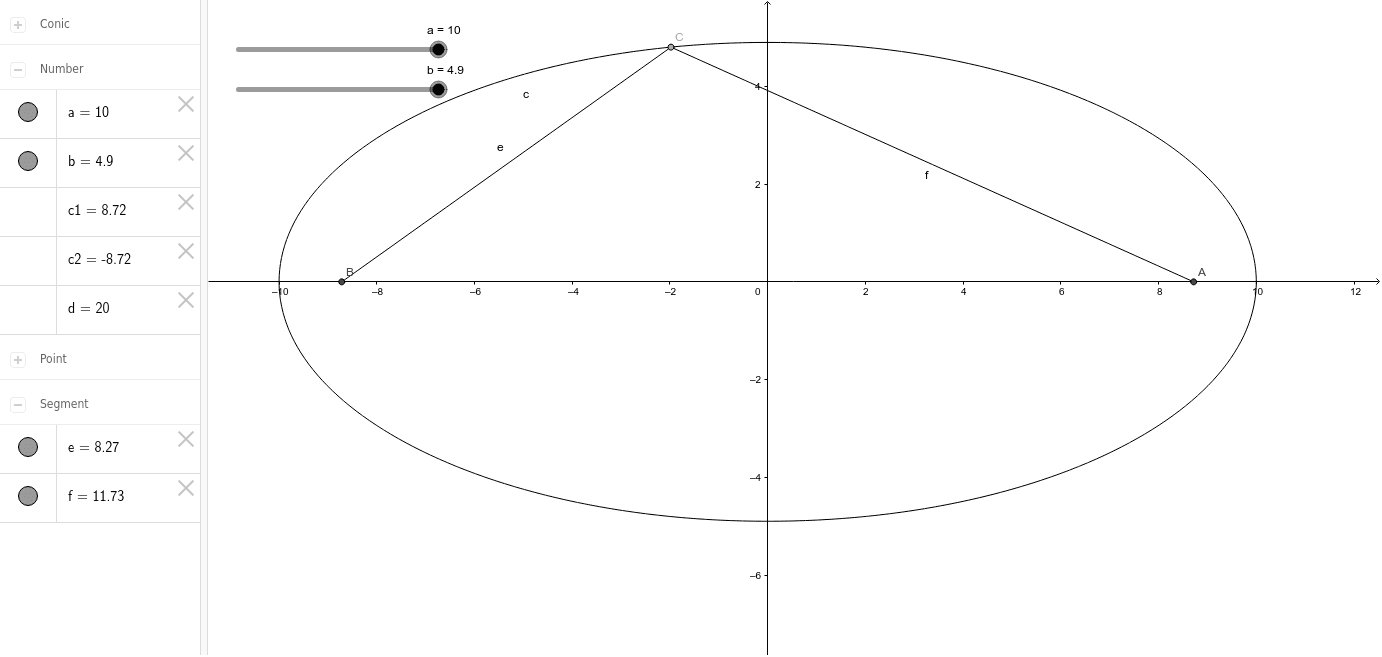
This GeoGebra example dynamically illustrates the geometric construction and properties of the foci of an ellipse. It demonstrates the fundamental definition of an ellipse—that the sum of distances from any point on the ellipse to the two foci is constant—by constructing the ellipse and its foci using basic objects like points and segments. The core mathematical concepts include the definition of an ellipse, foci, major and minor axes, and symmetry. The construction uses the Point command to create a moving point on the ellipse and the two foci, and the Segment command to connect the moving point to each focus, forming two segments. By dragging the moving point, students can observe that the sum of the two segment lengths remains constant, thereby verifying the ellipse definition. This example is suitable for middle school and high school conic sections lessons, as well as introductory university analytic geometry, helping learners grasp the geometric meaning and properties of ellipse foci.
GeoGebra Commands & Parameters
Point(c) → CSegment(C, B) → eSegment(C, A) → f