
Geometric Construction and Fitting
Loading the math board and drawing, please wait…
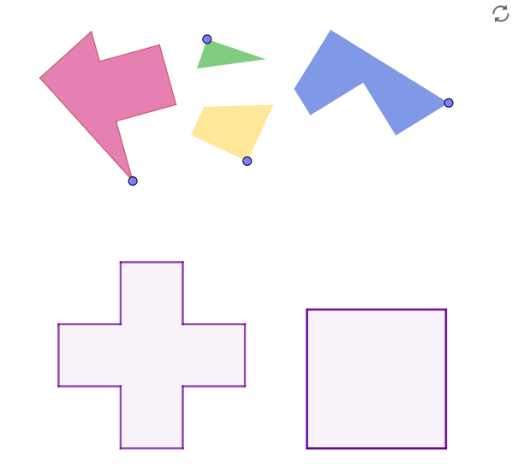
This example demonstrates the construction of geometric figures like equilateral triangles, median lines, and squares using basic elements such as points, line segments, and circles, exploring their relationships. Core mathematical concepts include line segments, equilateral triangles, median lines, squares, and coordinate geometry. The construction involves GeoGebra commands and objects like Point, Segment, Circle, OrthogonalLine, Intersect, Polygon, and Midpoint. It is suitable for high school mathematics teaching, focusing on geometric construction practice and concept understanding.
GeoGebra Commands & Parameters
Point(Circle[A, r]) → BSegment(A, B) → fCircle(A, r) → cCircle(A, (2 * r)) → dCircle(A, (3 * r)) → eOrthogonalLine(A, f) → gIntersect(c, g, 2) → CIntersect(d, g, 2) → DIntersect(e, g, 2) → EOrthogonalLine(C, g) → hOrthogonalLine(D, g) → iOrthogonalLine(E, g) → jCircle(C, r) → kCircle(C, (2 * r)) → pIntersect(k, h, 2) → FIntersect(k, h, 1) → IIntersect(p, h, 1) → JOrthogonalLine(F, h) → lOrthogonalLine(I, h) → mOrthogonalLine(J, h) → nIntersect(n, i) → GIntersect(j, m) → HIntersect(i, m) → KIntersect(i, l) → LPolygon(A, C, I, B, F, L, D, E, H, K, G, J) → poly1, a, j_1, i_1, b, c_1, f_1, l_1, d_1, e_1, h_1, k_1, g_1Segment(C, G) → qOrthogonalLine(C, q) → sIntersect(s, l_1) → MIntersect(s, f) → NPolygon(M, C, G, K, H, E, D) → poly2, m_1, c_2, g_2, k_2, h_2, e_2, d_2Polygon(N, C, G, J, I, B) → poly3, n_1, c_3, g_3, j_2, i_2, b_1Polygon(C, A, N) → poly4, n_2, c_4, a_1Polygon(L, F, C, M) → poly5, l_2, f_2, c_5, m_2Point(Circle[P, q]) → QSegment(P, Q) → tOrthogonalLine(P, t) → p_1Circle(P, m_1) → q_1Intersect(q_1, p_1, 2) → RSegment(R, P) → r_1Segment(R, Q) → s_1OrthogonalLine(P, s_1) → t_1Intersect(t_1, s_1) → SCircle(S, r) → p_2Intersect(p_2, s_1, 1) → TPolygon(S, T, 4) → poly6, q_2, r_2, s_2, t_2, U, VPolygon(P, R, S, V, U, T, Q) → poly7, p_3, r_3, s_3, v, u, t_3, q_3Circle(W, c_3) → d_3Point(d_3) → ZSegment(W, Z) → a_2OrthogonalLine(W, a_2) → b_2Circle(W, n_1) → e_3Intersect(e_3, b_2, 1) → A_1Segment(W, A_1) → f_3Midpoint(a_2) → B_1Circle(B_1, W) → h_3Circle(W, (2 * r)) → k_3Intersect(h_3, k_3, 1) → C_1Midpoint(W, C_1) → D_1Segment(W, C_1) → i_3OrthogonalLine(D_1, i_3) → j_3Circle(D_1, r) → d_4Intersect(d_4, j_3, 1) → E_1Polygon(W, Z, C_1, D_1, E_1, A_1) → poly8, w, z_1, c_6, d_5, e_4, a_3Point(Circle[F_1, r]) → G_1Segment(F_1, G_1) → l_3OrthogonalLine(G_1, l_3) → m_3Circle(G_1, r) → f_4Intersect(f_4, m_3, 2) → H_1Segment(L, M) → n_3OrthogonalLine(F_1, l_3) → b_3Circle(F_1, n_3) → g_4Intersect(g_4, b_3, 2) → I_1Segment(I_1, H_1) → h_4Polygon(I_1, F_1, G_1, H_1) → poly9, i_4, f_5, g_5, h_5Point(Circle[J_1, r]) → K_1Segment(J_1, K_1) → j_4OrthogonalLine(K_1, j_4) → k_4Segment(A, N) → l_4Circle(K_1, Segment[A, N]) → p_4Intersect(p_4, k_4, 2) → L_1Polygon(J_1, L_1, K_1) → poly10, k_5, j_5, l_5Point(Circle[M_1, c_3]) → N_1Segment(M_1, N_1) → m_4Polygon(M_1, N_1, 4) → poly11, n_4, q_4, r_4, s_4, O_1, P_1