
Geometric Area Reflection Demo
Loading the math board and drawing, please wait…
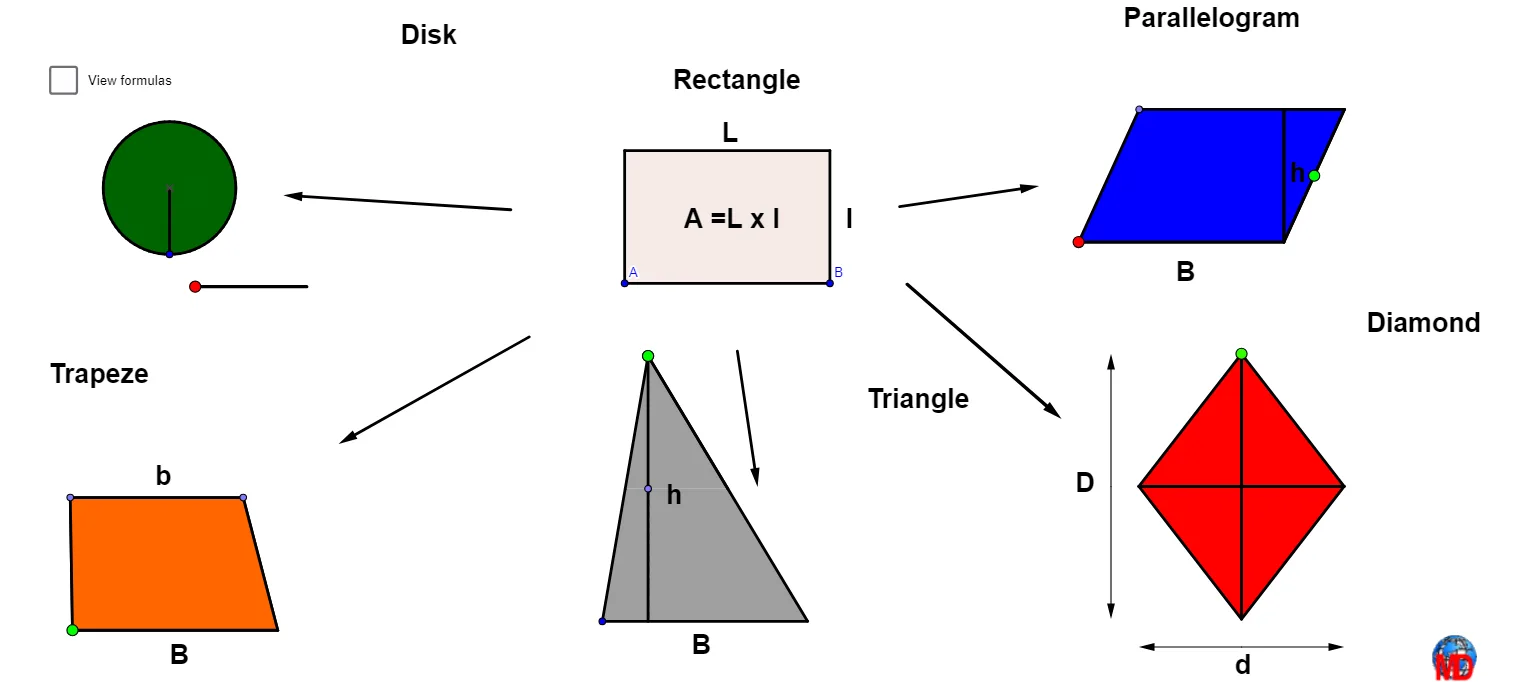
This example demonstrates exploring the change in geometric area through reflection transformations. It involves core math concepts like area calculation, reflection, analytical geometry, and trigonometry. Construction highlights include commands/objects like Line, Point, Vector, Translate, OrthogonalLine, Intersect, Segment, Polygon, Midpoint, Circle, Mirror, Semicircle, Angle, Rotate, CircumcircleArc, Sequence, Min, Max from GeoGebra. Suitable for high school and above for learning geometric transformations and area calculations visually.
GeoGebra Commands & Parameters
Line(A, xAxis) → b_3Point(b_3) → BVector(A, O) → eTranslate(B, e) → B'_4Line(A, B) → a_6OrthogonalLine(B, a_6) → cTranslate(C, e) → C'_4OrthogonalLine(C, c) → dOrthogonalLine(A, a_6) → bIntersect(d, b) → DTranslate(D, e) → D'_4Segment(E, E + (2, 0)) → aVector(A, E_2) → uVector(A, F_2) → vVector(A, G) → wVector(A, H) → zPolygon(A, B, C, D) → poly1, a_1, b_1, c_1, d_1Translate(A, u) → A'Translate(B, u) → B'Translate(C, u) → C'Translate(D, u) → D'Polygon(A', B', C', D') → poly1', a', b', c', d'Translate(A, v) → A'_1Translate(B, v) → B'_1Translate(C, v) → C'_1Translate(D, v) → D'_1Polygon(A'_1, B'_1, C'_1, D'_1) → poly1'_1, a'_1, b'_1, c'_1, d'_1Translate(A, w) → A'_2Translate(B, w) → B'_2Translate(C, w) → C'_2Translate(D, w) → D'_2Polygon(A'_2, B'_2, C'_2, D'_2) → poly1'_2, a'_2, b'_2, c'_2, d'_2Translate(A, z) → A'_3Translate(B, z) → B'_3Translate(C, z) → C'_3Translate(D, z) → D'_3Polygon(A'_3, B'_3, C'_3, D'_3) → poly1'_3, a'_3, b'_3, c'_3, d'_3Translate(A, e) → A'_4Polygon(O, B'_4, C'_4, D'_4) → poly1'_4, j_2, m_2, q_2, r_2Point(c') → JLine(J, a') → fLine(J, E_2) → gLine(B', g) → hIntersect(f, h) → KMidpoint(C', E_2) → LMidpoint(K, B') → NMidpoint(J, E_2) → MSegment(M, N) → iPoint(i) → O_2Circle(O_2, Distance[N, K]) → qLine(O_2, h) → jIntersect(q, j) → P, QLine(Q, d') → l_2Intersect(f, l_2) → R_2Polygon(R_2, P, Q) → poly3, q_1, r, p_1Midpoint(F_2, B'_1) → SMidpoint(c'_1) → TMidpoint(a'_1) → UPoint(c'_2) → VLine(V, d'_2) → mIntersect(m, a'_2) → WMirror(C, W) → C'_5Mirror(W, V) → W'Mirror(S, T) → S'Polygon(W', G, B'_2) → poly4, b'_6, w', g_1Polygon(S', D'_1, S, C'_1) → poly5, s', d'_5, s, c'_6Intersect(g_1, c'_2) → ZIntersect(c'_2, b'_6) → A_1Polygon(Z, C'_2, B'_2) → poly6, b'_7, z_1, c'_7Polygon(D'_2, A_1, G) → poly7, g_2, d'_6, a_2Line(D'_3, C'_3) → n_2Point(n_2) → B_1Point(n_2) → C_1Polygon(B_1, H, B'_3, C_1) → poly8, b_2, h_1, b'_8, c_2Polygon(A_1, Z, B'_2, G) → poly9, a_3, z_2, b'_9, g_4Polygon(J, K, B', E_2) → poly10, j_1, k_1, b'_{10}, e_2Segment(S', S) → pPoint(p) → H_1Midpoint(c'_6) → I_1Midpoint(d'_5) → J_1Midpoint(s') → K_1Midpoint(s) → L_1Vector(I_1, J_1) → tVector(K_1, L_1) → u_1Polygon(D'_1, T, S') → poly11, s'_1, d'_7, t_1Translate(D'_1, Vector[(Distance[S', H_1] / Distance[S', S] * u_1)]) → M_1Translate(T, Vector[(Distance[S', H_1] / Distance[S', S] * u_1)]) → T'Translate(S', Vector[(Distance[S', H_1] / Distance[S', S] * u_1)]) → S''Polygon(M_1, T', S'') → poly11', s'', m_1, t'Polygon(S', T, C'_1) → poly12, c'_8, s'_2, t_2Translate(S', Vector[(Distance[S', H_1] / Distance[S', S] * t)]) → S''_1Translate(T, Vector[(Distance[S', H_1] / Distance[S', S] * t)]) → T'_1Translate(C'_1, Vector[(Distance[S', H_1] / Distance[S', S] * t)]) → N_1Polygon(S''_1, T'_1, N_1) → poly12', n_1, s''_1, t'_1Polygon(D'_1, C'_1, S) → poly13, s_1, d'_8, c'_9Segment(V, W) → i_1Semicircle(W', B'_2) → r_1Semicircle(G, W') → f_2Point(r_1) → O_1Segment(O_1, Z) → l_1Semicircle(V, C'_2) → h_2Angle(B'_2, Z, C'_2) → αRotate(O_1, α, Z) → D_1Segment(Z, D_1) → e_1Intersect(h_2, e_1) → E_1,Polygon(O_1, Z, E_1) → poly14, e_3, o_1, z_3Point(f_2) → F_1Semicircle(D'_2, V) → f_1Angle(D'_2, A_1, G) → βRotate(F_1, (-β), A_1) → G_1Segment(G_1, A_1) → d_2Intersect(f_1, d_2) → P_1,Polygon(F_1, P_1, A_1) → poly15, a_4, f_3, p_2Polygon(A_1, V, W') → poly16, w'_1, a_5, v_1Midpoint(b'_8) → Q_1Mirror(H, B'_3) → H'Line(B_1, C_1) → i_2Mirror(H, Q_1) → H'_1CircumcircleArc(H, B_1, H'_1) → k_2Point(k_2) → R_1Angle(R_1, Q_1, H) → γRotate(B_1, (-γ), Q_1) → S_1Rotate(H, (-γ), Q_1) → H'_2Rotate(B'_3, (-γ), Q_1) → T_1Rotate(C_1, (-γ), Q_1) → U_1Polygon(S_1, H'_2, T_1, U_1) → poly8', s_2, h'_2, t_3, u_2Point(a) → FSequence((x(O) + (R * sin((i * θ))), y(O) + R - (R * cos((i * θ)))), i, 0, (2 * n)) → list1Min((x(F) - x(E)) / (a / 2), 1) → kSequence(If[k < 1, (x(O) + ((l_3 * sin((i * φ))) * cos((i * φ)) / sin(φ)), y(O) + ((l_3 * sin((i * φ))) * sin((i * φ)) / sin(φ))), (x(O) + (l_3 * i), y(O))], i, 0, (2 * n)) → list2Max((x(F) - x(E)) / (a / 2) - 1, 0) → k'Sequence(Sector[Rotate[Translate[Circle[(x(O) + 0, y(O) + R), Element[list1, i]], Vector[Element[list1, i], Element[list2, i]]], (((-((2 * i) - 1)) * k) * θ / 2), Element[list2, i]], Rotate[Translate[Element[list1, i], Vector[Element[list1, i], Element[list2, i]]], (((-((2 * i) - 1)) * k) * θ / 2), Element[list2, i]], Rotate[Translate[Element[list1, i + 1], Vector[Element[list1, i], Element[list2, i]]], (((-((2 * i) - 1)) * k) * θ / 2), Element[list2, i]]], i, 1, n, 1) → liste1Sequence(Sector[Rotate[Rotate[Translate[Circle[(x(O) + 0, y(O) + R), Element[list1, i]], Vector[Element[list1, i], Element[list2, i]]], (((-((2 * i) - 1)) * k) * θ / 2), Element[list2, i]], (180° * k'), (x(O) + (n * l_3) - (R * sin(θ / 2) / 2), y(O) + (R * cos(θ / 2) / 2))], Rotate[Rotate[Translate[Element[list1, i], Vector[Element[list1, i], Element[list2, i]]], (((-((2 * i) - 1)) * k) * θ / 2), Element[list2, i]], (180° * k'), (x(O) + (n * l_3) - (R * sin(θ / 2) / 2), y(O) + (R * cos(θ / 2) / 2))], Rotate[Rotate[Translate[Element[list1, i + 1], Vector[Element[list1, i], Element[list2, i]]], (((-((2 * i) - 1)) * k) * θ / 2), Element[list2, i]], (180° * k'), (x(O) + (n * l_3) - (R * sin(θ / 2) / 2), y(O) + (R * cos(θ / 2) / 2))]], i, n + 1, (2 * n)) → liste2Midpoint(m_2) → V_1Midpoint(r_2) → W_1Segment(V_1, W_1) → c_3Midpoint(C, A) → Z_1Midpoint(V_1, B'_4) → A_2Midpoint(j_2) → B_2Midpoint(J, B') → C_2Midpoint(a') → D_2Midpoint(p_1) → G_2Segment(H_1, S) → d_3Midpoint(b'_9) → H_2Midpoint(c_1) → I_2Midpoint(b_1) → J_2Midpoint(L_2, K_2) → M_2Vector(M_2, L_2) → lVector(M_2, K_2) → w_1Midpoint(s_1) → N_2Vector(M_2, P_2) → v_2Midpoint(K_2, P_2) → Q_2Midpoint(S_2, T_2) → U_2Vector(U_2, T_2) → w_2Vector(U_2, S_2) → u_3OrthogonalLine(V, b'_9) → g_3Intersect(g_3, b'_9) → V_2Segment(V, V_2) → h_3Midpoint(h_3) → W_2OrthogonalLine(B_1, h_1) → i_3Intersect(i_3, h_1) → Z_2Segment(B_1, Z_2) → j_3Midpoint(j_3) → A_3Midpoint(B_1, C_1) → B_3Midpoint(h_1) → C_3Segment(W_1, O) → k_3Sequence(Segment[Element[list2, i], Element[list2, i + 1]], i, 1, Length[list2]) → liste3Segment(D_3, E_3) → m_3Segment(F_3, G_3) → n_3Segment(H_3, I_3) → p_3Midpoint(d_1) → J_3Midpoint(J_3, W_1) → K_3Midpoint(W_1, K_3) → L_3Midpoint(K_3, J_3) → M_3Midpoint(b_1) → N_3Midpoint(e_2) → O_3Midpoint(N_3, O_3) → P_3Midpoint(N_3, P_3) → Q_3Midpoint(P_3, O_3) → R_3Midpoint(N_3, D'_1) → S_3Midpoint(S_3, N_3) → T_3Midpoint(S_3, D'_1) → U_3Vector(Q_3, R_3) → v_3Vector(T_3, U_3) → w_3Vector(M_3, L_3) → q_3Midpoint(A, C_1) → V_3Midpoint(A, V_3) → W_3Midpoint(V_3, C_1) → Z_3Vector(W_3, Z_3) → r_3Midpoint(a_1) → A_4Midpoint(z_2) → B_4Midpoint(A_4, B_4) → C_4Midpoint(A_4, C_4) → D_4Midpoint(C_4, B_4) → E_4Vector(D_4, E_4) → s_3
AI Drawing Prompt Reference
Draw a quadrilateral determined by a point on the x-axis and a slanted line, then construct perpendiculars to form a complete shape. Translate this quadrilateral by several distinct vectors to create multiple congruent copies, each drawn as a polygon. On one translated copy, pick a point on a side, draw auxiliary lines through it and other vertices, find midpoints of certain segments, and connect those midpoints with a segment to illustrate area relationships under reflection and translation.
The prompt above was compiled from the original drawing commands and is for reference only.