
Geometric Addition of 2D and 3D Vectors
Loading the math board and drawing, please wait…
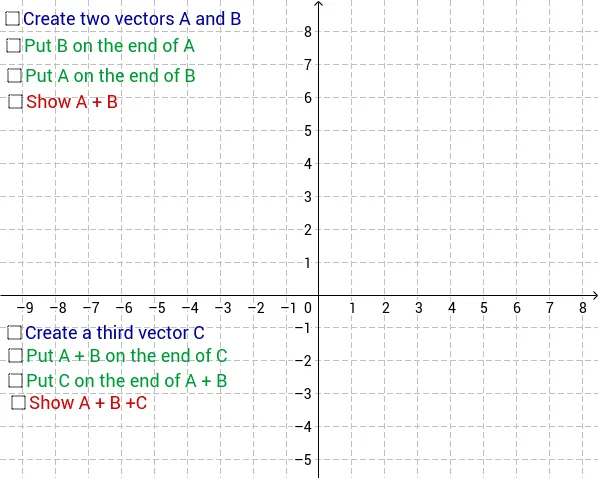
This example demonstrates the Parallelogram Rule for adding 2D and 3D vectors geometrically. It involves core math concepts like vector addition, parallelogram rule, and 3D spatial geometry. Constructed using GeoGebra commands like Vector, points (F_1, F_2, F_3), vectors (u, v, w), and text objects (text2, text3). Suitable for high school and above students to learn vector operations and spatial geometry.
GeoGebra Commands & Parameters
Vector(A) → F_1Vector(B) → F_2Vector(A, A + B) → uVector(B, B + A) → vVector(C) → F_3Vector(C, C + A + B) → aVector(A + B, A + B + C) → b
AI Drawing Prompt Reference
Draw a geometric demonstration of adding 2D and 3D vectors, showing the parallelogram rule. Start by drawing two 2D vectors, then construct a parallelogram using their starting and ending points, with the diagonals representing the vector sum. Next, introduce a 3D vector and perform vector addition between it and the sum of the 2D vectors, displaying the result in 3D space. Label key points and vectors with text annotations.
The prompt above was compiled from the original drawing commands and is for reference only.