
Geogebra Parametric Curves & Integral Demo
Loading the math board and drawing, please wait…
In collections
Color 3D surfaces
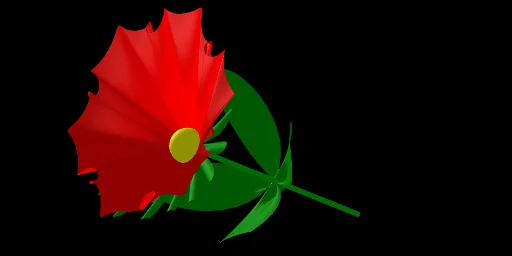
This example dynamically demonstrates parametric curves, their geometric forms, and definite integral calculations. Core math concepts include parametric equations, coordinate geometry, definite integrals from calculus, and constructions involving line segments and spheres. Key GeoGebra commands and objects used are CurveCartesian, Segment, Midpoint, Surface, and Sphere, as listed in the construction summary. Suitable for high school and above students to understand parametric curves, integral applications, and 3D geometric constructions.
GeoGebra Commands & Parameters
CurveCartesian(x(B) + (open * cos(t + k)) + (0.5 * cos((7 * t))) + (1 / 3 * cos((-17 * t) + 3.142 / 2)), y(B) + 2.5, z(B) + (open * sin(t + k)) + (0.5 * sin((7 * t))) + (1 / 3 * sin((-17 * t) + 3.142 / 2)), t, 0, theta) → bSegment(C, D) → eSegment(A, E) → iCurveCartesian(x(A) + (a_1 * cos(i + k)), y(A), z(A) + (a_1 * sin(i + k)), i, 0, theta) → aMidpoint(i) → GSurface(x(A) + ((j * cos(i°)) * cos(((m * i))°)), y(A) + ((0.5 * (j - 1)) * cos(((m * i))°)^(2)), z(A) + ((j * sin(i°)) * cos(((m * i))°)), i, 0, 720, j, 0, 4.8) → lSurface(x(A) + 0.45 + (u * x(a(t))) + ((1 - u) * x(b(t))), y(A) + 3.5 + (u * y(a(t))) + ((1 - u) * y(b(t))), z(A) + (u * z(a(t))) + ((1 - u) * z(b(t))), t, 0, theta, u, 0, c) → dSurface(x(G) + ((j * cos(i°)) * cos(((m / 4 * i))°)), y(G) + ((j - 1) * cos(((m / 4 * i))°)^(2)), z(G) + ((j * sin(i°)) * cos(((m / 4 * i))°)), i, 0, 720, j, 0, 4.8) → nSphere(A + (0, 0, 1), a_1 - 0.01) → gSurface(x(A) + ((a_1 * cos(i)) * cos(j)), y(A) + ((a_1 * cos(i)) * sin(j)), z(A) + (a_1 * sin(i)), i, 0, (2 * π), j, 0, π) → oSurface(x(A) + (((a_1 - 0) * cos(i)) * cos(j)), y(A) + 0.1 + (((a_1 - 0) * cos(i)) * sin(j)), z(A) + ((a_1 - 0) * sin(i)), i, (-π), π, j, (-0.5 * π), (0.5 * π)) → f
AI Drawing Prompt Reference
Draw a parametric curve with a sphere and multiple surfaces. First, draw a parametric curve, then a sphere, followed by two line segments, two surfaces, and finally two rotational surfaces.
The prompt above was compiled from the original drawing commands and is for reference only.