
GeoGebra Geometric Model for Conditional Probability
Loading the math board and drawing, please wait…
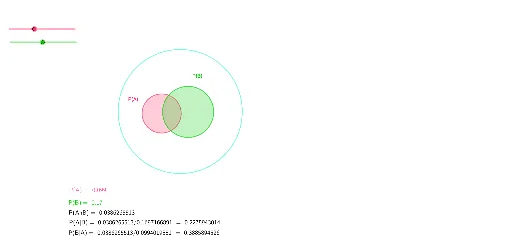
This GeoGebra example constructs a geometric probability model using circles, sectors, and point positioning to illustrate conditional probability. It demonstrates how to compute probabilities based on area ratios and distance constraints within a geometric figure. Core concepts include conditional probability, geometric probability, circular area and sector area, and distance calculation (potentially involving the Pythagorean theorem). The construction utilizes GeoGebra commands such as Circle, CircleSector, Intersect, PointIn, and Distance, with objects defined by points, sectors, and measured distances. Suitable for high school probability and statistics units, or for learners exploring the intersection of geometry and probability theory.
GeoGebra Commands & Parameters
Circle(A, α) → cCircle(B, β) → dArea(d) → bPointIn(d) → PointdArea(c) → ePointIn(c) → PointcCircle(C, γ) → hIntersect(d, h, 2) → DIntersect(d, h, 1) → ECircleSector(C, E, D) → kCircleSector(B, D, E) → pArea(k) → iPointIn(k) → Pointk_1Area(p) → jPointIn(p) → Pointp_1PointIn(p) → PointpPointIn(k) → PointkArea(h) → oPointIn(h) → PointhDistance(C, B) → distanceCBDistance(C, B) → CB