
GeoGebra Example: Function and Integral Calculation
Loading the math board and drawing, please wait…
In collections
CCGPS AA Unit 6 Lesson 1
This example demonstrates the process of function graphing and integral calculation. It involves core math concepts like functions, derivatives, integrals, and coordinate geometry. Constructed using GeoGebra commands and objects such as LaTeX, TableText, x2, x1, dx, t2, t1, dt, r, intercept, stepMax, stepper, steps, counter, RandomizationText, Original, Randomized, t0, x0, and various text elements. Suitable for high school students learning calculus and function graphs.
GeoGebra Commands & Parameters
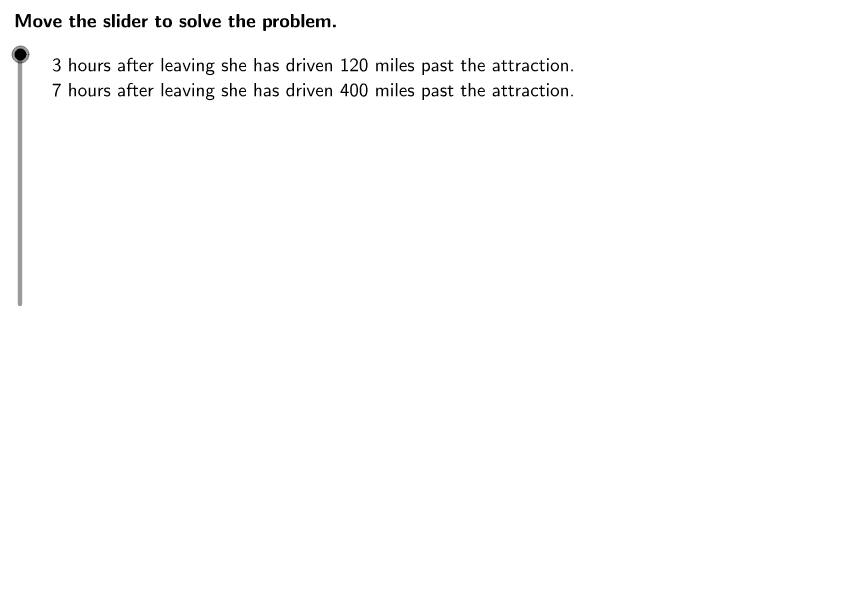
LaTeX(steps) → counterLaTeX("\text{Use the buttons below to return to the original problem or}\cr\text{randomly generate a similar practice problem.}") → RandomizationTextLaTeX("\text{Let the independent variable be time in hours, }\textcolor{#000099}{t}.") → text2LaTeX("\text{Let the dependent variable be the distance in miles, }\textcolor{#000099}{d}.") → text3LaTeX("\text{Name a dependent variable and an independent variable based on the given data.}") → text1LaTeX("\text{Write ordered pairs for the data in the problem based on the identified variables.}") → text4LaTeX((((((((("\text{The ordered pairs will be of the form }\textcolor{#000099}{(t, d)}\text{, since the independent variable is on the}\cr\text{x-axis and the dependent variable is on the y-axis. Therefore, the ordered pairs for the}\cr\text{given data are }\textcolor{#000099}{(" * t1) * ", ") * x1) * ")}\text{ and }\textcolor{#000099}{(") * t2) * ", ") * x2) * ")}.")) → text5LaTeX("\text{Write an equation for the speed in terms of the distance and time.}") → text6LaTeX("rate=\frac{distance}{time}\text{ or }\textcolor{#000099}{r=\frac{d}{t}}") → text8LaTeX((((("\text{Chloe’s speed during her " * t2) * "-hour drive was ") * r) * " miles per hour.}")) → text14LaTeX("\text{Use the point-slope formula, }\textcolor{#000099}{y – y_1 = m(x – x_1)}\text{, to write the linear equation in one}\cr\text{variable.}") → text15LaTeX((("\text{In the point-slope formula, }\textcolor{#000099}{y – y_1 = m(x – x_1)}\text{, }\textcolor{#000099}{m}\text{ is the slope and }\textcolor{#000099}{(x_1, y_1)}\text{ is a point}\cr\text{on the line. Use the value }\textcolor{#000099}{r = " * r) * "}\text{ from the previous step for the slope and either}\cr\text{of the given ordered pairs for }\textcolor{#000099}{(x_1, y_1)}\text{ in this formula.}")) → text16LaTeX((((("\text{Let’s use }\textcolor{#000099}{(" * t1) * ", ") * x1) * ")}\text{. Simplify and solve for }\textcolor{#000099}{d}.")) → text17LaTeX(Simplify[(-x1)]) → minusy1LaTeX(((-r) * t1)) → minusmx1LaTeX("\text{Find the value of }\textcolor{#000099}{d}\text{ when }\textcolor{#000099}{t=0}.") → text19LaTeX("\text{The time at which Chloe left college for the drive home is represented by }\textcolor{#000099}{t=0}.") → text20LaTeX((("\text{When }\textcolor{#000099}{t=0}\text{, }\textcolor{#000099}{d=–" * intercept) * "}.")) → text22LaTeX("\text{Interpret the results based on the information given in the problem to determine how}\cr\text{far Chloe drove before passing the roadside attraction. }") → text23LaTeX("\text{Move the slider to solve the problem.}") → text0LaTeX((((((((("\text{" * t1) * " hours after leaving she has driven ") * x1) * " miles past the attraction.}\cr\text{") * t2) * " hours after leaving she has driven ") * x2) * " miles past the attraction.}")) → ProblemLaTeX((((((((("\text{Let }\textcolor{#000099}{(" * t1) * ", ") * x1) * ")}\text{ represent }\textcolor{#000099}{(t_1, d_1)}\text{ and }\textcolor{#000099}{(") * t2) * ", ") * x2) * ")}\text{ represent }\textcolor{#000099}{(t_2, d_2)}\text{. Substitute these values into}\cr\text{the formula for slope.}")) → text12LaTeX("\text{Use the two ordered pairs and the formula for the slope of a one-variable}\cr\text{equation, }\textcolor{#000099}{m = \frac{y_2 − y_1}{x_2-x_1}}\text{, to find the rate.}") → text9LaTeX("\text{The slope formula can be used to find the rate because the slope formula is of the same}\cr\text{form as the formula }\textcolor{#000099}{r = \frac{d}{t}}.") → text10LaTeX("\text{Recall that the two-point slope formula is }\textcolor{#000099}{m = \frac{y_2 − y_1}{x_2-x_1}}\text{ for points }\textcolor{#000099}{(x_1, y_1)}\text{ and }\cr\textcolor{#000099}{(x_2, y_2)}\text{. We can think of this as }\textcolor{#000099}{r = \frac{d_2 − d_1}{t_2-t_1}}\text{ for points }\textcolor{#000099}{(t_1, d_1)}\text{ and }\textcolor{#000099}{(t_2, d_2)}\text{. Thus,}\cr\text{the slope }\textcolor{#000099}{m}\text{ would also be the rate }\textcolor{#000099}{r}\text{ at which Chloe drives.}") → text11TableText({{LaTeX["\textcolor{#000099}{r=\frac{d_2-d_1}{t_2-t_1}}"], LaTeX["\text{Slope formula written in terms of the rate, }\textcolor{#000099}{r}"]}, {LaTeX[(((((((("\textcolor{#000099}{r=\frac{(" * x2) * ") - (") * x1) * ")}{(") * t2) * ") - (") * t1) * ")}}")], LaTeX[(((((((("\text{Substitute }\textcolor{#000099}{(" * t1) * ",") * x1) * ")}\text{ for }\textcolor{#000099}{(t_1,d_1)}\text{ and }\textcolor{#000099}{(") * t2) * ",") * x2) * ")}\text{ for }\textcolor{#000099}{(t_2,d_2)}.")]}, {LaTeX[(((("\textcolor{#000099}{r=\frac{" * dx) * "}{") * dt) * "}}")], LaTeX["\text{Simplify.}"]}, {LaTeX[(("\textcolor{#000099}{r=" * r) * "}")], LaTeX[""]}}) → text13TableText({{LaTeX[(((("\textcolor{#000099}{d=" * r) * "t-") * intercept) * "}")], LaTeX["\text{Equation from the previous step}"]}, {LaTeX[(((("\textcolor{#000099}{d=" * r) * "(0)-") * intercept) * "}")], LaTeX["\text{Substitute }\textcolor{#000099}{t=0}."]}, {LaTeX[(("\textcolor{#000099}{d=-" * intercept) * "}")], LaTeX["\text{Simplify.}"]}}) → text21LaTeX("\text{This is a distance-rate-time problem in which the rate or speed, }\textcolor{#000099}{r}\text{, is the distance}\cr\text{divided by the time.}") → text7TableText({{LaTeX["\textcolor{#000099}{y-y_1=m(x-x_1)}"], LaTeX["\text{Point-slope formula}"]}, {LaTeX[(((((("\textcolor{#000099}{(d)-(" * x1) * ")=(") * r) * ")\left[(t)-(") * t1) * ")\right]}")], LaTeX[(((((("\text{Substitute }\textcolor{#000099}{(" * t1) * ",") * x1) * ")}\text{ for }\textcolor{#000099}{(x_1,y_1)}\text{, }\textcolor{#000099}{d}\text{ for }\textcolor{#000099}{y}\text{, }\textcolor{#000099}{r=") * r) * "}\text{ for }\textcolor{#000099}{m},")]}, {LaTeX[""], LaTeX["\text{and }\textcolor{#000099}{t}\text{ for }\textcolor{#000099}{x}."]}, {LaTeX[(((((("\textcolor{#000099}{d" * minusy1) * "=") * r) * "t") * minusmx1) * "}")], LaTeX["\text{Distribute.}"]}, {LaTeX[(((("\textcolor{#000099}{d=" * r) * "t-") * intercept) * "}")], LaTeX["\text{Simplify.}"]}}) → text18LaTeX((((((((((((((((((((((("\text{If Chloe drove at a constant speed of " * r) * " miles per hour, the ordered pair (") * t1) * ", ") * x1) * ")}\cr\text{implies that she had traveled }") * t1) * " \cdot ") * r) * "\text{ or }") * mx1) * "\text{ miles from her starting point. The}\cr\text{distance ") * x1) * " in the ordered pair implies that Chloe was ") * mx1) * " – ") * x1) * " or ") * intercept) * " miles }\cr\text{past that starting point when she passed the roadside attraction. Therefore, }\cr\text{Chloe drove ") * intercept) * " miles before passing the roadside attraction.}")) → text24
AI Drawing Prompt Reference
Draw a function graph showing the relationship between time t and distance d, and use integral calculation to find Chloe's total travel distance. First, mark the key points (t1, x1) and (t2, x2), then calculate the speed r based on these points. Next, plot the speed line using the point-slope equation y-y1=m(x-x1) and find its intersection with the y-axis, which represents Chloe's starting position. Finally, calculate the integral to show Chloe's total travel distance.
The prompt above was compiled from the original drawing commands and is for reference only.