
Geogebra Demo: Equation of a Perpendicular Bisector
Loading the math board and drawing, please wait…
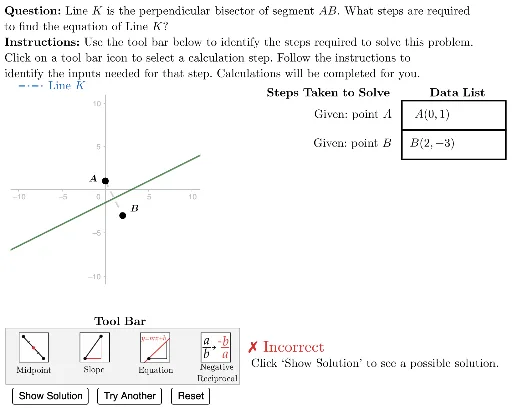
This example demonstrates how to draw and calculate the perpendicular bisector of a line segment using GeoGebra, including finding the midpoint, calculating slopes, and deriving the line equation. Key mathematical concepts involve midpoints, perpendicularity, slope computation, and linear equations. The construction leverages commands like Polygon, Length, Sequence, Element, UnitVector, Point, Zip, TableText, LineBisector, LaTeX, Segment, and Vector. Suitable for high school coordinate geometry education to enhance understanding of perpendicular bisectors' properties and applications.
GeoGebra Commands & Parameters
Polygon({DataListFrameAnchor, DataListFrameAnchor + (12 * u), DataListFrameAnchor + (12 * u) - vHeight, DataListFrameAnchor - vHeight}) → ValueFrameTemplateLength(dTypes) → numStepsSequence((-10, -20) + ((3.5 * i) * u), i, 0, 9) → iconAnchorsSequence(Translate[ValueFrameTemplate, Vector[(-((vHeight * i)))]], i, 0, numSteps - 1) → ValueFramesSequence(Polygon[Element[iconAnchors, i], Element[iconAnchors, i + 1], 4], i, 1, (2 * Length[iconAnchors]), 2) → iconFramesPolygon({(left, bottom), (left, top), (right, top), (right, bottom)}) → viewboxElement(G3, caseNum) → A3Element(G4, caseNum) → A4Polygon({ToolAnchor - (2 * v) - u, ToolAnchor + (4.5 * v) - u, ToolAnchor + (4.5 * v) + (26 * u), ToolAnchor - (2 * v) + (26 * u)}) → toolBarUnitVector(Vector[A3, A4]) → uABElement(iconFrames, currentAction) → iconHighlighterPoint(studentAnswer) → lblStudentLineElement(ValueFrames, 1) → vFrame1Element(ValueFrames, 2) → vFrame2Element(ValueFrames, 3) → vFrame3Element(ValueFrames, 4) → vFrame4Element(ValueFrames, 5) → vFrame5Element(ValueFrames, 6) → vFrame6Element(ValueFrames, 7) → vFrame7Zip(Element[ValueFrames, A], A, selectedList) → highlightedItemsTableText({dDisplay}, "vc") → valueTblTableText({Join[{{"\phantom{find the equation of a line through (-1,-3) with slope -5}"}, dSteps}]}, "vr") → stepsTableLineBisector(A3, A4) → answerLineLaTeX((((("\text{\textbf{Question: }" * QUESTION) * "\\\textbf{Instructions: }") * INSTRUCTIONS) * "}")) → allInstrucSegment(A3, A4) → D3LineBisector(A3, A4) → questionLineVector((1, Slope[answerLine])) → testUnitVector(Vector[(1, Slope[answerLine])]) → uAnswerSegment((-10, 12), (-7, 12)) → legendLineK