
Function Variations Demo
Loading the math board and drawing, please wait…
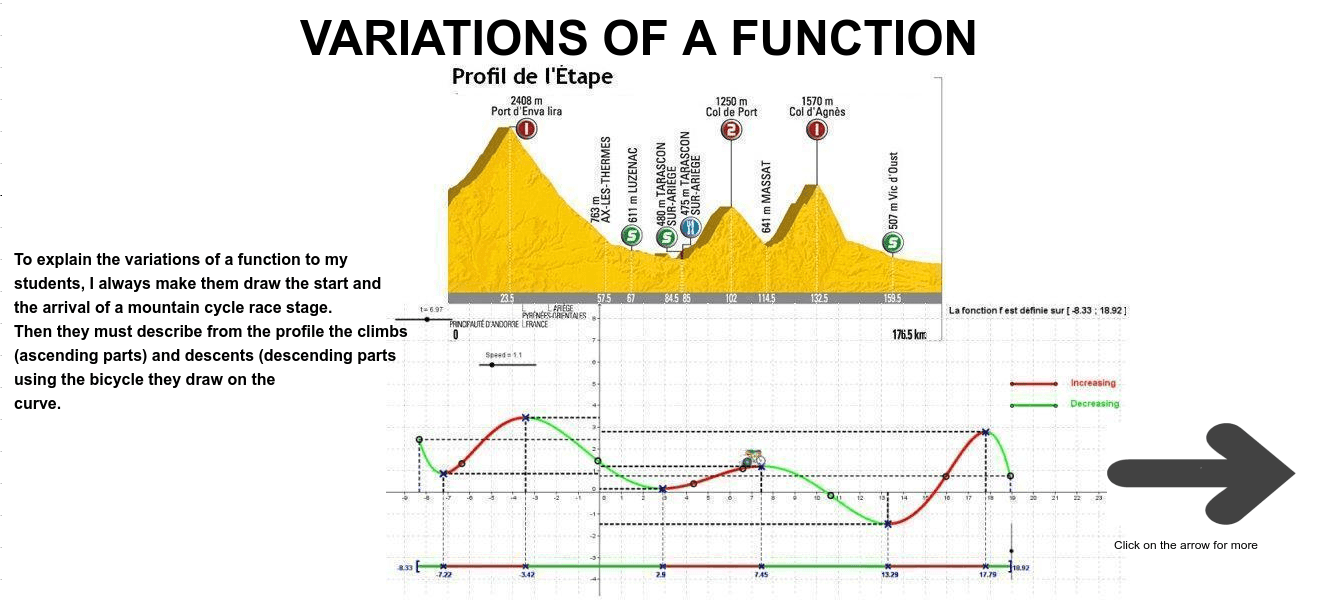
This example demonstrates dynamic variations of function graphs, highlighting key points like maxima and minima under changing parameters. Core math concepts include function graphs, polynomials, derivatives, linear regression, logarithmic functions, etc. GeoGebra commands and objects used are Max, Min, Polynomial, Function, Sequence, Segment, Point, Tangent, Circle, Intersect, Vector, Line, Join, PolyLine, Polygon, Midpoint. Ideal for high school and above students to explore function properties and dynamic geometric constructions.
GeoGebra Commands & Parameters
Max(Xliste1) → xmaxMin(Xliste1) → xminPolynomial(liste1) → fFunction(f, xmin, xmax) → gFunction(g', xmin, xmax) → hSequence(Root[h, i], i, xmin, xmax) → liste2Sequence(g(x(Element[liste2, i])), i, 1, Length[liste2]) → liste3Sequence((x(Element[liste2, i]), Element[liste3, i]), i, 1, Length[liste2]) → liste4Unique(liste4) → l2Unique(liste2) → l1Sequence((x(Element[l1, i]), m - 4), i, 1, Length[l1]) → liste8bSequence(Segment[Element[liste2, i], Element[liste4, i]], i, 1, Length[liste2]) → liste5Function(gr, xmin, xmax) → grouSegment((xmin, 0), (xmax, 0)) → aMax(Yliste1) → YmaxSegment((xmin, 0), (xmin, g(xmin))) → bSegment((xmax, 0), (xmax, g(xmax))) → cPoint(liste4) → IPoint(liste4) → KSegment(J, L) → dSegment(M, N) → eSegment(O, P) → iSequence((x(Element[liste2, i]), m), i, 1, Length[liste2]) → liste6Sequence(Segment[Element[liste6, i], Element[liste6, i + 1]], i, 1, Length[liste6]) → liste7Function(ss, xmin, xmax) → ss1Sequence(Segment[Element[liste2, i], Element[liste6, i]], i, 1, Length[liste2]) → liste8Sequence((x(Element[liste2, i]), m - 3), i, 1, Length[liste2]) → liste9Sequence(Segment[Element[liste4, i], (0, Element[liste3, i])], i, 1, Length[liste2]) → liste10Segment((xmin, g(xmin)), (0, g(xmin))) → jSegment((xmax, g(xmax)), (0, g(xmax))) → kSequence(Text[Element[XX, i], Element[liste6, i] - (0.3, 0.5)], i, 1, Length[liste6]) → liste11Tangent(Q, grou) → qTangent(Q, g) → lCircle(Q, n) → pIntersect(p, l) → R, SCircle(Q, 1) → c_1Intersect(c_1, l) → U, VSegment(U, V) → a_1Sequence((x(Element[liste8b, i]), m - 4 + (0.5 * y(Element[l2, i]))), i, 1, Length[l2]) → liste6cVector(A_1, Element[liste6c, 1]) → wVector(Element[liste6c, Length[liste6c]], Z) → zSegment(U, V) → b_1Sequence(Vector[Element[liste6c, i], Element[liste6c, i + 1]], i, 1, Length[liste6c]) → liste12Sequence(Segment[Element[liste6c, i], Element[Unique[liste6], i]], i, 1, Length[liste6c]) → l3Segment(A_1, Element[liste6c, 1]) → debSegment(Element[liste6c, Length[liste6c]], Z) → finaLine(Q, yAxis) → dritIntersect(drit, xAxis) → C_1Intersect(drit, deb) → D_1Join({{A_1}, liste6c, {Z}}) → toutPolyLine(tout) → f_1Intersect(drit, f_1) → E_1Segment(Q, E_1) → g_1Sequence(Text[y(Element[l2, i]), Element[liste6c, i] - (0.5, 0.75)], i, 1, Length[liste6c]) → l4Polygon(F_1, H_1, I_1, G_1) → q1, h_1, i_1, j_1, k_1Polygon(K_1, J_1, H_1, F_1) → q2, l_1, m_1, n_1, p_1Polygon(L_1, K_1, F_1, M_1) → q3, q_1, r_1, s_1, t_1Polygon(M_1, N_1, G_1, F_1) → q4, e_1, f_2, g_2, h_2Midpoint(K_1, M_1) → O_1Midpoint(F_1, N_1) → P_1