
Function and Inequality Verification Example
Loading the math board and drawing, please wait…
In collections
CCSS Support Math II Unit 2
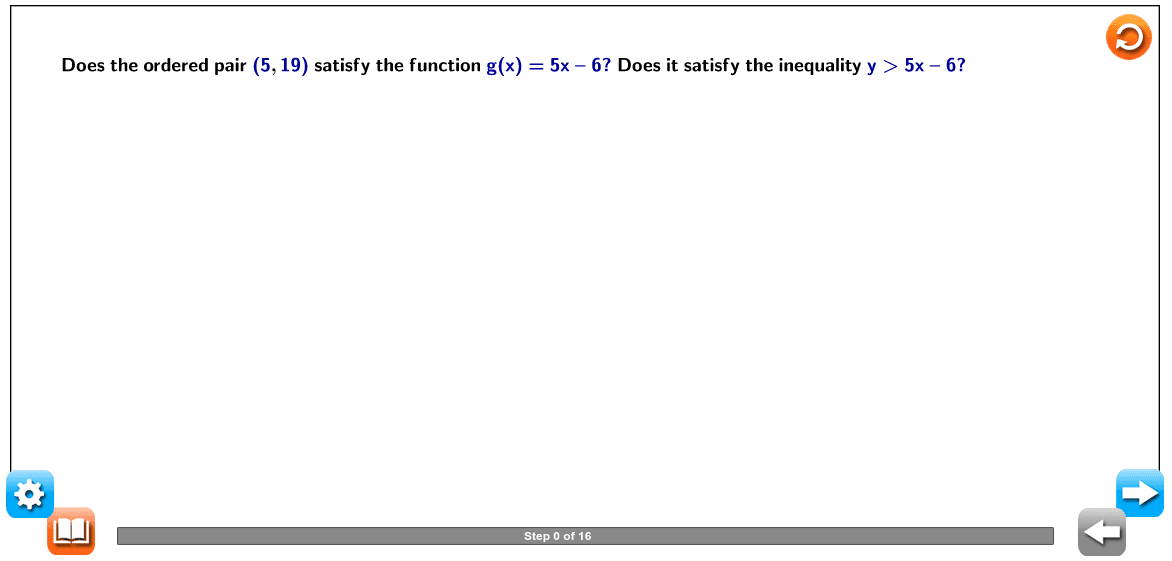
This example demonstrates how to verify whether the ordered pair (5, 19) satisfies the function g(x) = 5x – 6 and the inequality y > 5x – 6. The core mathematical concepts involved include function verification and inequality judgment. The construction highlights the use of GeoGebra commands and objects such as SelectedElement, LaTeX, SelectedIndex, If, and elements like Border, Gear, Book, etc. It is suitable for high school mathematics teaching and function graph analysis.
GeoGebra Commands & Parameters
SelectedElement(FXC) → FXCVSelectedElement(FXX) → FXXVSelectedElement(GXC) → GXCVSelectedElement(GXX) → GXXVLaTeX("\text{Substitute the ordered pair into the function and simplify.}") → text2_2LaTeX("\text{Rewritten function}") → text2_5LaTeX("\text{Given inequality}") → text2_{17}LaTeX("\text{Rewrite the function \textcolor{#000099}{g(x) = 5x\; –\; 6} so that it is not in function notation.}") → text2LaTeX((((("{Does\; the\; ordered \;pair\; \textcolor{#000099}{(" * FXXV) * "}, \textcolor{#000099}{") * FXCV) * ")}\; satisfy \;the \;function\; \textcolor{#000099}{g(x) = 5x \;–\; 6?}\; Does\; it\; satisfy \;the\; inequality\; \textcolor{#000099}{ y > 5x\; –\; 6?}}")) → text1LaTeX((((("\text{\textcolor{#000099}{" * FXCV) * " = ") * valu1) * "\;–\; 6}")) → text2_8LaTeX((((("\text{\textcolor{#000099}{" * FXCV) * " = ") * valu2) * "}}")) → text2_9LaTeX((("\text{Multiply \textcolor{#000099}{5} by \textcolor{#000099}{" * FXXV) * "}.}")) → text2_{11}LaTeX((("\text{Subtract \textcolor{#000099}{6} from \textcolor{#000099}{" * valu1) * "}.}")) → text2_{10}LaTeX((("\text{Multiply \textcolor{#000099}{5} by \textcolor{#000099}{" * FXXV) * "}.}")) → text2_{21}LaTeX((("\text{Subtract \textcolor{#000099}{6} from \textcolor{#000099}{" * valu1) * "}.}")) → text2_{23}LaTeX("\text{Substitute the ordered pair into the inequality \textcolor{#000099}{y > 5x\; –\; 6} and simplify.}") → text2_{14}LaTeX((((("\text{\textcolor{#000099}{" * FXCV) * " > ") * valu1) * "\;–\; 6}")) → text2_{20}LaTeX((((("\text{\textcolor{#000099}{" * FXCV) * " > ") * valu2) * "}}")) → text2_{22}SelectedIndex(FXX_1) → FXXV_1SelectedIndex(FXC_1) → FXCV_1SelectedIndex(FXX_2) → FXXV_2LaTeX((((("\text{statement, the ordered pair \textcolor{#000099}{(" * FXXV_2) * "},\textcolor{#000099}{") * FXCV_1) * ")} not satisfies the function \textcolor{#000099}{g(x) = 5x \;–\; 6}.}")) → text2_{27}LaTeX((((("\text{Once simplified, the equation is \textcolor{#000099}{" * FXCV_1) * " = ") * valu2_2) * "}. Because this is a false}")) → text2_{26}LaTeX("\text{one element of the range; that is, for every value of x, there is exactly }") → text3_1LaTeX("\text{one value of y. }") → text3_2LaTeX("\text{quantities that are not equivalent}") → text3_3If(FXCV ≠ valu2, LaTeX[(((("\text{Once simplified, the equation is \textcolor{#000099}{" * FXCV) * " = ") * valu2) * "}. Because this is a false}")], LaTeX[(((("\text{Once simplified, the equation is \textcolor{#000099}{" * FXCV) * " = ") * valu2) * "}. Because this is a true}")]) → text2_{12}If(FXCV ≥ valu2, LaTeX[(((("\text{Once simplified, the inequality is \textcolor{#000099}{" * FXCV) * " > ") * valu2) * "}. Because this is not a true statement,}")], LaTeX[(((("\text{Once simplified, the inequality is \textcolor{#000099}{" * FXCV) * " > ") * valu2) * "}. Because this is a true statement,}")]) → text2_{24}LaTeX((((("\text{\textcolor{#000099}{(" * FXCV) * ")}=\textcolor{#000099}{5}\textcolor{#000099}{(") * FXXV) * ")} \textcolor{#000099}{- 6}}")) → text2_6LaTeX((((("\text{\textcolor{#000099}{(" * FXCV) * ")}\textcolor{#000099}{>5}\textcolor{#000099}{(") * FXXV) * ")} \textcolor{#000099}{- 6}}")) → text2_{18}LaTeX((((((((("\text{The ordered pair is \textcolor{#000099}{(" * FXXV) * "},\textcolor{#000099}{") * FXCV) * ")}. Substitute \textcolor{#000099}{") * FXXV) * "} for \textcolor{#000099}{x} and \textcolor{#000099}{") * FXCV) * "} for \textcolor{#000099}{y}.}")) → text2_3LaTeX("\text{ \textcolor{#000099}{y = 5x\; –\; 6}}") → text2_4LaTeX((((("\text{Substitute \textcolor{#000099}{" * FXXV) * "} for \textcolor{#000099}{x} and \textcolor{#000099}{") * FXCV) * "} for \textcolor{#000099}{y}.}")) → text2_7LaTeX((((((((("\text{Use the same ordered pair, \textcolor{#000099}{(" * FXXV) * "},\textcolor{#000099}{") * FXCV) * ")}. Again, substitute \textcolor{#000099}{") * FXXV) * "} for \textcolor{#000099}{x} and \textcolor{#000099}{") * FXCV) * "} for \textcolor{#000099}{y}.}")) → text2_{15}LaTeX("\text{ \textcolor{#000099}{y > 5x\; –\; 6}}") → text2_{16}LaTeX((((("\text{Substitute \textcolor{#000099}{" * FXXV) * "} for \textcolor{#000099}{x} and \textcolor{#000099}{") * FXCV) * "} for \textcolor{#000099}{y}.}")) → text2_{19}LaTeX("\text{\mathbf{function} a relation in which every element of the domain is paired with exactly}") → text3LaTeX("\text{\mathbf{inequality} a mathematical sentence that shows the relationship between }") → text3_4LaTeX("\text{x-coordinate:}") → DKT1LaTeX("\text{y-coordinate:}") → DKT2If(FXCV ≥ valu2, LaTeX[(((("\text{the ordered pair \textcolor{#000099}{(" * FXXV) * "},\textcolor{#000099}{") * FXCV) * ")} does not satisfy the inequality \textcolor{#000099}{y > 5x\; –\; 6}.}")], LaTeX[(((("\text{the ordered pair \textcolor{#000099}{(" * FXXV) * "}, \textcolor{#000099}{") * FXCV) * ")} satisfies the inequality \textcolor{#000099}{y > 5x\; –\; 6}.}")]) → text2_{25}If(FXCV ≠ valu2, LaTeX[(((("\text{statement, the ordered pair \textcolor{#000099}{(" * FXXV) * "},\textcolor{#000099}{") * FXCV) * ")} does not satisfy the function \textcolor{#000099}{g(x) = 5x \;–\; 6}.}")], LaTeX[(((("\text{statement, the ordered pair \textcolor{#000099}{(" * FXXV) * "},\textcolor{#000099}{") * FXCV) * ")} satisfies the function \textcolor{#000099}{g(x) = 5x \;–\; 6}.}")]) → text2_{13}LaTeX("\text{To rewrite the function \textcolor{#000099}{g(x) = 5x\; –\; 6} so that it is not in function notation, replace \textcolor{#000099}{g(x)} with \textcolor{#000099}{y} to get \textcolor{#000099}{y = 5x\; –\; 6}.}") → text2_1