
Full Geometry Proof of i - Example 2
Loading the math board and drawing, please wait…
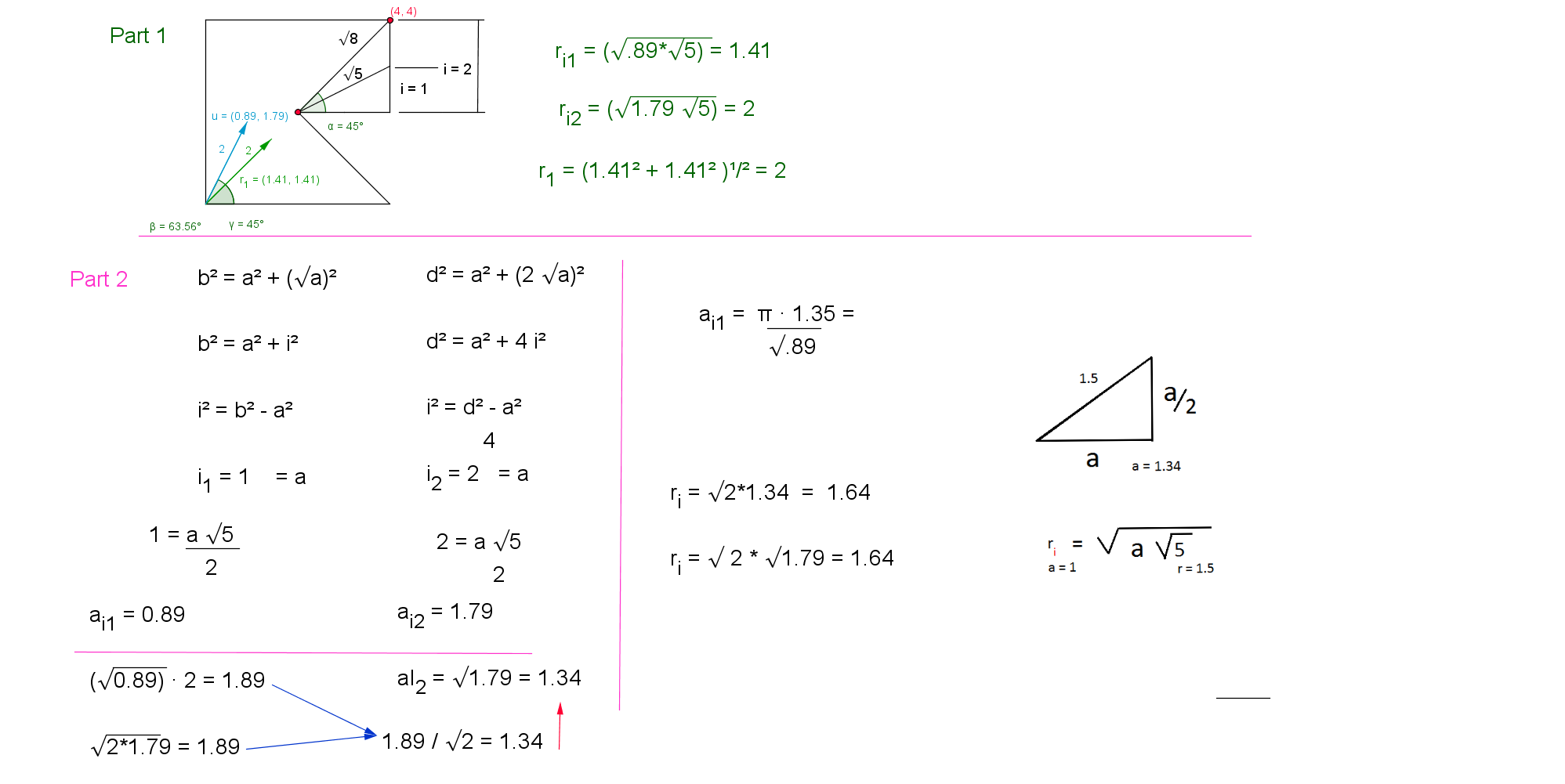
This example demonstrates a full geometric proof of i. Core math concepts include complex numbers and trigonometry. Using GeoGebra commands such as Semicircle, Segment, Circle, and Polygon, complex geometric shapes can be constructed. Suitable for high school math education and learning.
GeoGebra Commands & Parameters
Semicircle(C, D) → cSemicircle(D, C) → dSegment(A, D) → aCircle(A, 1) → fSemicircle(E, F) → rSemicircle(F, E) → gPolygon(B, A, C, G) → poly1, b_1, a_1, c_1, g_1Vector((1.414213562373095, 1.414213562373095)) → u_3Vector((1.79, 0.89)) → vSegment(G, B) → eSegment(G, J) → hSegment(G, K) → iAngle(B, G, K) → α_uAngle(B, G, J) → β_vVector((0.89, 1.79)) → wSegment(G, L) → jAngle(B, G, L) → δ_wAngle(J, G, L) → Δ_vCircle(G, K) → kPoint(r) → NPoint(g) → MSegment(N, A) → pSegment(A, M) → qSegment(M, N) → sPolygon(N, C, G, B, M) → poly2, n_1, c_2, g_2, b_2, m_1Vector((2, 1)) → tVector((1, 2)) → uSegment(G, N) → d_1Segment(G, M) → e_1Angle(M, G, N) → α_tSegment(A, R) → k_1Segment(A, Q) → l_1Segment(Q, R) → p_1Circle(A, S) → q_1Distance(G, A) → distanceGAPoint(Circle[A, 3]) → TSegment(A, T) → r_1Point(Circle[G, 3]) → USegment(G, U) → s_1Point(Circle[T, 2.8284271247461903]) → VSegment(T, V) → t_1Distance(G, Q) → distanceGQDistance(G, M) → distanceGMSegment(G, M) → a_2Segment(W, Z) → d_2Vector(A_1, B_1) → u_2Vector(C_1, D_1) → v_2Distance(G, N) → distanceGNMidpoint(G, N) →Segment(G, N) → f_2
AI Drawing Prompt Reference
Draw a geometric proof of the complex number i. Start by drawing a circle with center A and radius 1, then draw a circle with center A and radius 2. Next, draw a circle with center G and radius 3, and another with center G and radius 2.828. Construct points N and M, then draw lines AN, AM, and MN. Finally, draw a circle with center G and radius 3, and construct point U, then draw line GU.
The prompt above was compiled from the original drawing commands and is for reference only.