
Fractions: Proper and Improper Fractions as Parts of a Whole and on the Number L
Loading the math board and drawing, please wait…
In collections
Jessica's Fraction Book
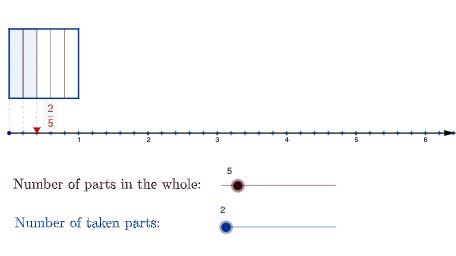
① This applet dynamically demonstrates proper and improper fractions, showing fractions both as parts of a whole (area model) and as points on a number line. ② Core math concepts include the meaning of fractions, distinction between proper and improper fractions, correspondence between fractions and points on the number line, and part-whole relationships. ③ Construction highlights: Uses GeoGebra commands such as Mod (to compute remainder of numerator divided by denominator), Polygon (to build whole and part regions), Vector and Sequence (to generate number line ticks), Zip, Append, Segment, and If (for dynamic updates and conditional display). Key objects include n (numerator), d (denominator), remainder, whole, poly1, etc. Changing n and d via sliders or input updates the visual representation. ④ Suitable for upper elementary to middle school students learning fraction concepts, and for teachers to demonstrate how fractions map to the number line and how improper fractions relate to mixed numbers.
GeoGebra Commands & Parameters
Mod(n, d) → remainderPolygon(A, B, 4) → poly1, a, b, c, e, C, DVector((0, 0), (1, 0)) → uSequence(B + (i * u), i, 0, whole) → SecondLow, {(1, 0.5)}Sequence(A + (i * u), i, 0, whole) → FirstLow, {(0, 0.5)}Zip(Polygon[X, Y, 4], X, FirstLow, Y, SecondLow) → list1Sequence(Point[A, Vector[(i * u / d)]], i, 1, n) → PtBottom, {(0.2, 0.5), (0.4, 0.5)}Sequence(Point[D, Vector[(i * u / d)]], i, 1, n) → PtTop, {(0.20000000000000012, 1.5), (0.40000000000000013, 1.5)}Append(D, Take[PtTop, 1, n - 1]) → PtTop1Append(A, Take[PtBottom, 1, n - 1]) → PtBottom1Zip(Polygon[E, F, G, H], E, PtBottom1, F, PtBottom, G, PtTop, H, PtTop1) → list2Polygon(C, B, 4) → poly2, f, g, h, i, E, FPolygon(F, E, 4) → poly3, j, k, l, m, G, HPolygon(H, G, 4) → poly4, p, q, r, s, I, JPolygon(J, I, 4) → poly5, t, a_1, b_1, c_1, K, LPolygon(L, K, 4) → poly6, d_1, e_1, f_1, g_1, M, NSequence(Point[OO, Vector[(i * u / d)]], i, 1, (10 * d)) → list3, {(0.2, 0), (0.4, 0), (0.6000000000000001, 0), (0.8, 0), (1, 0), (1.2000000000000002, 0), (1.4000000000000001, 0), (1.6, 0), (1.8, 0), (2, 0), (2.2, 0), (2.4000000000000004, 0), (2.6, 0), (2.8000000000000003, 0), (3, 0), (3.2, 0), (3.4000000000000004, 0), (3.6, 0), (3.8000000000000003, 0), (4, 0), (4.2, 0), (4.4, 0), (4.6000000000000005, 0), (4.800000000000001, 0), (5, 0), (5.2, 0), (5.4, 0), (5.6000000000000005, 0), (5.800000000000001, 0), (6, 0), (6.2, 0), (6.4, 0), (6.6000000000000005, 0), (6.800000000000001, 0), (7, 0), (7.2, 0), (7.4, 0), (7.6000000000000005, 0), (7.800000000000001, 0), (8, 0), (8.200000000000001, 0), (8.4, 0), (8.6, 0), (8.8, 0), (9, 0), (9.200000000000001, 0), (9.4, 0), (9.600000000000001, 0), (9.8, 0), (10, 0)}Zip(Segment[M, N], M, list3, N, PtBottom) → list4Segment(A, OO) → h_1Sequence(Point[D, Vector[(i * u / d)]], i, 1, (d * (whole + 1))) → allTop, {(0.20000000000000012, 1.5), (0.40000000000000013, 1.5), (0.6000000000000002, 1.5), (0.8000000000000002, 1.5), (1, 1.5)}Sequence(Point[A, Vector[(i * u / d)]], i, 1, (d * (whole + 1))) → allBott, {(0.2, 0.5), (0.4, 0.5), (0.6000000000000001, 0.5), (0.8, 0.5), (1, 0.5)}Zip(Segment[M, N], M, allTop, N, allBott) → list5If(n < d, textFr, If[IsInteger[n / d], textW, textM]) → TextFraction
AI Drawing Prompt Reference
Draw a figure to show a fraction as a part of a whole and a point on a number line. First, draw a rectangle to represent the whole. Then, based on the numerator and denominator, draw part regions. Next, draw tick marks from 0 to 10 on the number line and mark the corresponding points for the fraction. Finally, depending on whether the numerator is less than the denominator, display the appropriate fraction type (proper fraction, improper fraction, or mixed number).
The prompt above was compiled from the original drawing commands and is for reference only.