
GeoGebra Math Problem: Parallelogram and Cosine Function Construction
Loading the math board and drawing, please wait…
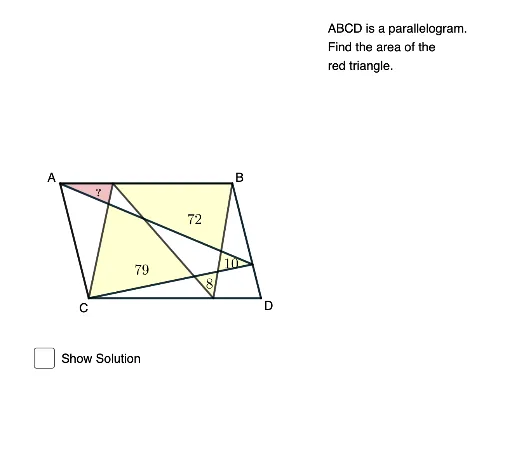
This example demonstrates how to use GeoGebra to draw a parallelogram and analyze it with cosine functions. Key mathematical concepts include area calculation, cosine theorem, quadratic functions, and coordinate geometry. Construction involves using commands like Line, Intersect, Polygon, Angle, and objects such as Point, Mirror, Midpoint. Suitable for high school students or college students learning geometry and function relationships, helping to understand transformations and graph associations.
GeoGebra Commands & Parameters
Line(A, B) → fLine(C, f) → gLine(A, C) → hLine(B, h) → iIntersect(i, g) → DPolygon(A, C, D, B) → q1, a, c, d, bPoint(q1) → EPolygon(C, D, E) → t1, e, c_1, d_1Polygon(E, A, B) → t2, b_1, e_1, a_1Point(b) → FPoint(c) → GPolygon(A, C, F) → t3, f_1, a_2, c_2Polygon(F, G, B) → t4, b_2, f_2, g_1Mirror(C, b) → C'Mirror(G, b) → G'Midpoint(b) → HCircleArc(H, C', C) → kAngle(C', H, C) → αCircleArc(H, G, G') → pAngle(G, H, G') → βRotate(C, ((-α) * t), H) → C'_1Polygon(F, C'_1, A) → t5, a_3, f_3, c'_1Rotate(G, (β * t), H) → G'_1Polygon(F, G'_1, B) → t6, b_3, f_4, g'_1Mirror(C, d) → C'_2Mirror(A, d) → A'Midpoint(d) → ICircleArc(I, A', A) → qCircleArc(I, C, C'_2) → rAngle(A', I, A) → γAngle(C, I, C'_2) → δRotate(A, ((-γ) * t), I) → A'_1Polygon(E, A'_1, B) → t7, b_4, e_2, a'_1Rotate(C, (δ * t), I) → C'_3Polygon(E, C'_3, D) → t8, d_2, e_3, c'_3Intersect(d_1, b_2) → JIntersect(d_1, f_2) → KIntersect(b_1, f_2) → LIntersect(b_1, b_2) → MIntersect(b_1, a_2) → NPolygon(C, J, M, N) → q2, c_3, j_1, m, nPolygon(J, G, K) → t9, k_1, j_2, g_2Polygon(L, K, E) → t10, e_4, l, k_2Polygon(L, B, F, M) → q3, l_1, b_5, f_5, m_1Polygon(A, N, F) → t11, f_6, a_4, n_1Point(a) → OPoint(d) → PSegment(O, P) → sIntersect(a, c) → QSegment(P, Q) → h_1OrthogonalLine(C', b) → i_1Mirror(A, f) → A'_2Mirror(C, f) → C'_4Mirror(D, f) → D'Mirror(B, f) → B'Polygon(A'_2, C'_4, D', B') → q1', a'_2, c'_4, d', b'Mirror(A, d) → A'_3Mirror(C, d) → C'_5Mirror(D, d) → D'_1Mirror(B, d) → B'_1Polygon(A'_3, C'_5, D'_1, B'_1) → q1'_1, a'_3, c'_5, d'_1, b'_1