
Fraction Multiplication Demo by benny varghese
Loading the math board and drawing, please wait…
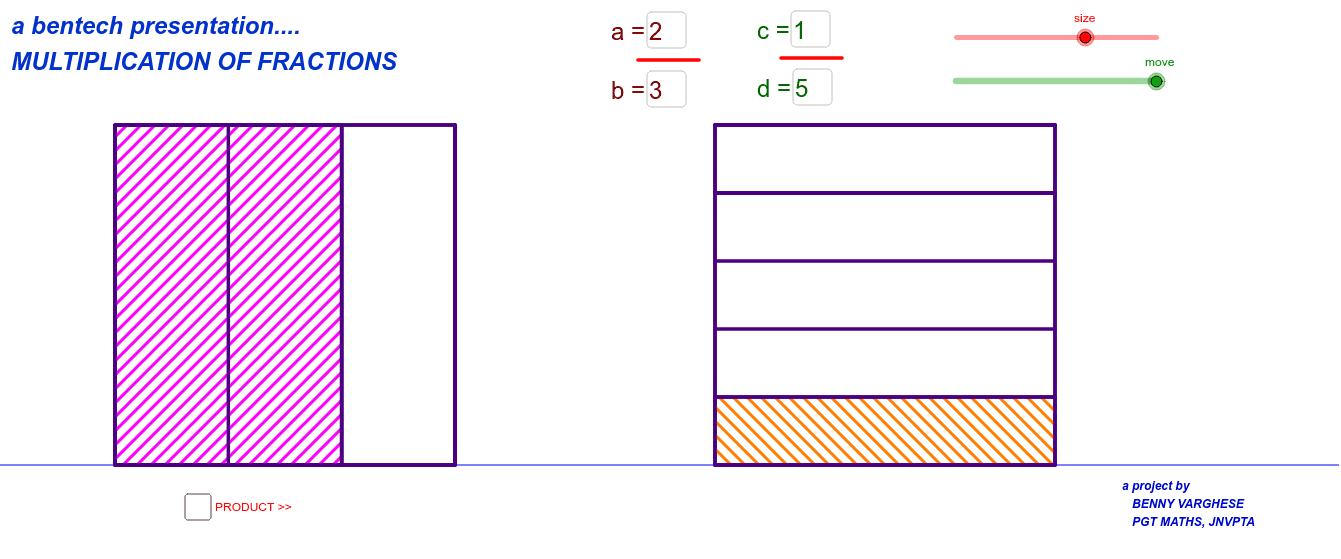
This example demonstrates the geometric meaning of fraction multiplication through dynamic visuals, intuitively showing the process and result of multiplying fractions. It involves core math concepts like fraction operations, geometric shapes (lines, segments, polygons), coordinate geometry, and transformations. GeoGebra commands and objects such as Line, Point, Segment, Polygon, Circle, Intersect, OrthogonalLine, and Textfield are used to construct a visual model of fraction multiplication. Suitable for middle school and above learners to understand the principles and geometric applications of fraction multiplication.
GeoGebra Commands & Parameters
Line(A, B) → a_5Point(a_5) → CPoint(a_5) → DPoint(Circle[D, abs(size)]) → FSegment(D, F) → c_5Polygon(D, F, 4) → poly1, d, e, f, g, G, HCircle(H, i_1) → kIntersect(k, f) → I,Line(I, g) → jIntersect(j, a_5) → F_1Segment(I, F_1) → p_1Intersect(f, g) → R_1Polygon(A, Q_1, S_1, R_1) → poly2, a_3, q_2, s_2, r_2OrthogonalLine(U_1, a_5) → g_2Polygon(T_1, U_1, 4) → poly3, h_2, i_2, j_2, k_2, V_1, W_1Circle(U_1, z) → p_2Intersect(p_2, h_2) → Z_1,Circle(Z_1, z) → c_3Intersect(c_3, h_2) → A_2, B_2Circle(A_2, z) → d_3Intersect(d_3, h_2) → C_2, D_2Circle(C_2, z) → e_3Intersect(e_3, h_2, 1) → H_2Line(H_2, i_2) → m_3Line(A_2, i_2) → n_3Line(Z_1, i_2) → s_3Line(C_2, i_2) → t_3Intersect(j_2, m_3) → C_3Intersect(j_2, t_3) → D_3Intersect(j_2, n_3) → E_3Intersect(j_2, s_3) → F_3Segment(C_2, D_3) → a_4Segment(A_2, E_3) → b_4Segment(Z_1, F_3) → c_4Segment(H_2, C_3) → k_4Line(H_3, i_2) → l_4Line(V_1, W_1) → m_4Intersect(l_4, m_4) → I_3Polygon(B_2, V_1, I_3, H_3) → poly4, b_5, v_1, i_5, h_5Circle(I, i_1) → qIntersect(q, f) → J, KCircle(J, i_1) → rIntersect(r, f) → L, MCircle(L, i_1) → sIntersect(s, f) → N, OCircle(N, i_1) → d_1Intersect(d_1, f) → P, QCircle(P, i_1) → e_1Intersect(e_1, f) → R, SCircle(R, i_1) → f_1Intersect(f_1, f) → T, UCircle(T, i_1) → g_1Intersect(g_1, f) → V, WCircle(V, i_1) → h_1Intersect(h_1, f) → Z, A_1Circle(Z, i_1) → k_1Intersect(k_1, f) → B_1, C_1Circle(B_1, Z) → q_1Intersect(q_1, f) → D_1, E_1Line(J, p_1) → iLine(L, i) → lLine(N, l) → mLine(P, m) → nLine(R, n) → a_1Line(T, a_1) → b_1Line(V, b_1) → j_1Line(Z, j_1) → l_1Line(B_1, l_1) → m_1Line(E_1, m_1) → n_1Intersect(i, a_5) → G_1Intersect(l, a_5) → H_1Intersect(m, a_5) → I_1Intersect(n, a_5) → J_1Intersect(a_1, a_5) → K_1Intersect(b_1, a_5) → L_1Intersect(j_1, a_5) → EIntersect(l_1, a_5) → M_1Intersect(m_1, a_5) → N_1Intersect(n_1, a_5) → O_1Segment(J, G_1) → pSegment(L, H_1) → r_1Segment(J, N) → s_1Segment(I_1, N) → t_1Segment(P, J_1) → a_2Segment(R, K_1) → b_2Segment(T, L_1) → c_2Segment(V, E) → d_2Segment(Z, M_1) → e_2Segment(B_1, N_1) → f_2Segment(E_1, O_1) → t_2Intersect(e_3, h_2) → P_1, E_2Circle(P_1, z) → f_3Intersect(f_3, h_2) → F_2, G_2Circle(F_2, z) → g_3Intersect(g_3, h_2) → I_2, J_2Circle(I_2, z) → h_3Intersect(h_3, h_2) → K_2, L_2Circle(K_2, z) → k_3Intersect(k_3, h_2) → M_2, N_2Circle(M_2, z) → p_3Intersect(p_3, h_2) → O_2, P_2Circle(O_2, z) → q_3Intersect(q_3, h_2) → Q_2, R_2Circle(Q_2, z) → r_3Intersect(r_3, h_2) → S_2, T_2Line(F_2, k_4) → l_2Line(I_2, l_2) → m_2Line(K_2, m_2) → n_2Line(M_2, n_2) → b_3Line(O_2, b_3) → i_3Line(Q_2, i_3) → j_3Line(S_2, j_3) → l_3Intersect(j_2, l_3) → U_2Intersect(j_2, j_3) → V_2Intersect(j_2, i_3) → W_2Intersect(j_2, b_3) → Z_2Intersect(j_2, n_2) → A_3Intersect(j_2, m_2) → B_3Intersect(j_2, l_2) → G_3Segment(F_2, G_3) → d_4Segment(I_2, B_3) → e_4Segment(K_2, A_3) → f_4Segment(M_2, Z_2) → g_4Segment(O_2, W_2) → h_4Segment(Q_2, V_2) → i_4Segment(S_2, U_2) → j_4Segment(J_3, K_3) → n_4Textfield(o) → inputBox1Textfield(h) → inputBox2Textfield(w) → inputBox3Textfield(t) → inputBox4Segment(J_4, K_4) → n_5